The Art of Community

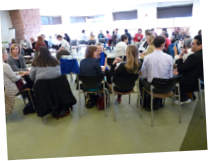
I loved working with the Church and Community Workers of the Global Ministries of the United Methodist Church. Most recently this occurred March 2-5, 2013 at Lake Junaluska, North Carolina. There were about 40 our us gathered. It was a continuing education event for them. Our intent was to learn and practice more participative leadership together so that they could apply and use it in their varied settings. Inspired leadership in people like Kathleen Masters, Cathy Whitlach and Judy Chung to put support behind such a gathering and a third in a series of training events over the last year. Inspiring participants.

There are many levels of harvest. The Art of Community is the name of the article that Marielynn Dunlap Grace, one of our participants, wrote. I love how she captured the core narrative and story.

A few additional harvests are below:

Drew Parsons — Hambone for CCW (0:53)

Circle Dance (1:29)

Becky Parsons — CCW AoH at Work (1:27 — battery died :()

Linda Stransky — CCW AoH at Work (3:20)

Judy Chung — CCW AoH at Work (1:27)

Photos on Flickr

Transitions of Grace

You could call it an end. That would be accurate. Yet, there are many attached thoughts to ending. I find it takes discipline to hold an ending as a transition. To hold it with grace. Without apology.

Last week was one of those times. I so appreciated the group that gathered for our Participative Leadership Practitioners Circle. This is a group that has met monthly in different constellations of 6 – 16 people for the past 3.5 years. We’ve met at times to share projects. At times to listen, to learn, to witness. At times to catalyze work, inspirations, and surprise together.

Below is the description I’ve most often used for this group. It has felt clear. Centering.

BulletWe are a group of learning friends, colleagues, and practitioners. We support a culture and practice of participative leadership in the Salt Lake Valley.
BulletWe meet the third Thursday of each month, 7:00 pm – 9:00 pm. Meeting space is offered by the Holladay United Church of Christ, 2631 East Murray Holladay Road.
BulletWe meet to strengthen our learning field, our relational field, and apply what we learn to projects that help in this valley.
BulletWe meet in varied constellations. You do not have to have participated in all or in previous circles. There is no fee.

We met last week to discern whether there was energy for a new cycle together, and, if others wanted to offer their leadership to continue it. It was clear for me — I was happy to be a participant but my attention has moved into other local projects and initiatives. Thus, we met to also explore the possibility of putting it down. Releasing it.

Releasing it was our discernment.

There was some important learning for me as we closed this group. Was it to be held in shame? As a “falling apart?” What really happened? These were some of the expressions during our evening together.

However, these questions are what I experience as thought traps. They come from a well-intended place of commitment or longevity. Yet, I wasn’t holding it as falling apart. Rather, as graceful letting go. “It was good. Now it is complete.” This was more accurate for me. For me it was important to notice how I felt the energy of this group, mine in relation to it, moving to new forms. Not a loss, but rather a redirection of energy.

What solidified from this group? These are the words that came to me that evening. A rhythm for potential to be realized because of our attention together. And then, to be released when it is time. Many of us found each other because of this circle. Or, found enough to follow a few sparks and offerings for this community. My friend Caitlin Frost is an important teacher of this for me. “It is until it isn’t.”

I appreciated the questions we asked of each other. What is this group to you now? What energy do you have for it now? And after discerning that letting it go was the natural energy, what do you celebrate in this decision?

I loved the reflections shared. Warm. Memories. Gratitudes. Appreciations. For calling it. For friendship. For learning. For movement of energy. For service. For the grace of letting go.

“Something has been added to me. I’m more because I came here.”

Thank you friends. All. The Salt Lake Center for Engaging Community for inspiring me to start it. Erin Gilmore and Glen Brown at the United Church of Christ for offering space to meet, friendship, and co-hosting. The Berkana Institute, a key point of lineage for me that has taught me some essentials of social architecture. For all of you that have participated along the way.

I look forward to the pause, to welcoming others in new ideas, to joining in with others.
The Discipline of Community

Last week I cohosted an event in Salt Lake City, The Discipline of Community: Perspectives and Practices to Restore Who We Are and How We Are Together. It featured Margaret Wheatley, long-time friend and colleague, and Peter Block, new friend that I’ve found inspiring for many years. Together we hosted 70 community leaders in a day together. To listen. To engage each other in conversation. To notice friends and allies in shared work in this local region. To begin to imagine added practices of being community. To see in community what we can do in local, small groups to support an evolution of healthy humaneness together.

The premise of this gathering was that although there is much yearning for community in most people, it takes discipline and essential practice to realize or reify it.

I appreciated these words from Meg, inviting us to create “islands of sanity” together. She offered an image of contemporary life being like a centrifugal spinner that separates us from one another. The tyranny of speed and competition tend to do this. Yet ironically, these are times when we most need to be together.

Meg also offered several perspectives — many of which I could hear as practices for creating community:
-knowing that our desire to think and be together is biological
-supporting and building trust in one another (my friend Tim Merry recently shared this in a question he uses with teams — “What am I willing to let go of to be in the truth of the work itself and relationships of trust with others?”)
-accepting that humans want to be generous and caring with one another
-suffering comes from NOT paying attention to what is emerging between people (it’s a voice I’ve heard in Meg over the years inviting a shift from command and control leadership to working to support conditions for emergence)

Peter offered several protocols that he is learning about and practicing:
-welcome the stranger (be with people you don’t know)
-every way of describing what is happening is fiction (I very much relate to this; it is a deep understanding of the perceptions that we inhabit as objective declaration of what the world is)
-don’t be helpful (it was a welcome to stay in the uncertainty that evolves our experience together)
-confronting people with their gifts (a beautiful practice of generosity, and of receiving from others)

I offered an experiential exercise I created recently to help people feel the difference between what is simple, complicated, complex, and chaotic. So often it seems that we in community work, particularly under duress, try to impose a simplicity that dishonors the truth of the work in its complexity.

A key exercise in practice was to have participants in teams pick one of three questions to explore together:
1)Explore a recent action or decision that reveals your belief about human goodness.
2)What are the ways that you are staying awake together?
3)How are you adding to your capacity to dwell in complexity?

If the intent is to create, build, or sustain community, these are the kinds of questions that make for most helpful staff and board meetings. I love them as capacity questions — building capacity to do well the things that people care about.

The last part of the day was a brief touch on interest groups in the area. So that we could meet again. So that people could see one another if they haven’t already. So that people could know their neighbors, those interested and committed to similar work. So that participants could see some of the friends and colleagues that they might get started with.

-air quality in the valley
-self-sustaining communities and transitioning from fossil fuels
-preserving species and animals
-diversity as strength
-healthcare and healing
-rap music and working with youth
-raising children
-grieving and healing
-finding joy in the life you lead
-reclaiming faith groups as communities of practice

Overall it was a very helpful day. Good for enabling further work together that supports the essential work of community that we are up to in this valley. Gratitude to Meg, Peter, and all that showed up to be in learning and connection together.

Gifts of Circle - Question Cardsasd
Gifts of Circle is 30 short essays divided into 4 sections: 1) Circle's Bigger Purpose, 2) Circle's Practice, 3) Circle's First Requirements, and 4) Circle's Possibility for Men. From the Introduction: "Circle is what I turn to in the most comprehensive stories I know -- the stories of human beings trying to be kind and aware together, trying to make a difference in varied causes for which we need to go well together. Circle is also what I turn to in the most immediate needs that live right in front of me and in front of most of us -- sharing dreams and difficulties, exploring conflicts and coherences. Circle is what I turn to. Circle is what turns us to each other."

Question Cards is an accompanying tool to Gifts of Circle. Each card (34) offers a quote from the corresponding chapter in the book, followed by sample questions to grow your Circle hosting skills and to create connection, courage, and compassionate action among groups you host in Circle.

This will close in 60 seconds

asd
In My Nature
is a collection of 10 poems. From A Note of Beginning: "This collection of poems arises from the many conversations I've been having about nature. Nature as guide. Nature as wild. Nature as organized. I remain a human being that so appreciates a curious nature in people. That so appreciates questions that pick fruit from inner being, that gather insights and intuitions to a basket, and then brings the to table to be enjoyed and shared over the next week."

This set of Note Cards (8 cards + envelopes)  quotes a few favorite passages from poems in In My Nature. I offer them as inspiration. And leave room for you to write personal notes.

This will close in 60 seconds

asd
Most Mornings is a collection of 37 poems. I loved writing them. From the introduction: "This collection of poems comes from some of my sense-making that so often happens in the morning, nurtured by overnight sleep. The poems sample practices. They sample learnings. They sample insights and discoveries. They sample dilemmas and concerns."

This set of Note Cards (8 cards + envelopes)  quotes a few favorite passages from poems in Most Mornings. I offer them as inspiration. And leave room for you to write personal notes.

This will close in 60 seconds