
Oh Holy Night

Hmm… Please indulge me.

As a boy, I loved Christmas. In our family, it wasn’t particularly religious. It was more about gifts. Family. Food and drink. Games. Songs. Play.

My favorite Christmas carol as a kid was The Christmas Song. The version that I hear in my head is the one by Nat King Cole. “Chestnuts roasting on an open fire….”

This morning, however, Christmas Eve, I find myself humming and singing, “Oh Holy Night.” I’ve learned that the origin of this song goes to 1843, when Placide Cappeau, a French wine merchant and poet wrote the original. It was in 1847 that French Composer Adolphe Adam put the poem to music. In 1855, it was a minister, John Sullivan Dwight that translated it to English.

This morning, I found myself playing with the words. Adjusting them to celebrate a divine quality in all of us. It sorta just came out.

So, with a genuine nod to Jesus, and what this hymn has meant to many in deep religious contexts, and with further sheepish nod to those who wrote this beautiful song, here’s what I found this morning. To celebrate a kind of rising, perhaps that can be a part of many of us.

Oh Holy Night

Oh holy night, the stars are brightly shining,
It is a night to honor our births;
From worlds long layed in trouble and error pining,
We appear in our clear and kind worth.
A thrill of hope a weary world rejoices,
For yonder breaks a new and glorious morn;

Chorus
Stand from your knees, and sing your angel voices!
Oh night divine! O night when we are born.
O night, O holy night, O night divine.

Led by lights of Faith serenely beaming;
With glowing hearts by cradles we can stand:
So, led by light of a star sweetly gleaming,
We join as beloved ones from near and distant land,
Led by light we can claim we are not strangers,
Led by light we can call each other friend.

Chorus
Stand from your knees, and sing your angel voices!
Oh night divine! O night when we are born.
O night, O holy night, O night divine.

Learn to love, self and one another;
What matters now, is love and peace together;
Chains shall we break, we are sisters and we are brothers,
Together we stand, oppression can cease,
Sweet hymns of joy in grateful chorus we raise;
Let that within us praise kindness and grace.

Chorus
Stand from your knees, and sing your angel voices!
Oh night divine! O night when we are born.
O night, O holy night, O night divine.

Stand from your knees, and sing your angel voices!
Oh night divine! O night when we are born.
O night, O holy night, O night divine.

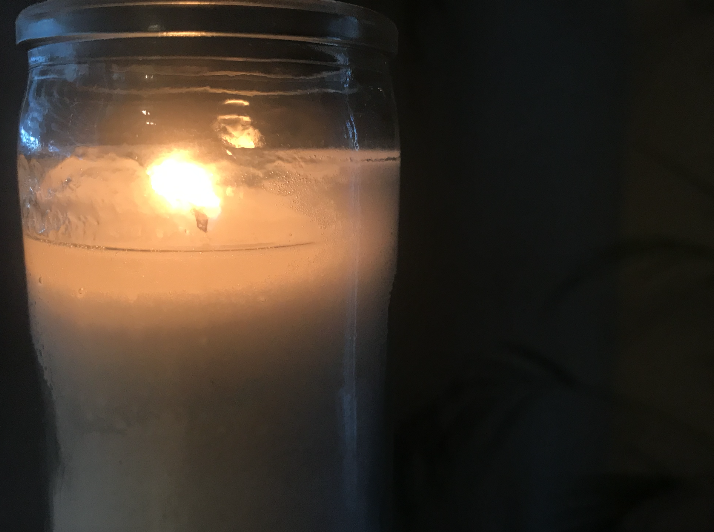
This morning, I lit a new candle. It’s the glass jar kind. It burns for three days. Safely. Mine will burn through today, through December 25th, and through December 26th. And go along with some family, some food and drink, some play, some gifts, and some song.

Oh, holy nights, of simple yet deeply felt things.
Making Room For Ourselves

In the northern hemisphere, solstice is a time when many people reflect upon the small beginnings of the return to light. People reflect on making choices and on making room.

Some people find room in religious and cultural celebration. Some people find it in nature. Some find it in quiet contemplation or added rest.

For me, the next five days will have some added quiet. Some longer walks in my neighborhood. Some longer rides on my stationary bike. For me, the next five days will also have some added company. Family in shared meal, or on Zoom for shared screen.

I love the feeling of pause.

Gunilla Norris is a person I continue to enjoy reading. Her words have a way of creating calm and of adding perspective that celebrates the inner world.

Again from her book, Inviting Silence, and from a chapter on Making Choices,

“The relief when unnecessary stimulation is removed is amazing.
As we listen to the body’s wisdom and attend to it
we are approaching some comfort with silence.

More and more in every day we begin to be aware
when things are too much or too frequent:
amounts of food on our plates,
appointments in our daytimers,
talk on the telephone,
hours in front of the computer.
These can take us away from presence in the present.

Here’s to making room. Any of us. All us us. Among us. And to amazing relief found uniquely in the present moment.

Open Awareness

Pema Chodron, the Buddhist Nun, is one of my favorite teachers. Over the last 15 years, I’ve listened to or read several of her talks and books. Her words used to express an orientation of wholeness have a way of sticking with me. They grow in me. “This very moment is the perfect teacher…” is an example. All of that has much to do with an awareness that I try to bring to my work with groups. Awareness. Awakeness. Leaning in for the good of varied efforts and causes. Growing consciousness.

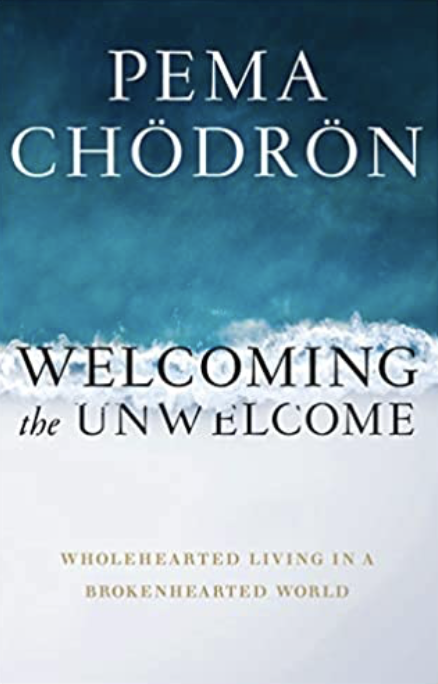
This recent book, Welcoming the Unwelcome: Wholehearted Living in a Brokenhearted World, is the one I’ve been reading lately, as well as gifting to a few friends. From a chapter on The Practice of Open Awareness, Pema writes,

Practicing open awareness is a gradual process of continually going back to seeing what we’re seeing, smelling what we’re smelling, feeling what we’re feeling. Whatever happens, the method is to keep letting go of the extra stuff and return to just what’s here.

I love Pema’s invitation to return to what is now. Return to sensing only what is in the present moment.

Thinking this way reminds me of a workshop I held a couple of years ago. I hosted a group on the power of emptying, on the wonder of “nothingness.” It was great to gather with a handful of people ready to lean to the mystery, even the quirkiness of it all. For me, the powerful insight, that really stuck and grew, was that at the bottom of nothingingness (try to overlook the inherent thingness of words) is everythingness.

“…just return to what is here…. This very moment is the perfect teacher.” This very moment holds access to so many important aspects of the journey, individually and collectively.

My body comes alive in such words. My being comes alive in such practice.

I continue to learn that awareness isn’t a destination. It is a commitment. It is a surrender. It might feel like a momentary landing spot. I’m ok with that because our brains seems to need it. But that is then followed by more movement and practice. The next moment, that becomes not even known by the word “moment,” but rather, dissolves to no thing, but wholeness.

As Pema writes in the same chapter, “If you taste chocolate ice cream, you tend to have a sense of an ‘I’ who is tasting. The subject (I) and the object (ice cream) are two separate things. But this separation doesn’t exist in the direct experience of tasting ice cream. In that direct experience, there is no ‘me’ or ‘it.’ There is just taste.”

Here’s to the wholeness, the open awareness that guides, and that contributes. Here’s to the people that write a few words — thanks Pema Chodron — that guide us along the way to reach into the depths together.

The Beauty of Dark and Quiet

I continue to learn that there is unique gift in the darkness. There is also gift in light. I continue to learn that there is notable life in the descent, just as there is life in the ascent. I continue to learn that there is importance and essence in the isolation, just as there is in the communal way.

Two Winter Solstice offerings are below.

One, by the American Poet Wendell Berry (with a thanks to my friend Roq Gareau for sharing it yesterday).

To Know The Dark
Wendell Berry

To go in the dark with a light
is to know the light.

To know the dark,
go dark.

Go without sight,
and find that the dark,
too,
blooms and sings,

and is traveled by dark feet
and dark wings.

The second is from my book, A Cadence of Despair, and from the final chapter on Birth and New Life.

Remember How To Go Quietly
Tenneson Woolf

Maybe the world is just noisy,
a cacophony of stimulation overload.

Maybe it is essential
to remember to go quietly.

Gifts of Circle - Question Cardsasd
Gifts of Circle is 30 short essays divided into 4 sections: 1) Circle's Bigger Purpose, 2) Circle's Practice, 3) Circle's First Requirements, and 4) Circle's Possibility for Men. From the Introduction: "Circle is what I turn to in the most comprehensive stories I know -- the stories of human beings trying to be kind and aware together, trying to make a difference in varied causes for which we need to go well together. Circle is also what I turn to in the most immediate needs that live right in front of me and in front of most of us -- sharing dreams and difficulties, exploring conflicts and coherences. Circle is what I turn to. Circle is what turns us to each other."

Question Cards is an accompanying tool to Gifts of Circle. Each card (34) offers a quote from the corresponding chapter in the book, followed by sample questions to grow your Circle hosting skills and to create connection, courage, and compassionate action among groups you host in Circle.

This will close in 60 seconds

asd
In My Nature
is a collection of 10 poems. From A Note of Beginning: "This collection of poems arises from the many conversations I've been having about nature. Nature as guide. Nature as wild. Nature as organized. I remain a human being that so appreciates a curious nature in people. That so appreciates questions that pick fruit from inner being, that gather insights and intuitions to a basket, and then brings the to table to be enjoyed and shared over the next week."

This set of Note Cards (8 cards + envelopes)  quotes a few favorite passages from poems in In My Nature. I offer them as inspiration. And leave room for you to write personal notes.

This will close in 60 seconds

asd
Most Mornings is a collection of 37 poems. I loved writing them. From the introduction: "This collection of poems comes from some of my sense-making that so often happens in the morning, nurtured by overnight sleep. The poems sample practices. They sample learnings. They sample insights and discoveries. They sample dilemmas and concerns."

This set of Note Cards (8 cards + envelopes)  quotes a few favorite passages from poems in Most Mornings. I offer them as inspiration. And leave room for you to write personal notes.

This will close in 60 seconds