
Delight in Wander

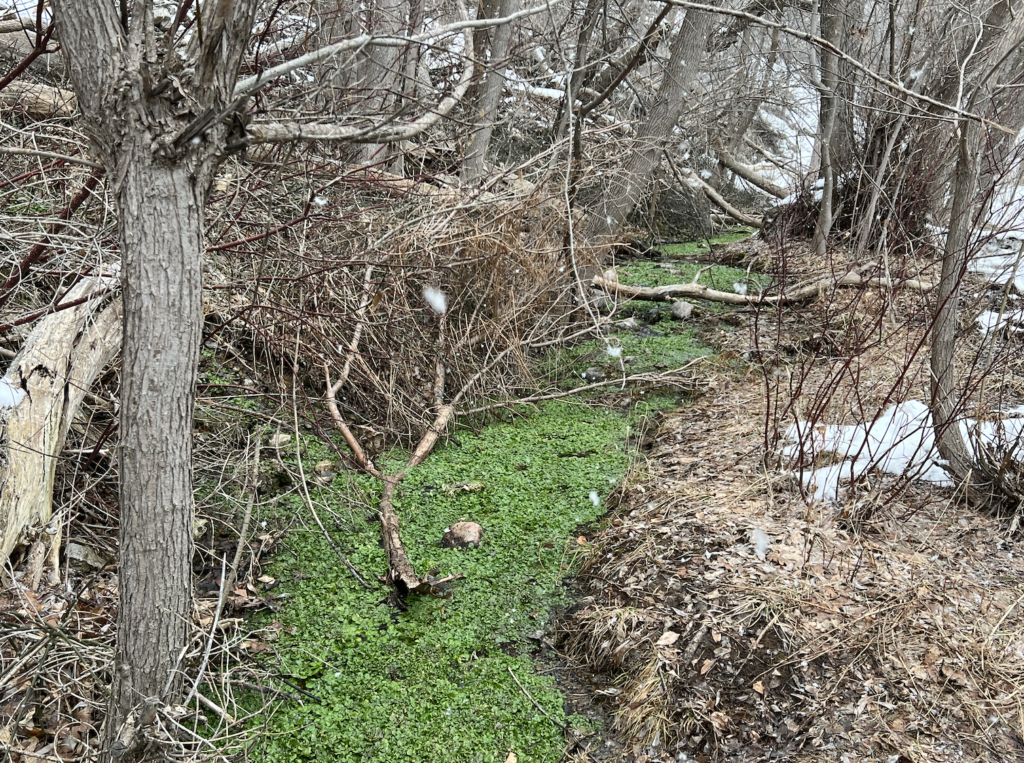
I’ve been exploring a new park lately with a friend. It’s City Creek, a watershed area near Salt Lake City. It’s new path. New sights. Lots of Blue Jays. And beautiful snow fall (shortly after I took this picture, that covered most of the ground).

It’s the green of the Watercress (from the cabbage family) that got my attention in this. From a February day growing so abundantly, next to trees and forest that remain mostly in winter rest.

One of my favorite games to play is embedded in the delight of wander, whether that be a new park, or the ordinary occurrences in a day. I’ll call it a game because I like to gamify just a bit. However, more deeply, it’s consciousness work — coming to know more of how the deeply and personal inner connects to the outer world of things, meetings, tasks, etc.

The game is basic. And is to be repeated. Wander builds wander. Consciousness builds consciousness.

What’s it like to be you?
What has your attention?
What might that have to do with who you are (or who you are becoming)?

In this Watercress instance, City Park, what it’s like to be me is to be a person feeling wonder. Wonder of exploring. Wonder of new land and path. Wonder of new feeling.

It is the Watercress that has my attention. I don’t know much about Watercress, but I’m drawn to its abundance in the contrast of sleeping winter. It’s abundance growing in the shallow creek.

In my version of becoming, I know that I seek to live with an overarching orientation to wonder. To live with appreciation. To live with curiosity. To celebrate what grows, be it the subtle within me that takes time, or be it that which pops up robustly in an instant.

There is delight in wander to me. It is one of the most fruitful and delightful practices of conscious living that I know. It can be found anywhere, anytime. Including at a nearby creek, offering it’s green to flourish within me.

Delight in wander.
Mindful in Conflict

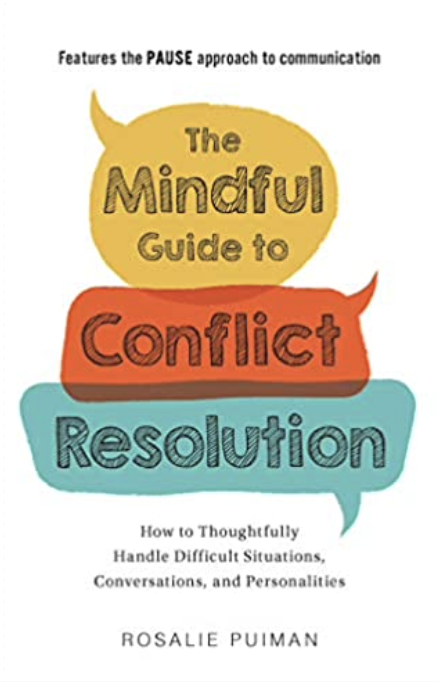
For an upcoming project with a team, I’ve been exploring this book above from Rosalie Puiman. Lots of Zen in it. Lots of attention to the inner condition that both sees from the balcony and from the ground view. I’m appreciating that.

Puiman created a model “PAUSE,” an acronym that includes each of the following with some of my riffing:

Presence — it matters to be showing for what is both known and unknown in the circumstance. It’s less about prepared speeches. It’s more about ability to listen together.

Acceptance — working with what is, accepting that it is only that most simple of conflicts that rely on black and white descriptions of content. Those are efforts at clarity. Most of the bigger conflicts, however, involve contrasting points of view and need time and patience to get beneath the words.

Undercurrent — this one builds off of acceptance (and each of her five practices). I hear it as, “there is likely more going on here and more that connects to older circumstances.” It’s “upstream” material. It’s also the invisible of current beneath the surface.

Synchronicity — this one speaks to emergence, as a language that I know. Solutions arise. Insights arise that weren’t part of a plan. Synchronicity invites attention to what isn’t yet known or felt, yet wants to be.

Exchange — this is where Puiman points back to how exchanges in conflict can be much more healthy and more kind. Many old school approaches to conflict oriented to “winning” and manipulating to that end. I’m glad for Puiman’s approach to changing how the interactions of conflict happen.

I do recommend the book. I’m glad for the learning. And for the way that that learning will cary with me into this next project.

Men’s Group

There is unique medicine that comes from men with men. I’ve known and experienced this over the last 15 years in particular. It’s men in story together. It’s men in loss and grief together. It’s men in laughter and joy together.

This was true again last night in my experience with the 11 of us that gathered for the most simple of formats. Taking turns picking up the talking piece (while the rest of us listen) to say the hello wished to be said, and then to pick an important point of personal living / learning to share into the center of the group. It was a round of offerings. Then it was a round of weaving, connecting some of the feelings, the questions, the unknowns, and the ahas. No resolutions needed. Just presence.

Men have unique medicine for men. I know this to be true in my experience of both receiving and offering. I know this to be true in my experience of showing up to be present.

Of course, what I share is true at broader levels of scale. Human beings have unique medicine for other human beings, in ways that weave across any narrowed construct of gender and identity. I find particular appreciation, perhaps from many years of clunky starving, that have me loving the unique company. Both in evening gatherings (Zoom, that meets every two weeks), and in longer retreat spaces (in person, over 3-4 days.

I’ll call on poetry and prose again, as I have each day this week in posting. From Yung Pueblo’s book, Clarity & Connection (thank Chris Smyth for gifting me a copy) — I saw and heard this expressed as a deep desire among men last night.

Clarity & Connection (p 42)

sometimes you need to move slowly
so you can then move powerfully

the modern world is so fast paced
that you feel the pressure to keep up

setting aside what everyone else is
doing and moving at your natural speed
will help you make better decisions
and lift up your inner peace.

Fire

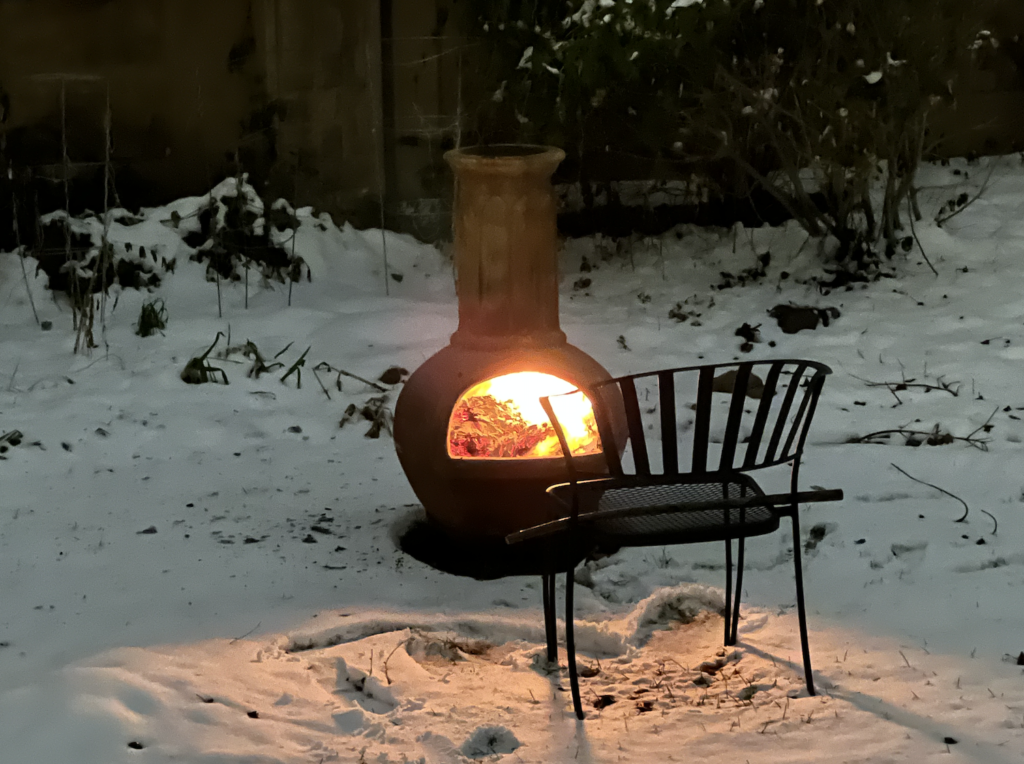
Fire is such a goto for me. Always has been. Most often, it’s this backyard chiminea for me. All seasons. The photo above is from a cold Utah night last week.

I bring things to the fire. And it brings things to me. Sometimes it is rituals — release, courage, clarity. Sometimes it is requests — with a few ancestors that I try to listen with. Sometimes it is feeling — I wish to be and feel a bit more elemental.

One of my favorite poems of all time, that I have used many times in working with groups is Judy Sorum Brown’s, Fire. A friend reminded me of it recently.

Fire
Judy Sorum Brown

What makes a fire burn
is space between the logs,
a breathing space.
Too much of a good thing,
too many logs
packed in too tight
can douse the flames
almost as surely
as a pail of water would.

So building fires
requires attention
to the spaces in between,
as much as to the wood.

When we are able to build
open spaces
in the same way
we have learned
to pile on the logs,
then we can come to see how
it is fuel, and absence of the fuel
together, that make fire possible.

We only need to lay a log
lightly from time to time.

A fire
grows
simply because the space is there,
with openings
in which the flame
that knows just how it wants to burn
can find its way.

Here’s to the invitations we create and the invitations we receive, to be with fire, to be with what is elemental.

Gifts of Circle - Question Cardsasd
Gifts of Circle is 30 short essays divided into 4 sections: 1) Circle's Bigger Purpose, 2) Circle's Practice, 3) Circle's First Requirements, and 4) Circle's Possibility for Men. From the Introduction: "Circle is what I turn to in the most comprehensive stories I know -- the stories of human beings trying to be kind and aware together, trying to make a difference in varied causes for which we need to go well together. Circle is also what I turn to in the most immediate needs that live right in front of me and in front of most of us -- sharing dreams and difficulties, exploring conflicts and coherences. Circle is what I turn to. Circle is what turns us to each other."

Question Cards is an accompanying tool to Gifts of Circle. Each card (34) offers a quote from the corresponding chapter in the book, followed by sample questions to grow your Circle hosting skills and to create connection, courage, and compassionate action among groups you host in Circle.

This will close in 60 seconds

asd
In My Nature
is a collection of 10 poems. From A Note of Beginning: "This collection of poems arises from the many conversations I've been having about nature. Nature as guide. Nature as wild. Nature as organized. I remain a human being that so appreciates a curious nature in people. That so appreciates questions that pick fruit from inner being, that gather insights and intuitions to a basket, and then brings the to table to be enjoyed and shared over the next week."

This set of Note Cards (8 cards + envelopes)  quotes a few favorite passages from poems in In My Nature. I offer them as inspiration. And leave room for you to write personal notes.

This will close in 60 seconds

asd
Most Mornings is a collection of 37 poems. I loved writing them. From the introduction: "This collection of poems comes from some of my sense-making that so often happens in the morning, nurtured by overnight sleep. The poems sample practices. They sample learnings. They sample insights and discoveries. They sample dilemmas and concerns."

This set of Note Cards (8 cards + envelopes)  quotes a few favorite passages from poems in Most Mornings. I offer them as inspiration. And leave room for you to write personal notes.

This will close in 60 seconds