
Currency is Exchange

I appreciated this topic for our monthly local Participative Leadership Practitioners Circle (PLPC), co-hosted last week by Ben Mates and myself. Complimentary Currencies is a body of work Ben has been supporting and exploring in the Salt Lake Valley.

As always with this group, we have a simple, deliberate format. The topic invitation is sent in advance so that people can choose to participate. We sit in a circle. The group has been 6-16 people. I usually offer a bit of context for the process and specifically for the evening. We check-in with a bit of voice from everyone. We give our attention and curiosity to the topic for the evening. We harvest some of the learning. We close with deliberateness. Good simple process for tapping intelligence in the group.

Ben’s description for the invitation was this:

The way we use currency to exchange and circulate wealth is often unconscious. We rarely consider that there might be alternative means of facilitating this exchange/circulation. I’m interested in convening conversations where we examine the often-unconscious assumptions around money and begin to explore alternative currencies that could offer healthier ways to be in relationship with each other and the world that gives us life. How can I best engage people and invite them to explore?

This was a great night of learning for me. Ben offered some framing about how money is energy and his focus is on creating alternative ways for energy to move and flow in a society. We played a couple of games to get this point. And then we played an additional game to help see some of our own patterns and beliefs in relation to money, things, exchange. The conversation that followed was very stimulating to me. Deep. Reflective. Thoughtful. Not surprising — this is what I know in how Ben is in the world. He is one of the good challengers and paradigm shifters that I know.

One part of the game had us naming for ourselves something that has three qualities (and energy). 1) what you like to do, 2) what you are good at, and 3) what people value. I found this particularly valuable to notice these things and notice that these becomes currencies that we can offer to each other. Nice. There is a spirit to it. That helped me to see more of that.

For those interested there are many further resources to stir the thinking.

-Ben has an article pending publication in Catalyst Magazine (benjmates@att.com)

An article by Michel Bauwens on post-capitalism (thanks to my friend Ria in Belgium)

-Several books by Bernard Lietaer: The Future of Money; The End of Money and the Future of Civilization, New Money for a New World (search for these on Google or Amazon)

-Several Books also by Charles Eisenstein: The Ascent of Humanity is particularly good I found.

Thanks Ben, all.
Serving Refugee Populations Better

Earlier this week I was on a first phone call with Debra Kreisberg, Joseph Nsabimbona, and Angeline Habonimana Nsabimbona. Debra was a a participant at an Art of Participative Leadership training a month ago in Utah. I appreciate her invitation to explore some community engagement work that she is involved in. Joseph and Angeline, whom I was meeting for the first time, are a married couple whose work is to support refugee populations in the Denver, Colorado area. Joseph and Angeline left Burundi in 1994. They are founders of A La Source Refugee Ministry.

The point of this call was to explore ways to help Joseph and Angeline with their work. I listened to them. Their work is inspiring, particularly oriented to serving refugees from the Great Lakes area of East Africa. They focus on youth, asylum seekers, and organizations that deal with refugee populations. Their format is what you would expect — training classes, forums, and seminars. Joseph and Angeline, like many others, are trying to imagine next ways for helping people get to the heart of the work. What they do is great. What they want to do is reach more people, scale their work. Yet, in scaling it, not lose the heartfulness of it. This is where Debra wanted to make the connection. She had felt and seen this at the Art of Participative Leadership training she participated in.

I appreciated in particular the clarity of story that we arrived at on the phone together. Or key points of the story that help their work now.

  1. Together We Are Stronger — This is the belief that Joseph and Angeline expressed. As well as variations of it: “Together we are better.” I offered the African proverb that I heard long ago. “If you want to go faster, go alone. If you want to go further, go together.”
  2. In Coming Together We Partake of that Strength — This is a fundamental belief in the value of coming together. And I believe it is one of the core questions that Joseph, Angeline, and Debra are asking: How can we experience the power of together in a way that lasts? This is different than just hearing the words, inspiring as they may be. And this is where I feel I can be helpful with them, offering social technologies and participative formats that entangle the group heart if you will, or the group imagination.
  3. Harvest Commitment — It is great to focus immediately on what we intend to harvest. Commitment is part of that. Appreciation is another. As powerful as it is, we don’t come together just to hear the strength of story and appeal to compassion. We invite and welcome that energy to move into the qualities of deeper relation and action.
  4. Make it Better — There are many of us who continue to adopt an energy of saving the world. I continue to learn patience to just make it better. I say this hear because many of the worlds that we are living in require a lot. There is a trap (of utter exhaustion for one) in expecting to save the world. Or to make it perfect. My friend Margaret Wheatley is a great teacher for me of these traps, reminding me that the spiritual warrior’s way is to do good because it is ours to do.
  5. Our Greatest Resource Is Each Other — Debra has a very strong voice on this. It is a call to reclaim the belief that human beings are resourceful. This contrasts some of the last several decades of a welfare model and disposition. I love the way that she challenges beliefs of scarcity of currency to abundance of human beings in relation with each other.

Serving better. Getting to the heart of it through well-held social engagement and interaction with each other. Inspiring.

Bullying Prevention at Glendale Community

Last night I hosted an event with my friend Carla Kelley of the Human Rights Education Center of Utah. It was an evening with 100 people from the Glendale community in Salt Lake City.

One of the things that I think we did particularly well in this evening was to keep a simple and purposeful design. While people were eating, I introduced some simple context. First, a concept I’ve learned with my Berkana colleagues — “Whatever the problem (dream), community is the answer.” And second, a principle I’ve learned with my friend Chris Corrigan about community work — “There is no finish line in community work.” I shared that in community work, we know that we must turn to one another. That is what we would do during the evening.

There were multiple ethnic groups gathered for this event with need for language translation: Spanish, Tongan, Swahili, Burmese, Nepali, Somali. Carla, John Erlacher (Glendale Middle School Principal) and I agreed that we wanted part of the evening to be less reliant on verbal communication. We played some simple cooperative games that had people standing in circle and crossing through the middle with different levels of interaction and attention with other participants.

We then moved our evening into two rounds of cafe style questions. The first, inviting participants to share stories with one another about what they appreciate in this community, and what they know is a challenge. We harvested these. The second round was an invitation to share suggestions for improvement. Again we harvested these.
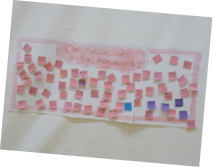
It is a lot to ask to move into what many would define as concrete action plans in the space of 90 minutes together in a first meeting. Carla, John, and I knew this. However, what is essential and what I believe we accomplished very well was helping to create a pattern of invitation, of turning to one another, of sharing stories, of being curious with each other. It is the re-establishing of pattern that helps a system to begin to change. This is a fundamental principle of working in living systems. We created the format for interaction — in play and in conversation — that can create conditions for well and thriving community. And it was a lot of fun.

There was some news coverage from one of the local TV stations. That report and video is here.

My friend and colleague Glen Brown posted a thoughtful blog on the evening. It is here.

Some of the other pictures I have from the evening are here.

Great to be part of this story, and to offer a process that will help it be sustainable and attractive.

All I Ever Needed I Learned at Breakfast and in My Son’s First Grade Class This Morning

This post is mostly my journal writing. It is personal experience that connect to helpful principles for human beings in work and community.

When I am not traveling I volunteer in my son’s school class once a week. Yes, this post has a bit of a feeling of learning the important principles at a young age. But particularly, for me, these come from noticing as a father of a child who is now in 1st grade.

A spectacular morning with Elijah. Very loving. Very playful. Very purposeful. Skillfully guided in principle. The kinds of stuff I love.

His mom dropped him off at 8:15 a.m. Tired. A bit cold. A bit grumpy. That’s OK. I know how to work with this, particularly when we are one on one and I haven’t seen him for several days.

– “I’m cold,” he says. I offer the ease of fixing that by turning the heat on. “How does that,” he points to the thermostat, “make it warm?” I see the opportunity for a fun mystery lesson and invite it. I ask if he knows where the furnace is. “No.” I ask if he wants to find it and invite him to be a detective. We find the furnace. I show him the pipes and tell him that these are secret pipes that run through the floor and ceiling. I show him the vent in his room and explain that this is how the thermostat talks to the furnace so that the heat can come through the secret pipes. I LOVE the learning. The content is interesting, but mostly I LOVE the process of getting curious together. Supporting him in his curiosity. He wasn’t satisfied to see just the vent in his room. We walked around each room upstairs and downstairs. And then I added playfully this principle — that I want to be warm, but don’t need to heat the whole house to do that.

– Elijah lays on the couch under the blanket to get warm. I tease and play with him staying close to him. I ask if he can think of lots of ways to keep himself warm. We start naming. “Have a fire. Go under a blanket. Have some hot chocolate. Have a hot bath. Exercise. Ride bikes.” It isn’t the specific naming that I care about so much. It is the curiosity and the imagining out loud together.

– We have oatmeal. Instant for today. I invite him to choose between original and apples and cinnamon. He chooses the latter. I join him with that. Principled again — invite choice and join in sometimes just to join in.

– I take him to school. We park at the end of the parking lot. “This is where we always park, isn’t it.” He is right. I reply with yes and that this is our spot. “What if someone else parked in it?” Elijah asks. I explain that it isn’t our spot but it is one that we often choose to park in. It is available for anyone though. I love again the naming of principle. We don’t have to. We choose too.

– At school, he wants to be the first to work with me. My job has been the same since the start of the school year. I work one on one with the kids, usually 3-8 in a 45 minute period. We do frequently used words and skip-counting. Each time I come I find a way to customize and play with a rather mundane task. The kids are starting to gather around wanting to be next because they know it or see it as being fun. Again, I offer choice — words or number first. And I do three things really  quickly with them. I invite relationship — comment on their shirt or ask what they did yesterday. I offer surprise in the order of the words, departures from what they expect. I challenge them to do something they think they can’t do but is really extension of pattern that they know. The can skip count by tens to 100 by remembering the song. I ask if they can do it from 100 – 200. Many say no. But then I help them to see the pattern that extends their learning. Their smiles are enormous when they realize they already know how to do it.

– The kids get excited when I come to recess. Today they wanted to chase me, which we did. Then I had them form into a circle and be in a cooperative game, passing a clap. Fun to see them shift to another surprise.

– Elijah is proud of me. He seems that way. And doesn’t want me to leave.

– Oh, and Elijah and I meditated too before school. We’ve done it before. For six minutes to match his age. Sit quietly and breath. With eyes open or shut. I try to make it easy yet purposeful. And sharing that mediation is for keeping you healthy and smart — I don’t tell him about emotional body or clarity of mind. Elijah regurgitates one of my answers when I ask why — “so that you can hear the trees.” I smile and I reinforce it with the simplicity and my belief that he will learn to hear many things in his life — that there are many things to hear.

A months worth of good, maybe more, happened in that one hour and forty-five minutes together. Eight home runs in one game — quite something.

Get curious together. Imagine out loud. Invite choice. Join in (participate). Less “have to” and more “choose to.” Invite relationship. Offer surprise. Help to see pattern. Experiment with cooperative play. Keep healthy and smart through deep listening.

Yup, just a bit of important learning and practices there that are about a whole lot more than first grade classes.

Gifts of Circle - Question Cardsasd
Gifts of Circle is 30 short essays divided into 4 sections: 1) Circle's Bigger Purpose, 2) Circle's Practice, 3) Circle's First Requirements, and 4) Circle's Possibility for Men. From the Introduction: "Circle is what I turn to in the most comprehensive stories I know -- the stories of human beings trying to be kind and aware together, trying to make a difference in varied causes for which we need to go well together. Circle is also what I turn to in the most immediate needs that live right in front of me and in front of most of us -- sharing dreams and difficulties, exploring conflicts and coherences. Circle is what I turn to. Circle is what turns us to each other."

Question Cards is an accompanying tool to Gifts of Circle. Each card (34) offers a quote from the corresponding chapter in the book, followed by sample questions to grow your Circle hosting skills and to create connection, courage, and compassionate action among groups you host in Circle.

This will close in 60 seconds

asd
In My Nature
is a collection of 10 poems. From A Note of Beginning: "This collection of poems arises from the many conversations I've been having about nature. Nature as guide. Nature as wild. Nature as organized. I remain a human being that so appreciates a curious nature in people. That so appreciates questions that pick fruit from inner being, that gather insights and intuitions to a basket, and then brings the to table to be enjoyed and shared over the next week."

This set of Note Cards (8 cards + envelopes)  quotes a few favorite passages from poems in In My Nature. I offer them as inspiration. And leave room for you to write personal notes.

This will close in 60 seconds

asd
Most Mornings is a collection of 37 poems. I loved writing them. From the introduction: "This collection of poems comes from some of my sense-making that so often happens in the morning, nurtured by overnight sleep. The poems sample practices. They sample learnings. They sample insights and discoveries. They sample dilemmas and concerns."

This set of Note Cards (8 cards + envelopes)  quotes a few favorite passages from poems in Most Mornings. I offer them as inspiration. And leave room for you to write personal notes.

This will close in 60 seconds