
What Time Is It?

I remember, almost, the first time I participated in a conversation framed by the question, “What time is it in the world?” I think it was a World Cafe format. I think Juanita Brown and David Isaacs were lightly steering. This was the 90s. I remember being stirred by how people were being thoughtful. Juanita and David were inviting perspective, which, was the work then, and so often is today.

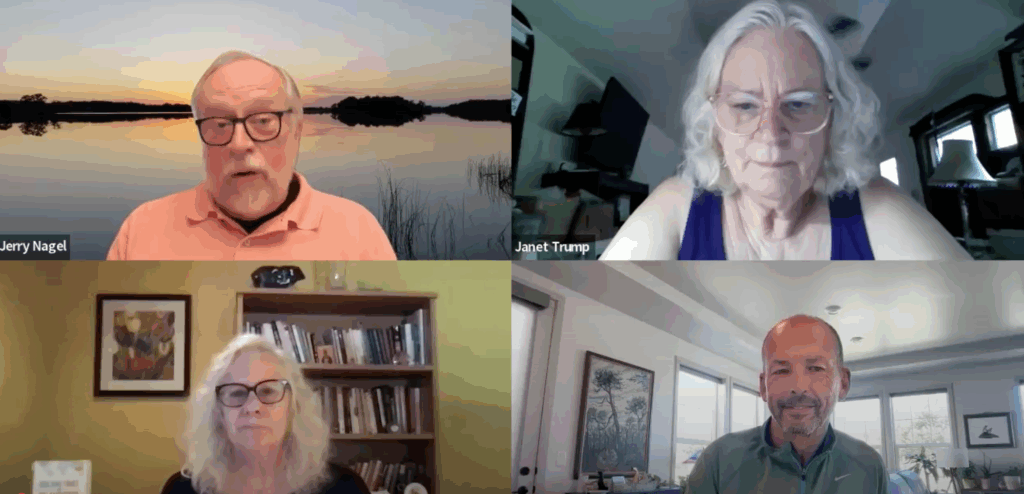
This Shades of Life video — thx Jerry, Kathy, Janet — asks this question. It sets up some of that context. Fun. And, led by Kathy and Jerry, touches the notion of “jump time,” a kind of punctuated equilibrium. It brings people to added layers of bigger picture and witness, which I love, and, which I feel is so often the work.

A couple of weeks ago I co-hosted a group of clergy which included some riffs on the question:

  • What time is it in the world?
  • What time is it in religious life?
  • What time is it in religious leadership?

Cool, thoughtful responses. I love the way that groups actually have hunger to interact around such questions. I used to see people more often resist these kind of questions. It was resistance that saw some fluff and said, “let’s get to the real work.” These days, oh gosh, so many more people recognize these questions are the real work. Or are the real contexting that helps us get to the real work.

Fun.

In the above video, we all offer some reflection on the question, What time is it? And we reference and play with the 2-Loops model for change that I learned with Meg Wheatley and Deborah Frieze in those early Berkana days. Some of us took that question and that model to a lot of places (Chris, Caitlin, Teresa, Tim, Tuesday, Kathy, Jerry).

In the video I respond with a few one-liners.

  • it’s a time of change
  • it’s a time of rapid change
  • it’s a time of letting go
  • it’s a time of high hopes
  • it’s a time of traumatic stress (both post and continual)
  • it’s a time of hints and hunches (for what helps, centers, moves)

And, and.

I love thoughtful questions. I love questions and contexts that engage the heart, mind, belly. And I love learning with my friends, coming alive, carrying to other place.

What time is it? It’s a time for just such wonder, punctuated here and there with particular actions, but also seasoned well with some long-arc wonder.

Let’s remember.
The Guest House — Rumi

My friend Jeremy Nash recently reminded me of this Rumi poem, The Guest House. Jeremy runs a monthly 1-hour poetry group on Zoom, with small Circle-based groups. I participate when I can. For the poetry. For the friendship. For the wonder.

I love the way this Rumi poem invites a spirit of welcome and a spirit of wonder. Rumi speaks to some of the deep work, perhaps of then, and of today too. He speaks to a what I relate to as a great discipline — of joy, of curiosity, of encountering life. Enjoy.

The Guest House
Jellaludin Rumi, 13th Century Persian Poet

This being human is a guest house.
Every morning a new arrival.

A joy, a depression, a meanness,
some momentary awareness comes
as an unexpected visitor.

Welcome and entertain them all!
Even if they are a crowd of sorrows,
who violently sweep your house
empty of its furniture,
still, treat each guest honorably.
He may be clearing you out
for some new delight.

The dark thought, the shame, the malice.
meet them at the door laughing and invite them in.

Be grateful for whatever comes.
because each has been sent
as a guide from beyond.

When You Stop Doing, Life Speaks

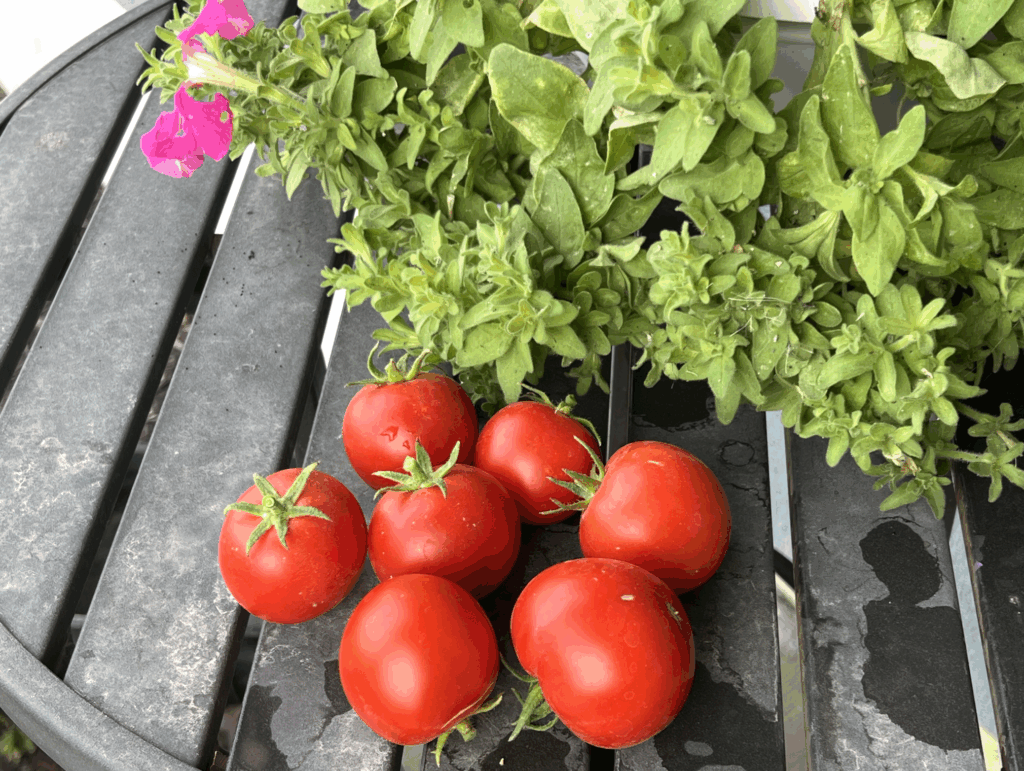
Tomato. Utah. Garden. Growing. Harvesting. Doing. Not doing.

Dana and I harvested our front porch tomatoes last week. Each is a bit bigger than golf-ball sized. And, as you can see, pretty ripe. Yummy for dinner last night. The pace of both growing and picking tomatoes is slow. Which I like. It reminds me of the many ways that my psyche values slowness these days. Not rushed. Not over-producing. Not frantic in performance. Not hijacked by the minutia.

I’m a 62 year-old human. I feel like I’m discovering what that means (without great attachment to the detail of the number). When I’m nuancing out loud with others nuancing their ages and presence in the world, I often say a couple of cheeky things. “Being in my sixties isn’t being in my forties. Nor is it my twenties. Nor is it my eighties.” I suppose that sometimes the honing in starts with differentiation, even the cheeky kind.

For those of you reading and following and jumping in for a while, you know that a couple of themes have grabbed me. Wander. Becoming. Belonging. Themes, yes. They are also practices. They are goals. They are surrenders. They are alignments. Even attunements. They touch the heart of things for me.

You know how when we have interest in something that not only do you look for it, but, well, it seems to start looking for you? I feel like Wander is doing this with me. Teaching me. Taking me for walks. Challenging me. Opening the beers on the back deck.

And then there are friends who start looking for us. They become part of the team seeking out the themes. This is happening a lot too. I love the insights.

My friend Bill did this recently. Bill is thoughtful. A counselor and therapist by profession. Kind and patient by personality. Knows a bunch. Bill sent me this article by Jeff Karp recently after Bill and I talked about Wander School. When You Stop Doing, Life Speaks.

Lots to love. Lots to pick and enjoy.

  • “doing nothing quiets the noise, creating the stillness needed to hear your own inner wisdom”
  • “your natural intelligence isn’t created; it’s remembered when you silence the mind’s anxious chatter”
  • “transformation comes from subtraction, not addition; let go of performance to reveal your true essence”
  • “stillness reveals you are not separate from life, but are a part of nature remembering itself”
  • “stillness is a source, not a void”
  • “natural intelligence is fluid; you don’t create it — you tune into it; it allows what you already know to come forth”
  • “in a hyper-productive world, doing nothing can feel unnatural — even wrong…; when we pause and let go of constant doing, life begins to move through us, not from us”

And, and, and.

I’m drawn to such notions. Life flowing through us. I find it requires some undoing — I’ll likely always have some layer of anxious doer in me. I find it requires some fierceness in me — a kind fierceness that celebrates first, life flowing.

Hmmm. The tomatoes were the goal. Yes. If we didn’t get any, I’d feel disappointed. But, perhaps grown tomatoes aren’t the only goal. Perhaps equally important is the generic participation in life moving and growing.

I’m learning to center myself in such things. Not 40. Not 20. Not 80. Just here. Now. Turning in the stories. Inviting others to turn in to their stories. Participating in life moving.

I have programs that do this. It’s my B & B Series. Rather simple. And I’m finding are part of good and lasting practice.

Welcome if you decide to stop by for a tomato!

Gifts of Circle - Question Cardsasd
Gifts of Circle is 30 short essays divided into 4 sections: 1) Circle's Bigger Purpose, 2) Circle's Practice, 3) Circle's First Requirements, and 4) Circle's Possibility for Men. From the Introduction: "Circle is what I turn to in the most comprehensive stories I know -- the stories of human beings trying to be kind and aware together, trying to make a difference in varied causes for which we need to go well together. Circle is also what I turn to in the most immediate needs that live right in front of me and in front of most of us -- sharing dreams and difficulties, exploring conflicts and coherences. Circle is what I turn to. Circle is what turns us to each other."

Question Cards is an accompanying tool to Gifts of Circle. Each card (34) offers a quote from the corresponding chapter in the book, followed by sample questions to grow your Circle hosting skills and to create connection, courage, and compassionate action among groups you host in Circle.

This will close in 60 seconds

asd
In My Nature
is a collection of 10 poems. From A Note of Beginning: "This collection of poems arises from the many conversations I've been having about nature. Nature as guide. Nature as wild. Nature as organized. I remain a human being that so appreciates a curious nature in people. That so appreciates questions that pick fruit from inner being, that gather insights and intuitions to a basket, and then brings the to table to be enjoyed and shared over the next week."

This set of Note Cards (8 cards + envelopes)  quotes a few favorite passages from poems in In My Nature. I offer them as inspiration. And leave room for you to write personal notes.

This will close in 60 seconds

asd
Most Mornings is a collection of 37 poems. I loved writing them. From the introduction: "This collection of poems comes from some of my sense-making that so often happens in the morning, nurtured by overnight sleep. The poems sample practices. They sample learnings. They sample insights and discoveries. They sample dilemmas and concerns."

This set of Note Cards (8 cards + envelopes)  quotes a few favorite passages from poems in Most Mornings. I offer them as inspiration. And leave room for you to write personal notes.

This will close in 60 seconds
