
Not Every Meeting is Everything For Everyone

Yup, that sounds rather obvious doesn’t it. Yet it’s often overlooked in design of meetings, particularly when group sizes get larger. With good intent to try to cover everything, the end result is often too watered down, or too rushed, or too scattered in purpose to yield what was the longed-for intention.

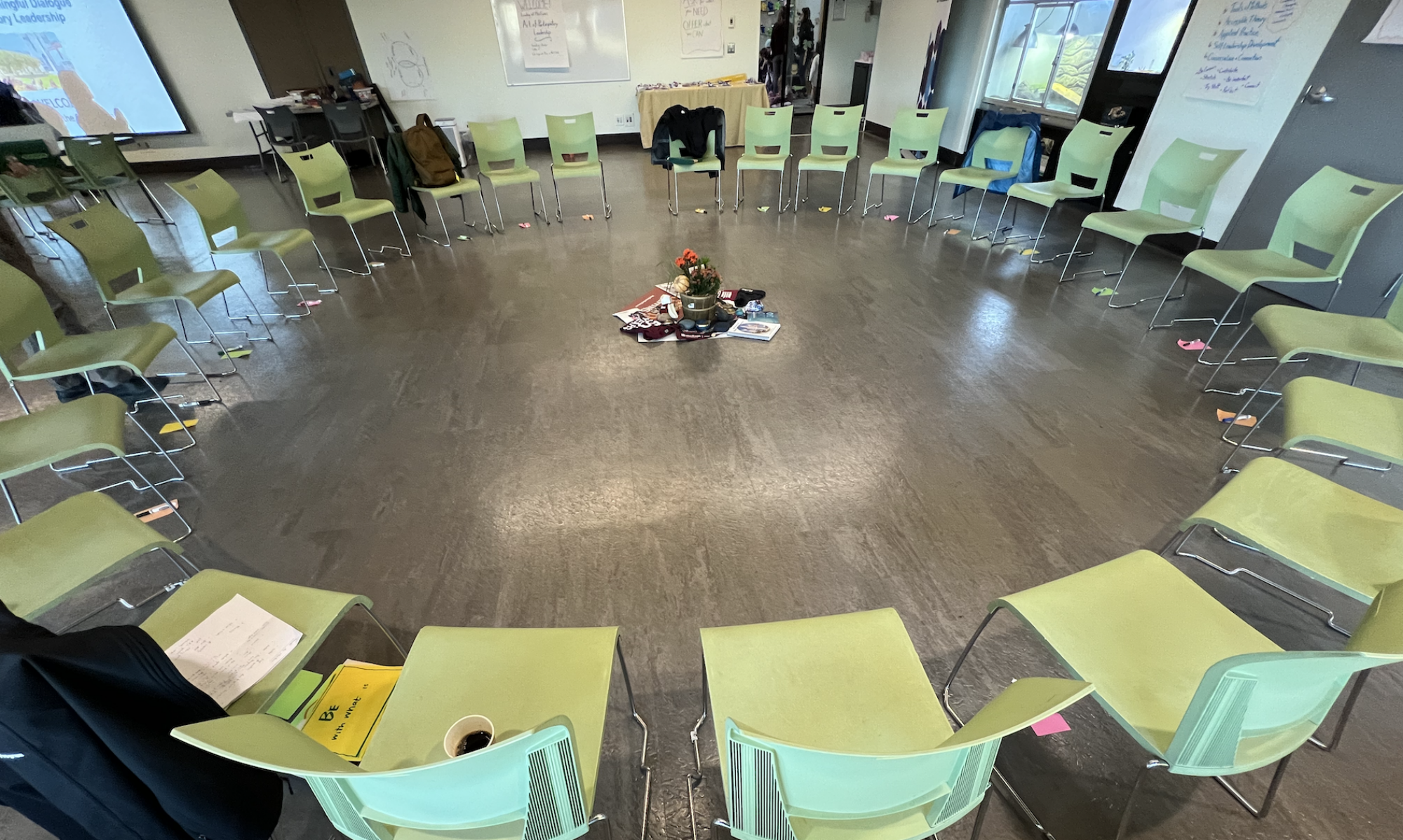
Recently in a coaching call I was listening to someone share an example of, what I believe was the trap of trying to be everything for everyone. What needed a series of meetings placed carefully over time with clear purpose and space for integration, was being smooshed into one meeting and several complex topics. What needed ample initial connection and reconnection among participants (in part because of continued online meetings) was being compressed to a list of albeit delicious intended outcomes, but still missing the essential relational qualities. This meeting needed depth and authenticity. It was defaulting in design to another skim of the shallow.

I would suggest we’ve all been there. I have. Argh. Trying for too much.

Well the coaching I offered this person was an intent to get to the essence of things. It wasn’t mine to fix the short-changing of time needed for this persons particular purpose. But it also wasn’t my job to dismiss the oversights and flippantly wish them good luck. My job, my desire, was to offered something principled that might help them nuance their thinking and their practice of meeting, starting with what was in front of them.

I offered three basic points that ground my learning and hosting of meetings and hosting of people who host.

  1. Remember (as above) that not every meeting is for everything and for everyone. The intent to be comprehensive is impressive. The intent to be efficient is impressive. But I would suggest the courage to even sip the depths together is often more lasting that another instance of surfacy production-line together. There is a maxim used by many that I learned in my early Berkana days — sometimes we need to slow down so that we can speed up. I offered this awareness with my client so as to reclaim permission and courage to design for meetings that would help people want to come back.
  2. Make sure that there is turning to one another. Yup, another obvious one. Turn to one another with story. Turn to one another with invitation to share experiences of what they see and notice. Turn to one another with invitation to name what they each feel is important and has relevance for their situation. Whether it is another online meeting or another face to face meeting, I think that people leading these often cave to the pressure to get on with the meeting. Turning to one another is what animates people, in part because of the need for connection, so that they can take on the complex stuff together. It’s so simple, online or face to face, to create a well-bounded experience to turn to one another, a partner or a group of three, rather than another instance of passive participation.
  3. Ask for improvements. Ask for people to offer what they think might help the situation. It’s less about complete fixes. It’s more about animating some fundamental energy for being in continued learning and practice with one another. What I shared with my client was the importance of being transparent with three scales that are happening all at the same time. Sometimes the scale for improvement is what the individual does. And not every individual the same. Just for one person. Sometimes the scale of improvement is for the team, or committee, or task force. What is one thing that you feel might help our team in moving forward? Sometimes the scale is for the larger organization or community. Because that scale is intertwined with the deeply personal.

That’s it. “Three things to weave to your thinking,” I offered. Three things that might restore a bit clarity in process and purpose. The real work of our times isn’t about imposing more manipulation to get people to do something. The real work is about getting ourselves in the room, inviting authenticity and imagination with others, and as lofty as all of that feels, invoking just a bit of Jedi practice and design to reclaim some of the caring that brought people to the work in the first place.

Here’s to good meetings. To good nudges of very purposed design. And to the taking on of complex things with new found simplicity.


Scale

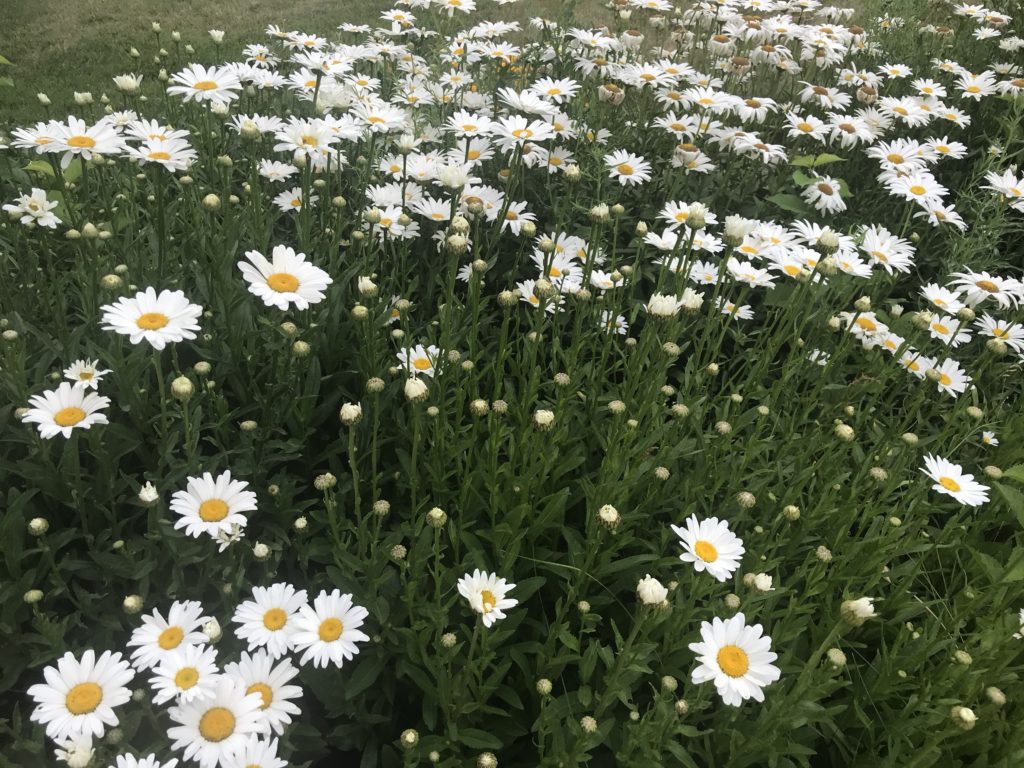
OK, so truth be told, I just like this set of three pictures, taken with iPhone camera as I enjoyed a bit of easy-paced Sunday morning time in my yard yesterday. In a “beyond words” way, they invite me to marvel a bit.

These are daisies growing near my front door, 2-3 feet tall. I love their wildness and abundance. They reseed prolifically each year. They bloom June through September where I live. I also love these perspectives of scale. The close-up interior of a single flower. The more distant perspective of a few flowers growing together. The yet more distant view of a larger section of garden.

These simultaneous views continue to teach me about myself and teach me in what I invite with groups. The inner world of individuals is rather rich, complex, and beautiful. So is the formation that is team. So is the shape that is organization.

I find myself pointing a lot these days — growing gardens if you will — to how the inner is connected to the outer, and how the the longer arc of things is connected to the now. How the big scale of how an organization works is connected to how its people work. And vice versa.

These are all scales that yield much important learning and consciousness. I’m grateful for the way daisies remind me of scale. And how they just bring aliveness in perspective.

Instructions, A Poem By Sheri Hostetler

There’s something very beautiful to me in this photo filled with Lambs Ear blossoms. They stand so fully themselves in my back garden, treating the eye to loads of pink and purple, and treating the fingers to leaves like, well, soft lamb ears.

There’s something beautiful in this poem that I’ve been referencing lately. It’s by Sheri Hostetler, an American poet and pastor in the Mennonite tradition. Something about standing so fully and so simply.

Enjoy.

Instructions
by Sheri Hostetler

Give up the world; give up self; finally, give up God.
Find god in rhododendrons and rocks,
passers-by, your cat.
Pare your beliefs, your absolutes.
Make it simple; make it clean.
No carry-on luggage allowed.
Examine all you have
with a loving and critical eye, then
throw away some more.
Repeat. Repeat.
Keep this and only this:
what your heart beats loudly for
what feels heavy and full in your gut.
There will only be one or two
things you will keep,
and they will fit lightly
in your pocket.

Striving & Surrendering

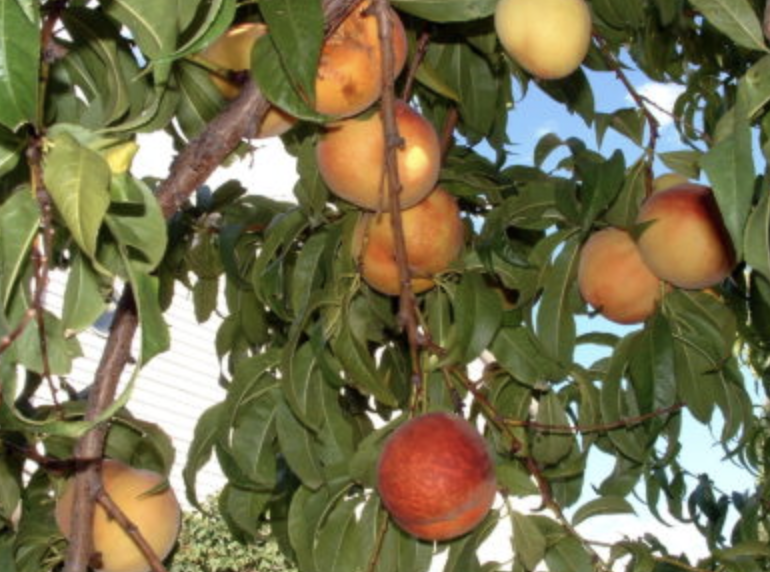
Earlier in June I had a nice wandering call with a colleague. It was catching up with each other in friendship. It was also sense-making together, as it always is. There is an inherent leaning to mystery that I so appreciate with this colleague. There was no particular destination, output, or conclusion that we needed to arrive at. And yet, in the freedom to not need any of that, there was abundant harvest together. As we referenced it, there were plenty of plums and peaches on those trees of our wandering together (like in this photo from a few years ago of my back yard peach tree).

One part of our conversation was sharing of our experiences with striving and surrendering. Striving tends to feel like it’s got direction, like it is movement to a particular intention. Striving tends to feel, for me, like accomplishment, like commitment to goals, like destination. I have plenty of striver in me, albeit quite changed in shape over the years. Striving energy in my teens, twenties, and thirties often had more imposing energy. Come hell or high water, get it done.

Surrendering, for me tends to feel less directed, like it is movement more akin to flow. Surrender tends to feel like giving myself to much bigger, and perhaps vague, organizing forces. There have been times when I felt this was God or some kind of spirit. More generally now, surrender is to something less dogmatic. Flow with life itself. Or surrender to the unknown. It sounds passive. It’s not for me. It’s actually quite deliberate as practice.

My colleague and I both shared our ongoing appreciation for both of these qualities, and the wisdom inherent in knowing that there are times when surrender is exactly what is needed. Yet also, times when striving is what is needed or is what helps with a group. The key point however, I’d suggest, is discernment. Knowing that both of these are important, and lending courage and clarity through these respective energies — well that is the kind of stuff that can really grow a deep humanity in groups of people and help that group to contribute / accomplish a bit more of what its gifts are with each other and with the larger world.

So here’s to the insight and honesty and commitment and discernment for any of us, giving ourselves fully to both the strive and the surrender, and with some grace, being able to nuance the difference and the similarity. And here’s to friends and colleagues that help us to see the peaches and plums

Gifts of Circle - Question Cardsasd
Gifts of Circle is 30 short essays divided into 4 sections: 1) Circle's Bigger Purpose, 2) Circle's Practice, 3) Circle's First Requirements, and 4) Circle's Possibility for Men. From the Introduction: "Circle is what I turn to in the most comprehensive stories I know -- the stories of human beings trying to be kind and aware together, trying to make a difference in varied causes for which we need to go well together. Circle is also what I turn to in the most immediate needs that live right in front of me and in front of most of us -- sharing dreams and difficulties, exploring conflicts and coherences. Circle is what I turn to. Circle is what turns us to each other."

Question Cards is an accompanying tool to Gifts of Circle. Each card (34) offers a quote from the corresponding chapter in the book, followed by sample questions to grow your Circle hosting skills and to create connection, courage, and compassionate action among groups you host in Circle.

This will close in 60 seconds

asd
In My Nature
is a collection of 10 poems. From A Note of Beginning: "This collection of poems arises from the many conversations I've been having about nature. Nature as guide. Nature as wild. Nature as organized. I remain a human being that so appreciates a curious nature in people. That so appreciates questions that pick fruit from inner being, that gather insights and intuitions to a basket, and then brings the to table to be enjoyed and shared over the next week."

This set of Note Cards (8 cards + envelopes)  quotes a few favorite passages from poems in In My Nature. I offer them as inspiration. And leave room for you to write personal notes.

This will close in 60 seconds

asd
Most Mornings is a collection of 37 poems. I loved writing them. From the introduction: "This collection of poems comes from some of my sense-making that so often happens in the morning, nurtured by overnight sleep. The poems sample practices. They sample learnings. They sample insights and discoveries. They sample dilemmas and concerns."

This set of Note Cards (8 cards + envelopes)  quotes a few favorite passages from poems in Most Mornings. I offer them as inspiration. And leave room for you to write personal notes.

This will close in 60 seconds