Choice, Friendship, and Welcome

Today, a friend that watches out for me sent me this.

“Love is the ability and willingness
to allow those that you care for
to be what they choose for themselves
without any insistence that they satisfy you.”

It is from Wayne Dyer, the American philosopher and self-help author, who died in 2015.

Yesterday, I was being interviewed about relational dynamics in leadership, by a PhD candidate working on his dissertation. I remembered this, from one of my closest pals, Chris Corrigan.

“Friendship is our business model.”

I’ve modified Dyer’s statement.

“Friendship [Love] is the ability and willingness
to welcome [allow] those that you care for
to be what they choose for themselves
without any insistence that thy satisfy you.”

Choice, and friendship, and welcome — they make all of the difference.

Dependent Origination

I met Bob Thompson a couple of years ago when planning an event for the World Parliament of Religions being held in Salt Lake City. Bob was helping myself and a few others imagine a two day event prior to the Parliament. I loved his open, playful, and endearing personality. Ever ready to share a story. I found him kind, gracious, and real.

One of Bob’s books is called, A Voluptuous God: A Christian Heretic Speaks. It’s loaded with rich references and stories told in such human ways. In that book, Bob speaks of the concept of dependent origination:

Dependent origination teaches that everything that exists is dependent on something else. Every part of life is dependent upon other parts of life. The universe is a living organism in which each cell works in balance and cooperation with every other cell in order to sustain the whole.

Good, right. Familiar too, right.

I’m grateful for the many people I’ve met, like Bob, and from many walks of life — theologians, biologists, school teachers, health care professionals, and the like — that feed this narrative arc of an undeniable connectedness. Most of us, in most systems, are trying to relearn this amidst the 300 year wave of industrialization and mechanism that has engrained a cultural story of separateness.

Essential Sustainability

Last week I was at the Intermountain Sustainability Summit, invited by my friend Bonnie Christiansen to host some Round Table Discussions. The summit was the 8th annual, held for the second time at Weber State University in Ogden, Utah. The summit is growing. In size. In awareness of. In creating community and essential connection. It was really fun to be a part of, and to spend the day with another good friend and colleague, Kinde Nebeker, who also facilitated these Round Table Discussions.

The opening keynote was Robert Davies, who is among many things, a physicist. His presentation on planetary boundaries was engaging, clear, and informative. It was also painful. He was speaking a narrative on the state of the planet and its resources. What I always appreciate in complex topics like this is the simplifying down to language that is easy to grasp. For example, “if everyone on the planet consumed at the rate of the average american then we would need five planets worth of resources.” Or that “we as human beings are overspending the bank account that is planetary resources. However, unlike human beings or corporations that make this mistake, the planet is not able to file for Chapter 11 Bankruptcy.”

It’s painful material. But it’s honest material. One of my favorite parts was in the brief question and answer period when someone from the audience began his question with an appreciation — “I enjoyed your talk.” It was just cordial. However, Rob Davies responded quickly and playfully, “Then you must not have been listening.” The message is dire.

When it came to the “what to do” part, there were two pieces that caught my attention in particular. The first was a concept from Joanna Macy. “Slow the damage. Repair the damage. Re-imagine the system causing the damage.” Again, simplicity. Accessible narrative. It’s a framework for anything from an individual beginning to recycle to countries trying to meet thirty year goals of carbon reduction and alternative energy development.

The second piece of todo from Rob Davies was a simple statement that invokes citizenry. “If you want to make a difference, the first thing is to talk about it.” Ah, that’s gold, right. Just talk about it. Just explore forms of listening together.

I’m both excited to hear this statement, and a bit saddened too. The excitement is that this is basic work that I often state as “remembered” work. I work in the fields of dialogue and change. We have to turn to one another. That’s the story for me. To be smart together. To be honest together. To be imaginative together. To take on hard things together.

The sad part for me is that the containers for listening in contemporary society, and more accurately, in the awry practice of meeting, is really freaking askew. Town meetings that are shouting matches. Dialogue panels that turn quickly to interruption at scale. Essential pause and silence that are filled with enormous amounts of data that is filling, but just not nourishing enough to further waken human spirit.

Sustainability is not just about planetary resources of water, clean air, and food systems. It is all of that. Essentially. However, sustainability is also about human beings rekindling genuine curiosity together, the essential spirit of working together rather than against.

Thanks Bonnie Christiansen, Alice Mulder, and all that convened such a great summit and invoked such good attention to sustainability on lots of layers.


The Four Fold Practice

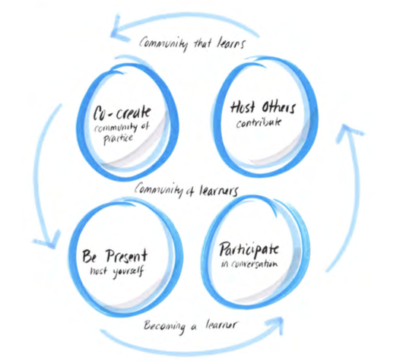
There are some teachings that have impacted me a lot in the last 20 years. That have become foundational for not only what stirs on the surface, but what churns at a molten, magma level. One of these for me, that I find myself returning to lately as I work with core teams, is “The Four Fold Practice” that grew among us in the Art of Hosting community of practitioners.

When I have introduced The Four Fold Practice at workshops, often I’ve referenced it as a curriculum that should be covered over at least two years. Each of its practices, its folds, are worth significant attention, learning, and dwelling with. And, as it is named, it is “practice.” It isn’t something you acquire and then are done (though I suppose this could be more true if thinking at the mastery level of 10,000 hours of practice when it becomes you). It is something you continue to do. And develop. And evolve. And stretch with. Just like cardio-fitness isn’t a one time, or a one week thing either.

Why I’m appreciating this model with core teams is that I’m trying to encourage from the onset the aspect of taking a journey together. Not just a meeting. Not just a series of planning sessions. Not just a single car-ride. It is journey. With unknowns, uncertainties, fears, excitements, questions to linger with, water to draw, food to prepare, and adaptations all along the way.

Here’s the folds in the practice:

Be Present — Showing up is the work. It sounds a bit silly to say such a basic thing. Yet, contemporary society demands much from most of us, doesn’t it. Multi-tasking is a norm (and even a shame if unable to keep up). I know of few people who aren’t required to do twice the work in half the time and with half of the resources. How the globalization pattern of incessantly seeking growth will evolve (or implode) in society is for another day of writing. Suffice it say that there are demands on all of us. And it gives rise, increasingly so, to an ability to practice focus, clarity of purpose, and stillness — both personally and corporally with a group.

Participate — Showing up from a practice of presence (perfection isn’t required), makes a big difference in participation. It’s not passive listening just waiting for the damn meeting to end. It’s not loaded-for-bear confrontation to bully one’s talking points. Presence changes the way that any of us are able to participate in gatherings. Adding in just a bit more ability to listen to what others say, to be curious about each other and ourselves and the many choices of how we approach our task at hand — this matters, right. In my work with The Circle Way, there are three practices that are always encouraged that I find guide participation. Speak with intention. Listen with attention. Tend to the well-being of the group. It’s part of the nuancing of participation, key reminders for all of us.

Host — To participate in society (and communities, and families, and teams) means that you will have your share of stepping in to host. To convene. To create containers so that many people can be in their learning together. Or their imagination. Or their grief. As some of my colleagues have said, “Hosting conversations is both more and less than facilitating. It is an act of leadership and means taking responsibility for creating and holding the ‘container’ in which a group of people can do their best work together.” Hosting does imply some of the basics — a time, a place, chairs, sometimes food. It’s not, however, about passing time. I often think of it as a practice of “activating and animating a composite being.” I think of it as waking up the “we” that is present and yet so illusive, though many of our cultural traditions point us at best to expect, “a collection of me’s.”

Co-Create — This one is the zinger to me. You can see from the above diagram the references to learning, and the evolution from “becoming a learner” to a “community of learners” to a “community that learns.” All of these are important. However, the community that learns, that holds as core identity the practices and habits of paying attention, amplifying curiosity, gathering to listen well together, unleashing creative energy to experiment together, trusting and supporting amidst unavoidable unknowns, uncertainties, and complexities — now that’s something to write home about. Co-creation, that deliberateness — it’s the gold of the journey, scaled. It’s the thing you look back to in 20 years and recognize, that’s when we changed, essentially so, who we were.

Here’s to core teams willing to take the journey. I’m glad to be involved with such good people, committed to holding each other from one point of the journey to the next.



Gifts of Circle - Question Cardsasd
Gifts of Circle is 30 short essays divided into 4 sections: 1) Circle's Bigger Purpose, 2) Circle's Practice, 3) Circle's First Requirements, and 4) Circle's Possibility for Men. From the Introduction: "Circle is what I turn to in the most comprehensive stories I know -- the stories of human beings trying to be kind and aware together, trying to make a difference in varied causes for which we need to go well together. Circle is also what I turn to in the most immediate needs that live right in front of me and in front of most of us -- sharing dreams and difficulties, exploring conflicts and coherences. Circle is what I turn to. Circle is what turns us to each other."

Question Cards is an accompanying tool to Gifts of Circle. Each card (34) offers a quote from the corresponding chapter in the book, followed by sample questions to grow your Circle hosting skills and to create connection, courage, and compassionate action among groups you host in Circle.

This will close in 60 seconds

asd
In My Nature
is a collection of 10 poems. From A Note of Beginning: "This collection of poems arises from the many conversations I've been having about nature. Nature as guide. Nature as wild. Nature as organized. I remain a human being that so appreciates a curious nature in people. That so appreciates questions that pick fruit from inner being, that gather insights and intuitions to a basket, and then brings the to table to be enjoyed and shared over the next week."

This set of Note Cards (8 cards + envelopes)  quotes a few favorite passages from poems in In My Nature. I offer them as inspiration. And leave room for you to write personal notes.

This will close in 60 seconds

asd
Most Mornings is a collection of 37 poems. I loved writing them. From the introduction: "This collection of poems comes from some of my sense-making that so often happens in the morning, nurtured by overnight sleep. The poems sample practices. They sample learnings. They sample insights and discoveries. They sample dilemmas and concerns."

This set of Note Cards (8 cards + envelopes)  quotes a few favorite passages from poems in Most Mornings. I offer them as inspiration. And leave room for you to write personal notes.

This will close in 60 seconds