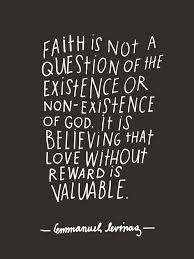
From Emmanuel Levinas, a 20th century French Hassidic philosopher. Good, no?


POET — COACH — GROUP PROCESS FACILITATOR
From Emmanuel Levinas, a 20th century French Hassidic philosopher. Good, no?
My son Isaac is being raised in the LDS tradition. The Mormons. It is a tradition that I practiced for 25 years. I carry with me much good from those many years.
Part of that tradition for young people his age, now 18, is serving a two year mission. Those two years do not include trips home. No Christmas returns. No summer breaks. They include proselyting, teaching, building relationships, community service, and a lot of learning.
Missions are treated as callings. Isaac, like others his age submit papers to go. It involves several interviews with ecclesiastical leaders. You don’t chose where you go. You are assigned, which is both exciting and a bit nerve-wracking. It could be almost anywhere in the world and often involves learning a language.
Opening the mission call is a significant moment. It is a letter and informational packet that includes most importantly, the naming of the geographic area in which you serve, the language you will speak, and the date when you will start. Among many friends cheering him on, last night Isaac opened his packet. He will serve in the Seattle Washington mission.
You can imagine that there is much speculation about where one goes prior to opening the call. This was true for Isaac. I was impressed by the way he let others do this, but for himself, just held back.
There is an important principle in this location assignment that I felt reiterated last night in my own thinking. Of course it is interesting and important where you go. Seattle is a great place, and a city that I spend a fair amount of time in (yes, there is irony in that). But more importantly, is what you do with where you go. There will be much good to find, everywhere.
This journey into Mormon culture, and in particular the invocation to make something of wherever you go, connects with another principle that guides me in organizational work. Start anywhere. Follow it everywhere. It was my friend and colleague Myron Rogers that I first remember saying that. It means there are many good places to start. You do well to pay attention to what arises after starting. The steps that become clear by walking.
I’m proud of my son. It takes significant effort and commitment to begin such an adventure. I hope he too gets the spirit, the abundance, and the naturalness, of what you do with where you go.
A friend sent this website to me, The Rules, as a truth telling website. It includes this video, a good piece on capitalism as a story, that can, and is being challenged.
I am flying at 35,000 feet, on my way to Des Moines, Iowa. The clouds below are spotted through the sky casting shadows on the midwest farmlands below. If I looked for long enough, or from a higher altitude than this plane will reach, I suspect I could see patterns in the clouds. The seemingly random has order.
Nature is ordered. Living systems organize themselves. This has been a primary framework for me since the early 1990s working with Margaret Wheatley. This is one of the concepts I hope to explore with a team that I’m meeting today for the first time face to face. It is a group of eleven from the Grinnell United Church of Christ.
They are “Strategic Discernment Stewards,” brought together for what is a six month strategy creation process through participative leadership. They are the group that will get the first wave of how we work together so as to help support the second wave which will take place this fall with a larger group of people. The stewards are the group that will also reconvene after the fall event to help share learnings and support a participative culture of accomplishment.
I’m reminded by Meg and coauthor, Myron Kellner-Rogers in their book, A Simpler Way,
“There is a simpler way to organize human endeavor. It requires a new way of being in the world. It requires being in the world without fear. Being in the world with play and creativity. Seeking after what’s possible. Being willing to learn to be surprised.
This simpler way to organize human endeavor requires a belief that the world is inherently orderly. The world seeks organization. It does not need us humans to organize it.
The simpler way summons forth what is best about us. It asks us to understand human nature differently, more optimistically. It identifies us as creative. It acknowledges that we seek after meaning. It asks us to be less serious, yet more purposeful, about our work and our lives. It does not separate play from the nature of being.”
 asd
asd
Gifts of Circle is 30 short essays divided into 4 sections: 1) Circle's Bigger Purpose, 2) Circle's Practice, 3) Circle's First Requirements, and 4) Circle's Possibility for Men. From the Introduction: "Circle is what I turn to in the most comprehensive stories I know -- the stories of human beings trying to be kind and aware together, trying to make a difference in varied causes for which we need to go well together. Circle is also what I turn to in the most immediate needs that live right in front of me and in front of most of us -- sharing dreams and difficulties, exploring conflicts and coherences. Circle is what I turn to. Circle is what turns us to each other."
Question Cards is an accompanying tool to Gifts of Circle. Each card (34) offers a quote from the corresponding chapter in the book, followed by sample questions to grow your Circle hosting skills and to create connection, courage, and compassionate action among groups you host in Circle.
This will close in 60 seconds

asd
In My Nature is a collection of 10 poems. From A Note of Beginning: "This collection of poems arises from the many conversations I've been having about nature. Nature as guide. Nature as wild. Nature as organized. I remain a human being that so appreciates a curious nature in people. That so appreciates questions that pick fruit from inner being, that gather insights and intuitions to a basket, and then brings the to table to be enjoyed and shared over the next week."
This set of Note Cards (8 cards + envelopes) quotes a few favorite passages from poems in In My Nature. I offer them as inspiration. And leave room for you to write personal notes.
This will close in 60 seconds
 asd
asd
Most Mornings is a collection of 37 poems. I loved writing them. From the introduction: "This collection of poems comes from some of my sense-making that so often happens in the morning, nurtured by overnight sleep. The poems sample practices. They sample learnings. They sample insights and discoveries. They sample dilemmas and concerns."
This set of Note Cards (8 cards + envelopes) quotes a few favorite passages from poems in Most Mornings. I offer them as inspiration. And leave room for you to write personal notes.
This will close in 60 seconds