A friend tells me of being on a weekend vacation with extended family. He is in his fifties, like me. His extended family includes his parents, his kids, four or five siblings with their spouses. Lots of nieces and nephews. “How was it?” I ask. “Mostly good,” he tells me. Then he shares the challenge he saw of getting everyone on the same page. “Everyone wants to do something. Everyone prefers to do it together. It’s impossible for everybody to agree on anything. We end up paralyzed. We end up frustrated. It happens this way all of the time.” He laughs when he tells me. The truth is often funny.
Chances are you have found yourself in a large group a time or two that, like my friend’s extended family, struggles to move together. A working team can’t agree on an approach. Your kids can’t agree on how to spend some weekend time together. A community event planning committee becomes separated in their differences. I believe the struggle in each of these is for enough unifying coherence among many people. The struggle comes from a natural value of shared experience. Belonging. I also believe the struggle is from misunderstanding of what moves a complex system.
Now, granted, my friend’s family, like mine, might be more complicated than complex (in the spirit of Dave Snowden’s distinctions). But I relate to the kind of frustration my friend shared. I don’t believe that movement in complex systems comes from everybody being on board for everything. It’s a nice platitude to “have all of our ducks in a row.” But everyone doesn’t do everything. And further, it isn’t endless debate for the perfect solution that moves people.
I believe, rather, that movement comes from offerings. “My kids and I are going bowling. Anyone who wants to join us is welcome.” “I am going for a hike. Anyone who wants to join me is welcome.” “I would like to focus on the invitation to our community event. I like doing that. Join me if you like.” There is an “all on board” quality to these statements. It just isn’t imposed upon the all-in shared activity. It is in the assumption that if all are doing what they want, with invitation for others to join, movement among many people happens. Stuff gets done. Contributions are made. People feel satisfied. The offerings hold the energy.
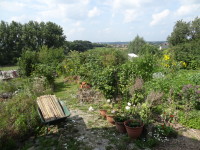 This summer I learned this principle with friends who live in Belgium. Me, my spouse, and her two kids were staying with these friends for a couple of days of our holiday. Our friends are developing what might become a retreat center and property. It involves restoring an old home, the farm building attached to it, and practicing permaculture on the land. Our friends have an operating principle for themselves and guests. “Do only what you have appetite for.” They mean it. They live it. This applied to choice of social experience, to when and how late to sleep. It applied to working in their gardens and home. There was a freedom in this that I loved. And, even better, a living example of people who were willing to challenge a principle of how movement happens in complex systems. They trust and support impulse and offerings. There is not need for imposition or obligation.
Open Space Technology (OST) is another way that has helped me to see this principle of movement in complex systems. In OST self-organized working groups convene based on passion (appetite) and invitation (offering). It is not an imposed agenda to get everybody doing the same thing. It is a shared overarching intention under which anyone is welcome to convene a conversation or working group. When people are invited to name and host what is important to them, it is my experience that people are energized. People offer themselves because they have appetite. Offerings help the system to evolve, or even emerge into a next version of itself.
There is more for this topic. More to explore. But these will be for another day or another conversation. Or another extended family weekend.