

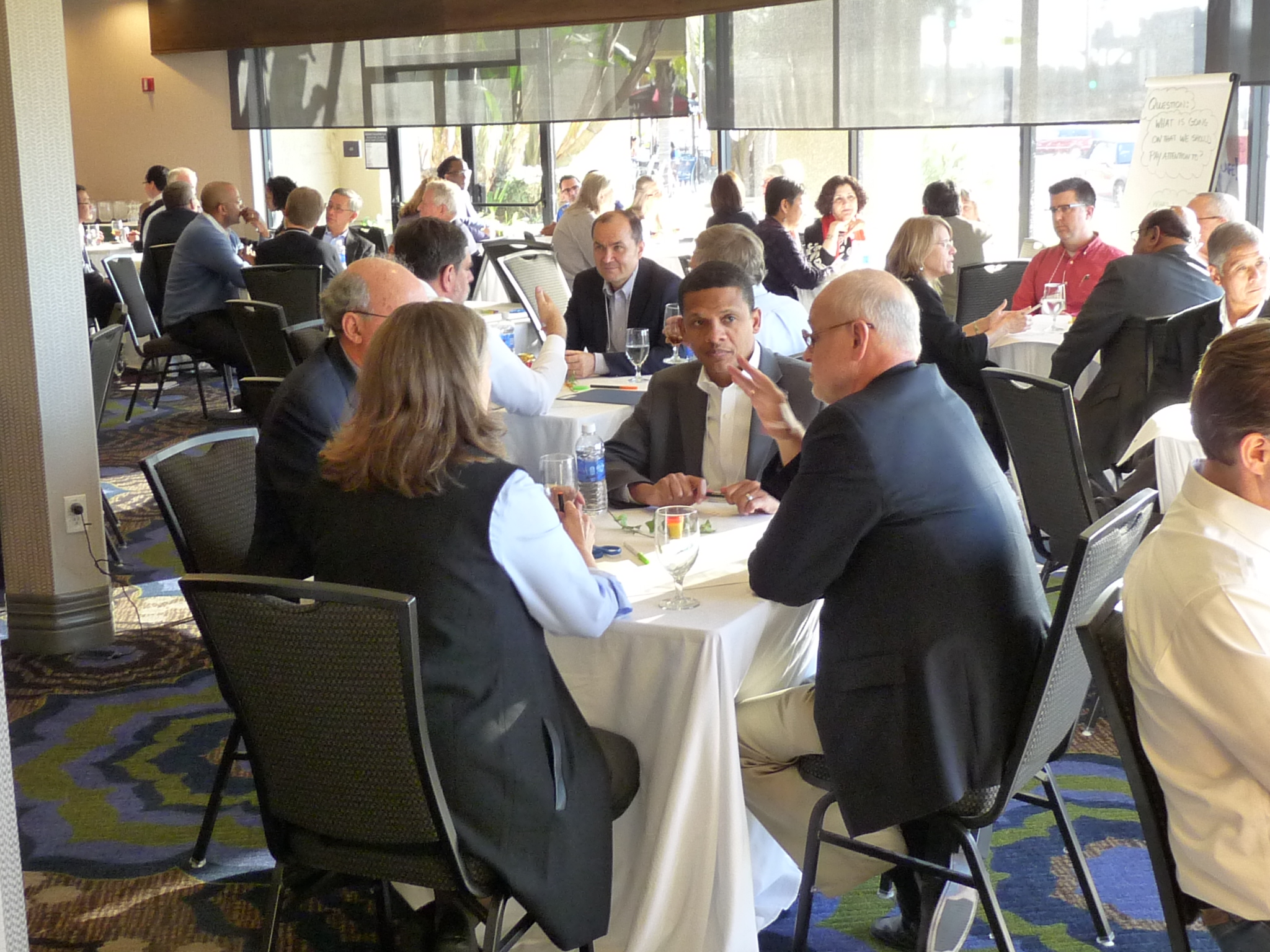
 I admit that I don’t always know how dialogue processes land in a group. I want them to go well, of course. I want people to feel engaged. Both in relationship and in a kind of access to stories and information that they don’t have by themselves. I want there to be several ahas! It’s just hard to tell sometimes, when I am hosting the process and not able participating directly in the table conversations.
At a recent consultation that I co-hosted with my partner, Teresa Posakony, and Rev. Myron Wingfield, Associate General Secretary of the General Board of Higher Education for the United Methodist Church, I had this feeling. What was happening in the room? Were they learning? Were they getting beyond a “nice” interaction together? Could they relax themselves into a participative format together, trusting that it would help?
These post event reflections from President Lalleen Rector, President of Garrett Evangelical Theological Seminary helped reality check this for me. I love the words, who they came from, and the context they set for ongoing patterns of dialogue. The first paragraphs of Lalleen’s reflections are below. The full post is here on The President’s Blog on the Garrett website.
I have just returned from a consultation in San Diego on theological education hosted by the United Methodist General Board of Higher Education and Ministry. About 50 persons were invited representing an array of constituencies inside and outside United Methodism: bishops, faculty, pastors, GBHEM staff, deans and presidents of seminaries and divinity schools, leaders of other denominations and related institutions.
Our meeting format was led by two consultants committed to a “living systems” approach in which much care was given to being present, to checking in about how we had arrived, to what we were being called and invited into, to the concerns we brought, to deep listening to ourselves and others, to an incredible trust in process, and to the power of dialogue that would move us to meaningfully consider action. No doubt some wondered about whether or not such a process could eventuate into anything but more talk that goes nowhere. To be honest, at this moment it is too soon to know what will come of our investment.
It was a challenge to be present in the midst of the busyness that surrounds our lives and that feels so demanding. However, I was committed to do so believing that conversation and dialogue are the basis upon which we begin to understand each other and at the heart of which lies something sacred. Such dialogue at times requires courage and perseverance and it is easier to turn away from than to engage. But perhaps it is the best hope we have for dealing with difference and for finding ways to truly collaborate toward a common good bigger than any of our personal or institutional agendas. I left the consultation reminded of a conviction I experienced at 12, i.e., that the process of listening, really listening, and of being listened to has transformative impact and embodies what I can now name as an incarnation of God’s grace among us.
There is a power in open dialogue. I’m grateful to people like Lalleen, Myron, and others present at this consultation that hold steady in such a narrative that transforms who we are and what we do together.
 In the morning, I typically spend a bit of time in meditation. Twenty minutes. Preferably sitting with my legs crossed (I don’t know why this really matters, but my meditations are better when I do this). Preferably with my back well supported. I set a timer. With my hands folded on my lap, I begin to breath. I try to make my breaths as long and slow as possible (again, I don’t really know why, but it just feels right). Often, I count slowly on the in-breath and on the out-breath. 1…2…3…4…5…6. A slow count. One per second, it feels like. Then a pause. Then on the out-breath, 1…2…3…4…5…6, and another pause. Once I get started, my counts tend to grow. Up to 12 or so. It is close to two breaths per minute when going really well.


