

A Thousand Mornings – Mary Oliver

Lately I’ve been reading more of Mary Oliver’s poems. She is one of my favorites in the way that she touches the simple of the natural world, which includes the natural world of the human spirit, through words and images. These particular readings come from the publication, A Thousand Mornings, named above.

Here are some that have meant the most to me:

Her quoting of Bob Dylan,

“Anything worth thinking about is worth singing about.”

Her poem, Three Things to Remember

As long as you’re dancing, you can break the rules.
Sometimes breaking the rules is just extending the rules.
Sometimes there are no rules.

This gem on stillness, called Today

Today I’m flying low and I’m
not saying a word.
I’m letting all the voodoos of ambition sleep.

The world goes on as it must,
the bees in the garden rumbling a little,
the fish leaping, the gnats getting eaten.
And so forth.

But I’m taking the day off.
Quiet as a feather.
I hardly move though really I’m traveling
a terrific distance.

Stillness. One of the doors
into the temple.

And this last one, on the beauty of questions, from The Man Who Has Many Answers.

The man who has many answers
is often found
in the theaters of information
where he offers, graciously,
his deep findings.

While the man who has only questions,
to comfort himself, makes music.

This publication itself is beautiful. A book that feels good to hold and share.
The Artistry of Change

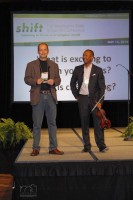
Tenneson, QuintonLast week I was able to be part of an opening for the Washington State Nonprofit Conference, Shift: Learning to Thrive in a Complex World. This was the 20th annual version of this conference. Alison McCaffree, Executive Director for Washington Nonprofits, put a lot of good thought into organizing this conference and it’s tracks on Paradigm Shift, Narrative Shift, Shape Shift, and Shift Change. I love it that she wanted to have many formats for learning at this large conference — I’m told there were 450 participants this year. I was happy to be part of imagining some of those options with her, along with my partner Teresa Posakony, early in the planning process, particularly about reshaping the large conference design..

My role was in the first session, joining Quinton Morris a concert violinist, chamber musician, and Assistant Professor of Chamber and Instrumental Music at Seattle University. Really good guy. I enjoyed meeting him, playfully bantering together. He played music of his choice, show tunes for this 8:00 start. I interviewed him on themes of shift, what he loves about his music, and how artistry is needed in leadership and change work. I found it to be playful and helpful.

I then had the role of, what I would call, activating the participants. It was a simple set up about the importance of turning to one another. It was also a set up for more engaged learning during the day. I had them turn to each other in partner conversations with these questions (different partner on each one):

  • How are you arriving today? (A simple question to get them started by sharing some of their inner condition, whether it was frazzled by traffic, or excited for the day.)
  • In what way is artistry important in your work? (Building on the theme to help draw attention to artistry, creativity, and the spirit of innovation.)
  • What is exciting to you in your shifts? What is challenging? (Some attention to where there is natural energy, and, to witnessing what are real challenges for them, rather than having those buried and unspeakable.)
  • In one phrase, what is the primary shift that you are giving attention to? Why? (We harvested this on post-it notes and based on the tracks that Alison had created. Steven Wright had made for large maps of the state on which participants could place these post-it notes — one for each track. We later categorized similar shifts together.)
  • What is one intention you have today to support you in your learning? (This was about an intention for the day, not for the broader picture of their work. I had them write this on their name tags so that it was visible and a could be a point of curiosity among participants later in the day.)

Glad to have been part of this event, and in particular this theme, the artistry of change. Activating the group, is part of that artistry for me.

A writeup from a participant, Jeni Craswell, Director of Philanthropy with Imagine Housing is here.


Acedia

I learned a new word recently from reading my friend Charles LaFond’s book, Fearless Church Fundraising: The Practical and Spiritual Approach to Stewardship. The word is “acedia,” a kind of boredom that has much to do with all forms of organization. Charles is very thoughtful. I find his views on stewardship of many kinds to be very helpful — check his blog here.

Acedia or spiritual boredom is a strong poison that can sicken the most thoughtful stewardship program. Acedia is a technical term in Christian spirituality, and it signifies joylessness, weariness, boredom, listlessness and, at its worst, a spiritual depression which clouds the mind and dulls the heart.

Sounding like a fair description of an epidemic in many organizations yet?

With acedia, nothing is “bad” — exactly — it is just that nothings seems good either…. The danger of acedia is that it is so like depression that you may not know you have it. Like alcoholism, the more drunk you are, the less likely you are to realize you are drunk. Similarly, the more spiritually depressed you are, the less likely you are to see the depression.

Acedia results in a dull pain, not a sharp one. The person, family, group or organization suffering from acedia will simply become immune to the blessings around them. For a person with acedia, the sun is too bright, the water is too wet, the day is too long, the hours are passing too slowly, and the apple is never sweet enough. It is the spiritual equivalent to riding in beautiful farmland with a blindfold on.

It is the dull pain, the numbed quality that stands out to me here. I meet so many people — brilliant people — that are in pain and a bit numbed in their organizational contexts. It is my experience that many of us come alive when invited to be more real, more engaged with each other.

Fearless. Practical. Spiritual. This combination of energies matter pretty much everywhere I go these days.

Thanks Charles.


Tweets of the Weeks

Gifts of Circle - Question Cardsasd
Gifts of Circle is 30 short essays divided into 4 sections: 1) Circle's Bigger Purpose, 2) Circle's Practice, 3) Circle's First Requirements, and 4) Circle's Possibility for Men. From the Introduction: "Circle is what I turn to in the most comprehensive stories I know -- the stories of human beings trying to be kind and aware together, trying to make a difference in varied causes for which we need to go well together. Circle is also what I turn to in the most immediate needs that live right in front of me and in front of most of us -- sharing dreams and difficulties, exploring conflicts and coherences. Circle is what I turn to. Circle is what turns us to each other."

Question Cards is an accompanying tool to Gifts of Circle. Each card (34) offers a quote from the corresponding chapter in the book, followed by sample questions to grow your Circle hosting skills and to create connection, courage, and compassionate action among groups you host in Circle.

This will close in 60 seconds

asd
In My Nature
is a collection of 10 poems. From A Note of Beginning: "This collection of poems arises from the many conversations I've been having about nature. Nature as guide. Nature as wild. Nature as organized. I remain a human being that so appreciates a curious nature in people. That so appreciates questions that pick fruit from inner being, that gather insights and intuitions to a basket, and then brings the to table to be enjoyed and shared over the next week."

This set of Note Cards (8 cards + envelopes)  quotes a few favorite passages from poems in In My Nature. I offer them as inspiration. And leave room for you to write personal notes.

This will close in 60 seconds

asd
Most Mornings is a collection of 37 poems. I loved writing them. From the introduction: "This collection of poems comes from some of my sense-making that so often happens in the morning, nurtured by overnight sleep. The poems sample practices. They sample learnings. They sample insights and discoveries. They sample dilemmas and concerns."

This set of Note Cards (8 cards + envelopes)  quotes a few favorite passages from poems in Most Mornings. I offer them as inspiration. And leave room for you to write personal notes.

This will close in 60 seconds