First, thx Molly Baskette for writing this piece as a Daily Devotional for the United Church of Christ. Molly calls it Chris in the Chaos. It’s all appealing to me. But Molly’s story of Xmas tree messery stood out. “It’s all right. It’s just a mess.”
Second, there’s some timely medicine for me in the message. And for a mess of a yesterday conversation that snuck up and on me. I’ve had a hard time sorting it. The mess isn’t actually the conversation. It’s the stuff that has been collecting dust in the cupboards for years — there’s the mess. I needed the lightness for my circumstance, told through a child. “It’s all right. It’s just a mess.”
Third, I’m so delighted by my closer-in colleagues. Today, one reached to me, affirming my invitation to participate in a Wisdom Council. It was such clarity and commitment. Didn’t surprise me. Just delighted me, again. I wrote email to her, thanking her.
On we go. Moving hearts. Saying yes. Being beloved and receiving beloved.
These little phrases shape a simple story. As I sip morning coffee. As I journal. Welcoming inspiration to guide the day, the meetings, the messes. And of course the delights found in the messes.
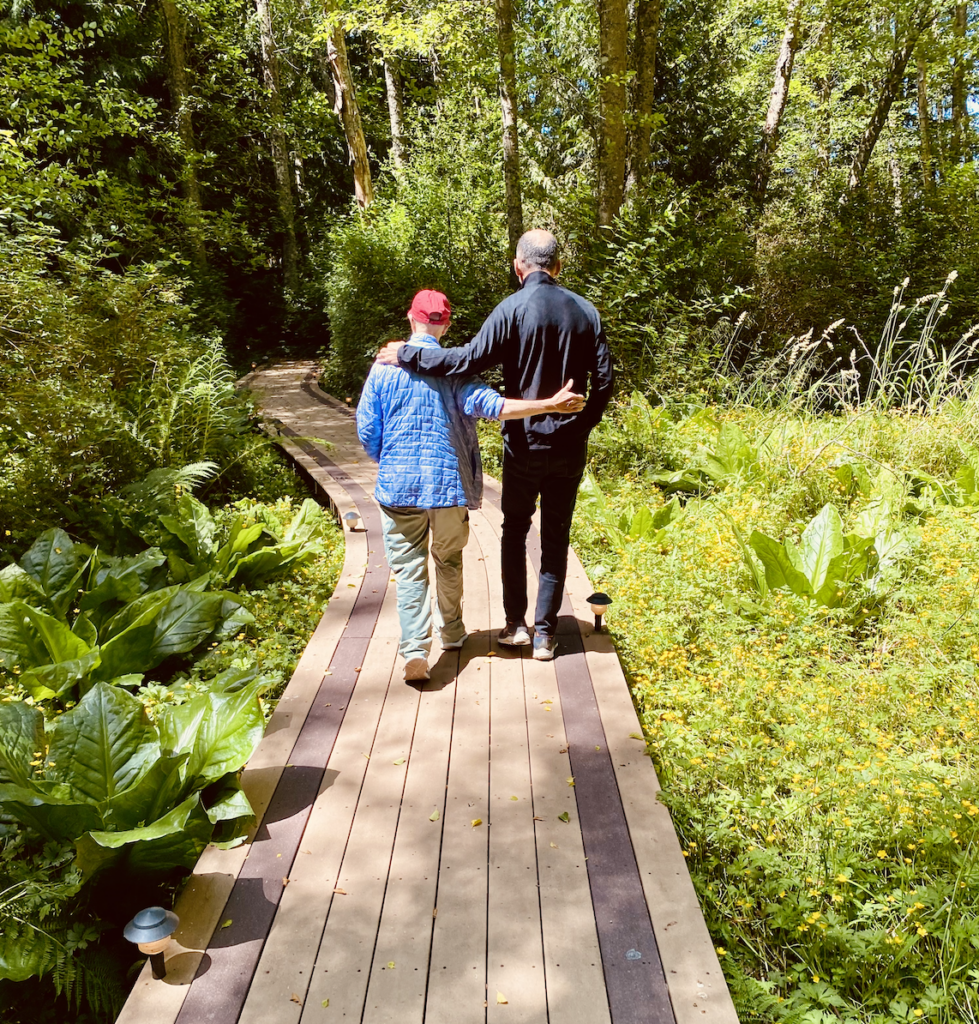
That’s me walking with my Pal Sarah. It was this summer on Whidbey, back at Aldermarsh. Thx Roq for catching the picture. I texted this photo to Sarah recently, and commented on how good friendships are so often walking each other home. She smiled back through text and affirmed.
So it is.
A couple weeks ago at NGLI (United Church of Christ’s Next Generation Leadership Initiative), the 4th year cohort lead closing worship. This is the group that I and Travis Winkler were able to teach and guide in 2024’s gathering. Their theme for Worship was “Belonging” and included this text from M Jade Kaiser.
I love it for all that it points to. I love it for what it affirms in the great walk of home.
To become is a life long process. Nothing is constant, not even the self. We evolve in the midst of narratives meant only for some and ways of being made narrow by fear and power. We must, then, have the courage to listen to the truth of our own lives, to the wisdom that comes from within – responding without resistance or need to control, but with welcome and curiosity. This is what ensures our becoming is an unfolding of our truest self.
This lifelong labor cannot be carried out alone. It requires help from friends, and lovers, family, and creaturely companions who bear witness to what makes us come alive. And say to us, “Listen. Look. Feel. Pay attention to that.”
Telling the stories. Sharing in the memories. Giving thanks for the relationships, understandings, and experiences past that have shaped us to this day.
Celebrating new beginnings that excite. Holding risks together. Leaning into unknowns with the promises of support and companionship.
Listening to the future calling uniquely to each of us in the midst of all of life’s noise. Helping one another find our place in the shared labor of collective life. Supporting each other in what it is the world’s ache is asking from us.
To say, for the first time, “This is who I am. This is the truth of my body. This is what I know about myself. This is my name and this is where my path is leading me.” And to have it heard. Have it received. Have it affirmed. And then, to say it again, and again, as we change and as the world changes, and to have each proclamation greeted with an open-armed embrace:
There is no me without you. We shape one another. The Sacred that birthed us weaves our lives together so that we can only find ourselves through shared becoming. For my journey and all its winding ways. For yours. For all the saints who labored for what is, all the kin whose lives made ours possible. For all those yet to come for whom living our truths today will mean breaking possibilities open for them tomorrow: We pause. We give thanks. We acknowledge.
Berkana is where I was formed for my adult working life. In values. In friendships. In experience. That’s Meg, Myron in the early 1990s. That’s Bob, Christina, Ann, Toke, Bonnie, Carol, Dave, and so many others in the late 1990s to early 2000s.
Berkana’s name comes from the Norse Runes, a symbol for growth and rebirth, flow into new forms.
I was looking through a few old folders recently. I found a one-page form that listed Berkana’s values.
We relay on human goodness.
We depend on diversity.
We treasure the power of community.
We trust life’s capacity to create order without control.
We nourish our relationships and ourselves.
These values are still in my heart (and facilitation, and writing, and creating of programs). And so are the friendships — brunch with Meg coming next weekend.
What a treat to reboot my Human 2 Human Podcast. It’s conversations with people that A) I find really interesting, and B) that have so much story and learning and questions to contribute.
Enjoy the listen, 30 minutes. We touch upon healing, ascent, mountain climbs, descent, Carl Jung, bridges (inner and organizational), presence, becoming curious, myths, fears, karaoke, certainty, taking responsibility, dance. And, and.
And on the Spotify platform. Experimenting.
Gifts of Circle
asd Gifts of Circle is 30 short essays divided into 4 sections: 1) Circle's Bigger Purpose, 2) Circle's Practice, 3) Circle's First Requirements, and 4) Circle's Possibility for Men. From the Introduction: "Circle is what I turn to in the most comprehensive stories I know -- the stories of human beings trying to be kind and aware together, trying to make a difference in varied causes for which we need to go well together. Circle is also what I turn to in the most immediate needs that live right in front of me and in front of most of us -- sharing dreams and difficulties, exploring conflicts and coherences. Circle is what I turn to. Circle is what turns us to each other."
Question Cards is an accompanying tool to Gifts of Circle. Each card (34) offers a quote from the corresponding chapter in the book, followed by sample questions to grow your Circle hosting skills and to create connection, courage, and compassionate action among groups you host in Circle.
This will close in 60 seconds
In My Nature
asd
In My Nature is a collection of 10 poems. From A Note of Beginning: "This collection of poems arises from the many conversations I've been having about nature. Nature as guide. Nature as wild. Nature as organized. I remain a human being that so appreciates a curious nature in people. That so appreciates questions that pick fruit from inner being, that gather insights and intuitions to a basket, and then brings the to table to be enjoyed and shared over the next week."
This set of Note Cards (8 cards + envelopes) quotes a few favorite passages from poems in In My Nature. I offer them as inspiration. And leave room for you to write personal notes.
This will close in 60 seconds
Most Mornings + Note Cards
asd Most Mornings is a collection of 37 poems. I loved writing them. From the introduction: "This collection of poems comes from some of my sense-making that so often happens in the morning, nurtured by overnight sleep. The poems sample practices. They sample learnings. They sample insights and discoveries. They sample dilemmas and concerns."
This set of Note Cards (8 cards + envelopes) quotes a few favorite passages from poems in Most Mornings. I offer them as inspiration. And leave room for you to write personal notes.