

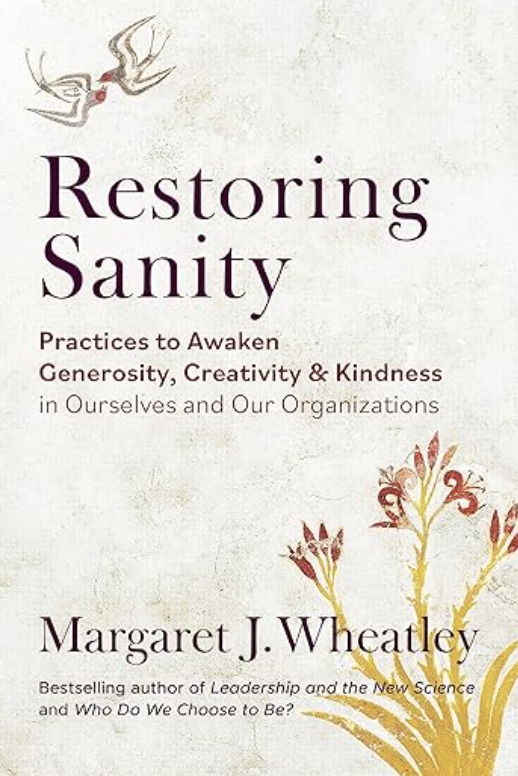
Restoring Sanity — Margaret Wheatley

What a treat to listen in to Meg Wheatley yesterday. She offered a zoom session — 300 ish people in the one I joined — to share some context for her new book that is available March 19th. Have a peek. Have a purchase.

Meg is one of my oldest friends. She’s been a mentor, a guide. She’s been a sushi-buddy. She’s been a fellow lamenter and a fellow celebrator. She’s been a boss, a colleague, a spiritual guide. She been someone to have tea with regularly.

I loved what she shared in yesterday’s call. Her awareness of her approach in her early days of consulting — “What is the problem? Let me fix it for you.” That evolving to an orientation she has now held for years that I relate to as the center of my work — “What is possible? Who cares?”

Meg highlights practices. Facing reality. Creating consciously committed community — islands of sanity — that awaken generosity together. And kindness. And joy.

Meg’s voice has been important to a lot of people. Definitely true for me over these years. Glad to celebrate her 12th book.
Remember These Three Things

When I facilitate groups, I remember that there is always a story under the story. It’s a purpose story. It’s a simplicity story. It may not be an explicit description of the event or gathering, but it is often the anchoring story that I depend on.

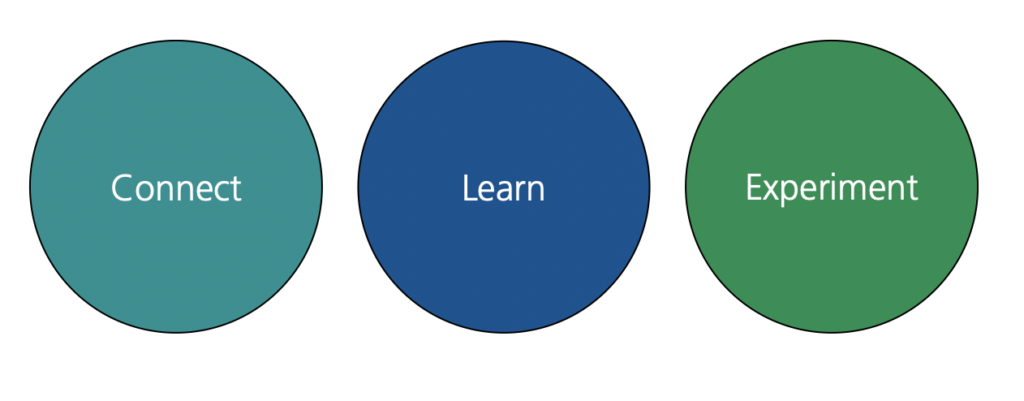
  1. Connect — I often name this as our first steps together. To connect the people in the room. To help them show up with one another. After some context-setting introduction, often this first connection for me is a series of short partner conversations (speed dates). 2-3 minutes with 4-5 different partners can do wonders to begin a pattern of connection that can then amplify to more connections over the longer length of time together.

    As my friend Meg taught early, “if you want a system to be healthy, connect it to more of itself.”

    Works with groups.
    as
  2. Learn — This is what arises out of our connection. Learning that can be so much more fulfilling. So much more productive. So much more integrated. When relationship is established and activated, then more rich, honest, and timely learning can take place. Often for me this is a World Cafe format. Again, there is much wonder in small group conversations that invite learning, noticing, wondering.

    Further from Meg, again learned early, “who we are together is different and more than who we are alone.”

    It goes for learning in groups too — what we learn together is different and more than what we learn alone.
    as
  3. Experiment — From such connection and such learning, well, these are primary conditions for more meaningful experiments together. Sometimes as simple as a long overdue, needed conversation. Sometimes a question engaged together. Sometimes a project imagined or refreshed in purpose. I rely on Open Space Technology as a format for this. It’s powerful to have participants name the topics they wish to explore and then self-select to groups in which they wish to contribute.

    One more time from Meg that she attributes learning to her mentor Marvin Weisbord, “What is possible here? And who cares?”

    What a potent thing to restore a group commitment to experiment.

***

Connect. Learn. Experiment.

I love working with groups in such simple story. The specific format for such can, and should, vary for unique circumstances and group composition. But this story — these three things to remember — I find this sticks so often. It invites people into attention and memory, and well, joy, of what matters most to so many human beings.

Interested? Let’s connect (and learn, and experiment).

Shades of Life — The Visible and the Invisible

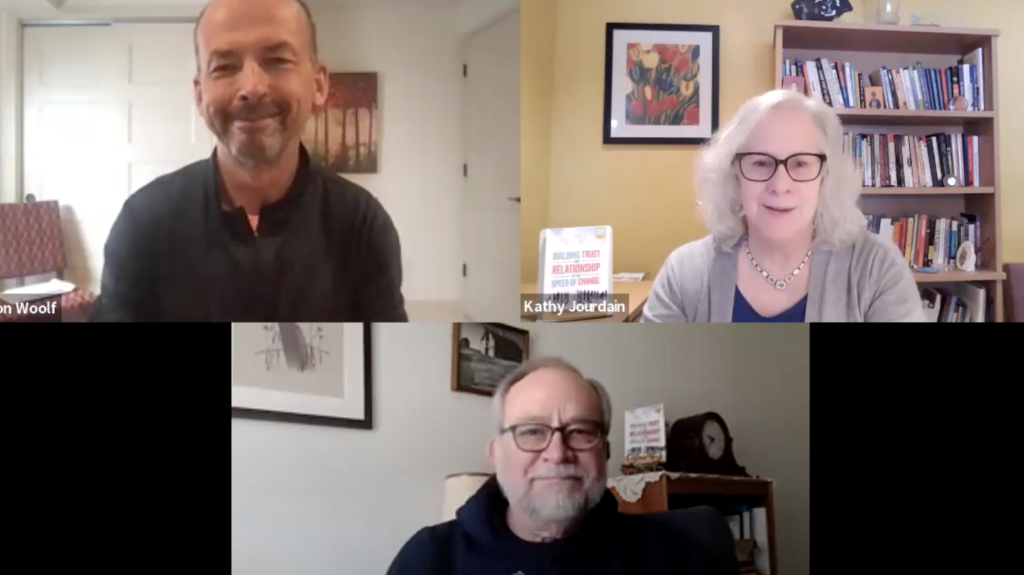
We call it Shades of Life. Jerry Nagel, Kathy Jourdain and I decided to give ourselves impromptu themes to explore together. We do it for learning. And friendship. And some freedom to wonder. We do it, I think, to feed each other and to feed the learning that we wish in our work.

It’s 38 minutes. Enjoy a listen. Share as inspired. Reach back too.

Grateful for such people in my life that bring out learning, love, love of learning, and learning of love.

Responsibility to Wonder, Connect

My Sweetheart’s Father was a pediatric cardiologist. This morning I was peeking at one of his articles, published in the 1965 Journal of Pediatrics.

Dr. Martin Riesman was a pioneer in his field. In this particular article he begins to explore the links between childhood lifestyle and adult heart disease.

The article is interesting to me, mostly because it is an exploring article. And in particular, his opening line:

“The speculations contained herein represent the author’s personal groping in an incompletely charted field of possible pediatric responsibility.”

So much that I love in that — from my field of group process facilitation.

“…personal groping…” is an acknowledgement of the importance of wonder. It speaks to the need to connect ideas. It speaks to the need to dream conclusions that others haven’t.

“…incompletely charted field...” is an acknowledgement of mystery. It speaks to the parts that aren’t all figured out, that call for our continued curiosity.

“…possible pediatric responsibility...” is an acknowledgment of accountability and invitation. It speaks to the baked in job responsibility — I would suggest for all of us in so many professions — to wonder and participate and learn in the mystery.

It’s delicious framing for working with groups. Wonder. Mystery. Learn.

A bow for this 1965 sharing. It was fun to follow the thread this morning.

Gifts of Circle - Question Cardsasd
Gifts of Circle is 30 short essays divided into 4 sections: 1) Circle's Bigger Purpose, 2) Circle's Practice, 3) Circle's First Requirements, and 4) Circle's Possibility for Men. From the Introduction: "Circle is what I turn to in the most comprehensive stories I know -- the stories of human beings trying to be kind and aware together, trying to make a difference in varied causes for which we need to go well together. Circle is also what I turn to in the most immediate needs that live right in front of me and in front of most of us -- sharing dreams and difficulties, exploring conflicts and coherences. Circle is what I turn to. Circle is what turns us to each other."

Question Cards is an accompanying tool to Gifts of Circle. Each card (34) offers a quote from the corresponding chapter in the book, followed by sample questions to grow your Circle hosting skills and to create connection, courage, and compassionate action among groups you host in Circle.

This will close in 60 seconds

asd
In My Nature
is a collection of 10 poems. From A Note of Beginning: "This collection of poems arises from the many conversations I've been having about nature. Nature as guide. Nature as wild. Nature as organized. I remain a human being that so appreciates a curious nature in people. That so appreciates questions that pick fruit from inner being, that gather insights and intuitions to a basket, and then brings the to table to be enjoyed and shared over the next week."

This set of Note Cards (8 cards + envelopes)  quotes a few favorite passages from poems in In My Nature. I offer them as inspiration. And leave room for you to write personal notes.

This will close in 60 seconds

asd
Most Mornings is a collection of 37 poems. I loved writing them. From the introduction: "This collection of poems comes from some of my sense-making that so often happens in the morning, nurtured by overnight sleep. The poems sample practices. They sample learnings. They sample insights and discoveries. They sample dilemmas and concerns."

This set of Note Cards (8 cards + envelopes)  quotes a few favorite passages from poems in Most Mornings. I offer them as inspiration. And leave room for you to write personal notes.

This will close in 60 seconds