Fine Arts First at Viterbo

I worked this week at Viterbo Campus in La Crosse, Wisconsin. The project was again focused on Arts Integration. There were 30 people — Viterbo Faculty, Students, Teachers, SchoFine Artsol and University Leadership, and Community Leaders. We were together for the three days, exploring together essential items to include in a second application for grant funding. I’ve written previously about this group here.

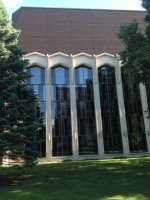
At the beginning of the week, I heard an interesting story that I haven’t heard before about the Fine Arts Building. You see, Viterbo is a small campus. It was started 125 years ago by the Franciscan Sisters of Perpetual Adoration, whose convent is through the courtyard and across the street. Forty years ago, there was only one other building on campus. The Sisters, with their commitment to the arts for the school and for the community, committed to supporting this building. I can imagine that there were several other choices. Perhaps a building to expand their commitment to education or to healthcare. They chose Fine Arts. I’m also told that the sisters ate from a food supply — canned potatoes, vegetables, etc — to help save for the building.

Rather impressive, no? I’m really impressed that in the context of prudence, practicality, and all the other pressures that may have been present, they chose to support the arts.

Harvest Tools

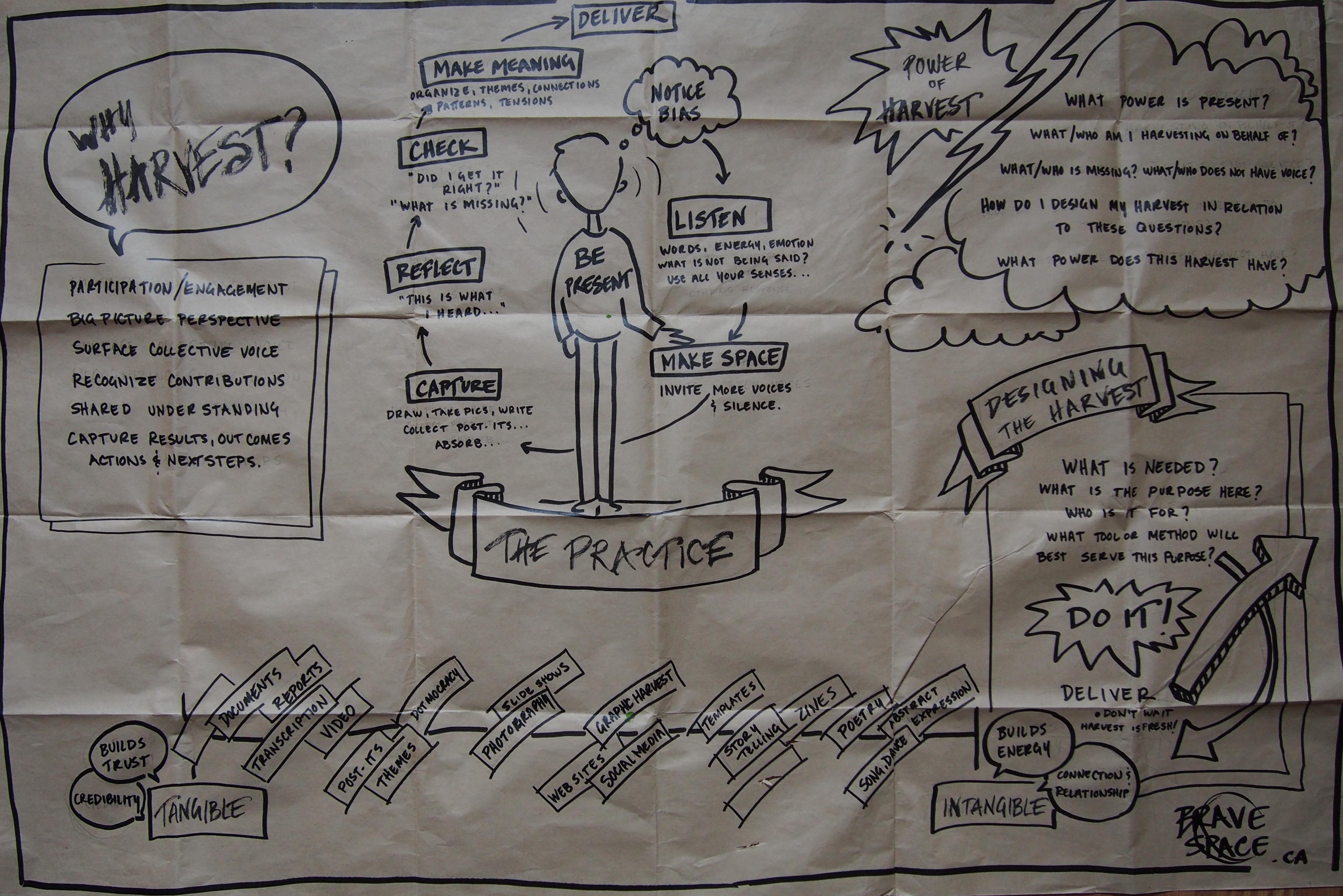
This collection of harvest tools was shared by Chris Corrigan. I love Chris’ commitment to harvesting, and to the principle, “We are not planning a meeting. We are planning a harvest.”

OLYMPUS DIGITAL CAMERA

The first is a map drawn by Marguerite Drescher, whom I just met last week. I love the visual of modes, principles, and purpose.

The second is a grid that shows some of the combinations possible. Some of the who, why, what, how, and distribution options. HARVEST GRID 0.2

The third is a document that names important questions to ask when planning a harvest and working with a harvest team. HarvestPlanQuestions

Thanks Chris.

The Circle Way

I consider The Circle Way to be a lineage. Often formerly referenced as PeerSpirit, The Circle Way features the work of two of my most respected colleagues, friends, and yes, mentors — Christina Baldwin and Ann Linnea. Since the 90s they have been telling a new story that is a reclaiming of an old story, bringing the listening tradition that is circle into contemporary use in all forms of organizations. As one who seeks for the simple foundation that holds up varied architectures, The Circle Way remains ever important to me. It is the first domain in which I suggest people practice, whether to act on deeply held dreams or on improvements to highly complex challenges.

My relationship with The Circle Way began in 1999. It was then that I met Ann and Christina in the context of a global conversational leadership initiative through my work with The Berkana Institute. Together with Ann and Christina, and Bob Stilger of New Stories, and Margaret Wheatley of Berkana, we were all exploring new territory together, connecting what we referenced as life-affirming leaders — people who cared about who humans are and how we could be together differently in service to issues that we most cared about. From far-reaching challenges of global warming to simple day to day desires for better meetings. Those efforts seeded friendships and commitments for me that have remained as strong today, 15 years later, as they were then. Our varied work runs like rivers to the same sea.

One level of my current relationship with The Circle Way is serving as a board member for The Calling the Circle Foundation. In the last year we have put together several videos that feature this work. You can find all of them here on the Foundation website. And for convenience, a few listed here:

The Circle Way Legacy (5 minutes) — Shares some of the founding story of The Circle Way, the journey of Ann and Christina, and the movement to the perspective, “A Leader in Every Chair.” Features a few reflections from Amanda Fenton on the role of guardian, Brit Hanson on needed fearlessness, myself on inviting deeper space, and Kristie McLean on needed sages.

Components of the Circle — Key points from Christina, Ann, and Sarah McDougal.
Part 1 (5 minutes), as they reflect on steps of Inviting, Hosting, Creating a Center, Agreements, and a starting Check-in.
Part 2 (3 minutes), reflections on Intention, Principles, and Practices.
Part 3 (4 minutes), guidance on Forms of Council, Use of a Talking Piece, The Role of Guardian, The Role of Scribe, and Check-out.

Celebration of the Circle Way in North America (4 minutes) — Some of the domains in which The Circle Way is being used, the video features Lisa Grotowski with student exchanges, Nancy Fritsche Eagan working with middle managers in New York City’s Department of Probation, Melissa and Scott Bailey-Kirk’s work with a faith community congregational council, Bethany Hayes working with health care and hospitals, and Brit Hanson, bringing together young people across difference.

One way to stay in touch, and contribute to the world wide practitioners of The Circle Way is through the Calling the Circle Foundation Facebook page. Explore it and Like it here.



Arts Integration

I’ve started a new project recently with some creative and visionary people from Viterbo University in La Crosse, Wisconsin. University leadership. University faculty from Arts Education and Generalist Education. Pre-service teachers. In-service teachers. Principals from an elementary school and a middle school. Community organizations. The central premise is that authentic arts experiences make better humans. That’s my interpretation.

Recently we gathered, about twenty of us, for 1.5 days as a kind of core team — people committed to the early purposing and grounding of what can be a multi-year effort to change lives through arts integration. Lives of students in the neighboring schools. Lives of all of the groups named above.

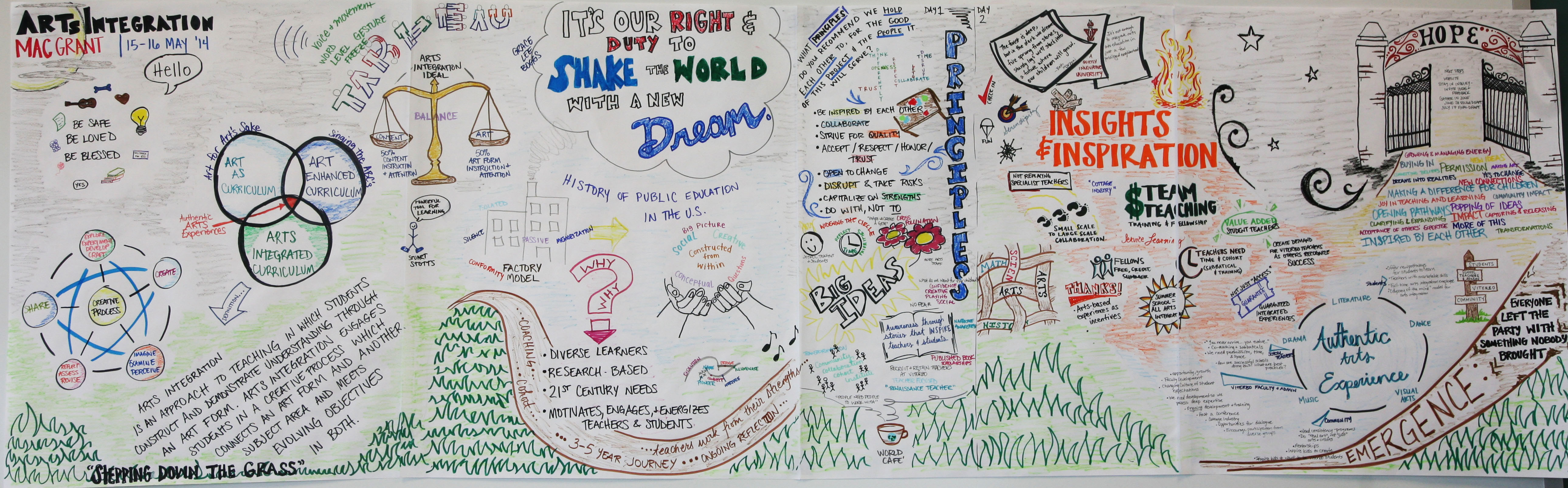
Gathering1_mapSarah Cook (Assistant Dean, Dahl School of Business) and Sami Weaver, two of our participants, created this graphic illustration of some of our content and process. Our first day together included attention on a starting context, hearing all participant voices on interest and importance, a framework on arts integration from Stuart Stotts, Kennedy Center Arts Integration Specialist, a framework for seeing how systems change, small table conversations on essential inclusions for our project, principles and agreements for the good of our project and the people it will serve, and witnessing our appreciations of this time together. Our second day together included attention on hearing all participant voices on their emerging energy for this work, clarifying our core narrative, exploring insights and inspirations from other national programs, stakeholder groups exploring essential beginnings, and some naming of next steps, which includes an expanded retreat in June.

There are several important resources that that this team has been adding too, that provide background information and recommendations. These resources name some of the scale that we in La Crosse are potentially involved in.

From PCAH, this publication, Reinvesting in Arts Education. The “better humans” part of this report includes these points on students who participate in the arts (compiled by Barb Gayle, Viterbo’s VP for Academic Affairs and Dean of Graduate Studies):
– are four times more likely to be recognized for academic achievement
– have higher GPA / SAT scores
– demonstrate a 56% improvement in spatial-temporal IQ scores
– show higher levels of math proficiency by grade 12
– are more engaged and cooperative with teachers and peers
– are more self-confident
– are better able to express their ideas

These are all provoking patterns, aren’t they. Particularly to me, as it seems that on federal and state levels, in times of crisis, complexity, and financial shortfall, budgets for the arts are among the first to go. With desire for essential innovation, we slash what creates the very conditions needed. Further in the report it is noted that high-poverty students are being disproportionately short-changed  on arts education opportunities in their schools.

We have started to catch some of this on a website, with values of transparency and openness.

Creative. Visionary. Arts Integration. All of these touch me deeply. And, I believe, change lives.

More to come.

Gifts of Circle - Question Cardsasd
Gifts of Circle is 30 short essays divided into 4 sections: 1) Circle's Bigger Purpose, 2) Circle's Practice, 3) Circle's First Requirements, and 4) Circle's Possibility for Men. From the Introduction: "Circle is what I turn to in the most comprehensive stories I know -- the stories of human beings trying to be kind and aware together, trying to make a difference in varied causes for which we need to go well together. Circle is also what I turn to in the most immediate needs that live right in front of me and in front of most of us -- sharing dreams and difficulties, exploring conflicts and coherences. Circle is what I turn to. Circle is what turns us to each other."

Question Cards is an accompanying tool to Gifts of Circle. Each card (34) offers a quote from the corresponding chapter in the book, followed by sample questions to grow your Circle hosting skills and to create connection, courage, and compassionate action among groups you host in Circle.

This will close in 60 seconds

asd
In My Nature
is a collection of 10 poems. From A Note of Beginning: "This collection of poems arises from the many conversations I've been having about nature. Nature as guide. Nature as wild. Nature as organized. I remain a human being that so appreciates a curious nature in people. That so appreciates questions that pick fruit from inner being, that gather insights and intuitions to a basket, and then brings the to table to be enjoyed and shared over the next week."

This set of Note Cards (8 cards + envelopes)  quotes a few favorite passages from poems in In My Nature. I offer them as inspiration. And leave room for you to write personal notes.

This will close in 60 seconds

asd
Most Mornings is a collection of 37 poems. I loved writing them. From the introduction: "This collection of poems comes from some of my sense-making that so often happens in the morning, nurtured by overnight sleep. The poems sample practices. They sample learnings. They sample insights and discoveries. They sample dilemmas and concerns."

This set of Note Cards (8 cards + envelopes)  quotes a few favorite passages from poems in Most Mornings. I offer them as inspiration. And leave room for you to write personal notes.

This will close in 60 seconds