Common Denominator

I’ve been thinking a lot about math lately. Oh, oh!

When I was a kid, I loved math. In Elementary School it was always my favorite subject. In part, because I was good at it. My family played a lot of cards which meant that I was often adding cards and numbers. A bunch of cribbage and friendly poker. In Junior High School I loved my math teacher, Mr. Mercer. He was the teacher that everyone thought was hard. Or weird. Again, I thrived to move beyond addition, subtraction, multiplication, and division into more involved algebra and geometry. Fun again. It was High School and University calculus that killed me. Math became not so much fun, but that’s when my life and life circumstances had me searching for more of an interior quality — psychology became my thing.

Remember the concept of “common denominator?” It’s a particularly important concept when adding fractions. The denominator is the number below the line in a fraction. It’s the number that identifies how many total parts there are. In “1/4” the four is the denominator, signaling that that whole is divided into four equal parts.

When adding fractions, an intermediary step is needed if the denominators don’t match. That step is to find a common denominator, and as I was taught, the lowest common denominator. “1/4” + “3/8” is an example. The lowest common denominator here is “8.” So to add the two with different denominators requires converting “1/4” into an expression of “eighths.” Multiply the denominator by 2 and then the numerator (the number above the line in the fraction) by the same. This gives you “2/8” which is equal numerically to “1/4.”

Yup, that’s math. So…

In this simple math, I’ve been remembering that there is always a common denominator. Not sometimes. Always. It may not seem so obvious as “1/4 + 3/8.” For example, “1/3” + “8/17” is a bit more complicated, but that common denominator is still there. In this case “3 x 17,” or “51.” Thus, the intermediary step so that these two fractions can talk to each other is to convert them to an expression with a denominator of “51.”

“1/3” is “17/51.”

“8/17” is “24/51.”

Add them together and you get “32/51.”

Enough math. On to psychology and, one of the domains that psychology lead me, to hosting participatory process and leadership.

My suggestion is that there is always a way to find a common denominator in people. Even when it seems like there is not. The common denominator is found in the interaction. It’s found by bringing two or more together. Even when it seems impossible. The common denominator is no longer a number. It becomes more of an energy of together. Of going together for a purpose.

I want to believe that in our utter humanness together, there is always common denominator. There is people who care about their community. There is respect for life. There is commitment to beauty. Or love. Or joy. Or play. Or excellence. Or imagination. Or creativity. The act of coming together helps us to find that. In respectful listening. In thoughtful sharing. In asking questions. In witnessing stories. In speaking honestly. In suspending certainty. In willingness to be surprised.

I’ve been thinking a lot, and hoping a lot, about math lately, and this simple awareness of common that feels very important to pay attention to.
 

Overnight News

This summer while working with Amanda Fenton over the course of three successive gatherings in three weeks of time, we developed a really helpful and easy rhythm of designing that included what we began to call, “Overnight News.”

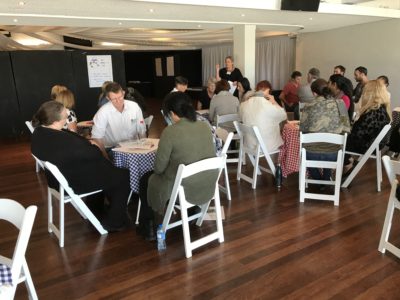
Amanda and I cohosted The Circle Way Practicum on Whidbey Island. Then a two-day workshop on The Circle Way in Brisbane, Australia for Uniting Care Community (seen above). Then another Circle Way Practicum in Australia’s Northern New South Wales.

Design for such events is never a formula. Though we work from an overarching template, there is always significant parts that are customized depending on who the participants are and how the gathering is unfolding. Often, a good chunk of that customizing comes from huddling in the evening, and then sleeping on the design, and then welcoming insights that have come over night when not thinking about it. Thus the “overnight news” naming.

We human beings are accustomed to trying pretty hard at things, aren’t we. Many of us have the upbringings that value a good work ethic, tenacity, and getting things done. It’s part of a larger culture that so values speed and efficiency. Even such good values and commitments can lead us astray from a different kind of entrance that challenges what my Mom used to tell me was “trying to hard.” I’d fret over things. Overthink things. Try so hard that I’d just befuddle myself. It was all super well-intended. However, what was missing in that was enough memory and trust that less focus can often lead to more clarity, and even swiftness.

With Amanda, it was such a nice rhythm. Get clear enough on what our design was for the next day. Then retreat to our respective sleeping spaces. Then huddle in the morning to share what settled, or what improvements we each woke with. Sometimes that meant changing the order slightly. Sometimes that meant removing a piece. Sometimes it meant something wholly new. Sometimes it meant a clear yes to go with what we had that came from a bit of rest. Each evening / morning we’d repeat this.

I know that there are many styles for learning. I know that I’m expressing a kind of preference in naming the overnight news. Fair enough. But one of the patterns underneath that I so value is the disposition that welcomes insights to arrive quite naturally rather than feeling need to always chase them or maneuver them into reality. Life, and spirit I’d say, wants to partner with us. And one of the ways that happens, I’ve learned, is through overnight news.

Not Knowing Intensified

Yesterday I watched a news broadcast on relief efforts from hurricanes that have ravaged Puerto Rico. This particular broadcast featured a 30-something man and his young teen daughter. The footage showed devastation. Trees fallen. Power lines down. Roofs blown away. Debris scattered everywhere. Despite all of this the man was in pretty good spirits. He described hunkering down in peak hurricane in one room of his home, a very simple home, and then scurrying to another room with his daughter when the roof was ripped away by the winds above them.

The story continued to describe how much “not knowing” the man was in. Prior to this news crew arrival, there had been no outside contact. Roads were mostly still collapsed or filled with devastation. Cell service was non-existent. Water supplies were gone. The news crew loaned this man a satellite phone so that he could call his mother. It was then that he wept uncontrollably, hearing her voice, feeling relief for a moment from one category of his worry born from not knowing.

I feel for these people in the level of not knowing that they are experiencing. Period. There is work to be done. Recovery to be supported. Physically. Emotionally. Spiritually.

I also want to suggest that “not knowing” is amplifying these days. For many, basic conditions of safety are diminishing. Climate change seems to call forth on a weekly basis references to “one hundred year storms” and the devastation that comes from that. And though predictive models have really become more sophisticated, climate is still a bunch of unknown, right. Terrorist acts are being committed in small and large crowds in sites where the primary purpose of being is joy and community. How on earth can you account for every room of every 30 story building that overlooks an outdoor concert. “Unknown” is scaling.

“Knowing” has always been an illusion for me. It’s a construct that grows naturally out of a paradigm of that privileges prediction, control, and certainty. Just like “perfection” is a construct. It’s attractive. Even seductive. But it’s more of a convenience than an honesty when you think of it. “Not knowing” feels so much more honest to me. But because “knowing” has had its foothold for so long in the human psyche (thank goodness for eastern traditions that have a different relationship with knowing), “not knowing on the rise” is feeding a lot of panic, fear, worry, and amplified reaction. It’s like we’ve come to feed off of “knowing and the perception of knowing,” like we would the farmers potato field. Now in this context of “scaled not knowing,” we are reacting like we’ve lost our crop. And thus our livelihood. And thus our security. And thus our place.

Shit! It’s full, isn’t it.

I want to suggest that “not knowing” isn’t new. It’s well-masked so that it feels new. But we humans still are familiar with it — whether intellectually, emotionally, or genetically in the recesses of our DNA that has always had to adapt to what is unknown. We laugh at not knowing what number might come up in a game of bingo or cards. Many welcome not knowing gender when a child is being born. Many get quiet and still when approaching the death of a loved one. “One never knows” is also part of our narrative.

We need to remember this now in these days when our emotions of fear and panic run away with us, shouting internally and externally that we will never know what to do. Humans do good to stick together. What’s being called forward now — one of the things — is to hold each other in our not knowing. To find the relief of not just finding a loved one, but coming to love the honesty of not knowing that grows us all.


It Is Hard Not To

It is hard not to feel sad in the world.

This morning I read of the mass shooting in Las Vegas, Nevada that took place last night. The description I read was of a lone gunman, perched high in a hotel overlooking an outdoor country music festival. He had many guns. Fifty people killed. Hundreds injured and taken to the hospital. One man, my age, laid on top of his kids — “I lived a good life. You have much in front of you.”

Sad is a euphemism. Shocked. Despair. Stunned. Traumatized. Paralyzed. Speechless.

It is hard not to feel angry in the world.

Anger is an accompaniment of sadness of this type. Anger goes with shock, despair, stunned, traumatized, paralyzed, and speechless. Who isn’t feeling fed up with the violence and the rhetoric of violence. And the bravado of violence. And sensationalism. It is so commonplace that a collective neural circuitry and psyche is being remade that will reside for generations. “War torn” is threading increasingly into the fabric of being human in this decade and century.

I’m not smart enough to know all of what to do. I’m grateful for the people who know more than me and who can respond to a very big picture. I’m grateful for those whose contribution is different than mine toward a common good. For me, when angry, I’ve always tried to find the step in front of me. Today, that is to be deliberate in not blocking the pain of the specific story nor of the broader pattern. It is to pause, to be quiet out side, to breathe, and to be still. It is to find with some deliberateness my own center, so that I can be helpful.

This violence is a phase. I hope this is true, the temporariness of “phase.” I feel lousy for even naming it that way, with such distance. I feel ripped apart inside when I think of those in Las Vegas and those in any of these similar acts. These are people being killed, not just numbers. With families. With partners. With stories.

One act of mass violence may never equal one act of simple local kindness, but it is this practice to stay in the now of local kind acts — without denying numbness and loss — that resets a foundation for reclaiming mass kindness. Love the ones in front of you in simple ways.

It is hard not to feel a desire for good. I’m trying to hold myself to that today, even when sad, angry, and pain. Please join me.


Gifts of Circle - Question Cardsasd
Gifts of Circle is 30 short essays divided into 4 sections: 1) Circle's Bigger Purpose, 2) Circle's Practice, 3) Circle's First Requirements, and 4) Circle's Possibility for Men. From the Introduction: "Circle is what I turn to in the most comprehensive stories I know -- the stories of human beings trying to be kind and aware together, trying to make a difference in varied causes for which we need to go well together. Circle is also what I turn to in the most immediate needs that live right in front of me and in front of most of us -- sharing dreams and difficulties, exploring conflicts and coherences. Circle is what I turn to. Circle is what turns us to each other."

Question Cards is an accompanying tool to Gifts of Circle. Each card (34) offers a quote from the corresponding chapter in the book, followed by sample questions to grow your Circle hosting skills and to create connection, courage, and compassionate action among groups you host in Circle.

This will close in 60 seconds

asd
In My Nature
is a collection of 10 poems. From A Note of Beginning: "This collection of poems arises from the many conversations I've been having about nature. Nature as guide. Nature as wild. Nature as organized. I remain a human being that so appreciates a curious nature in people. That so appreciates questions that pick fruit from inner being, that gather insights and intuitions to a basket, and then brings the to table to be enjoyed and shared over the next week."

This set of Note Cards (8 cards + envelopes)  quotes a few favorite passages from poems in In My Nature. I offer them as inspiration. And leave room for you to write personal notes.

This will close in 60 seconds

asd
Most Mornings is a collection of 37 poems. I loved writing them. From the introduction: "This collection of poems comes from some of my sense-making that so often happens in the morning, nurtured by overnight sleep. The poems sample practices. They sample learnings. They sample insights and discoveries. They sample dilemmas and concerns."

This set of Note Cards (8 cards + envelopes)  quotes a few favorite passages from poems in Most Mornings. I offer them as inspiration. And leave room for you to write personal notes.

This will close in 60 seconds