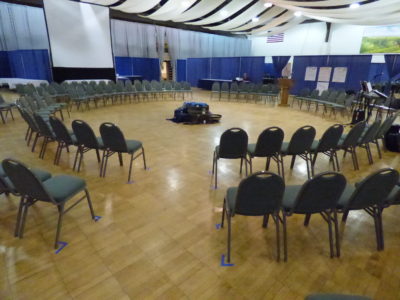
I love this image, the shape of circle for a large group. A center. A couple of layers of rim. Turned inward to one another. Readied for the United Church of Christ, Central Pacific Conference Annual Meeting. It is hearth.

POET — COACH — GROUP PROCESS FACILITATOR
I love this image, the shape of circle for a large group. A center. A couple of layers of rim. Turned inward to one another. Readied for the United Church of Christ, Central Pacific Conference Annual Meeting. It is hearth.
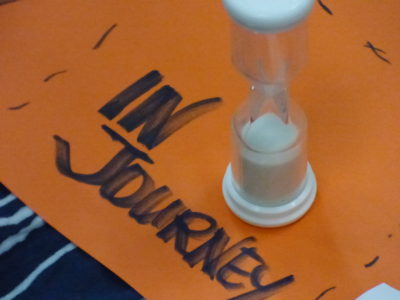
I know, aren’t we all. But perhaps, more true for some than others. Or perhaps more deliberate for some than others. Or maybe more acute.
This photo is from a recent gathering I co-hosted at which all were invited to create a “six word” story (or six phrases) to represent how they are. And further, to bring an item or object to help introduce a bit of the story of who they are.
A particular form of journey that I find myself in is my hunger to reclaim the timeless. It’s my hunger for Kairos, not just Chronos. For spaciousness, not just the precision of short increments stacked on top of each other. It’s pace and the essentialness of wandering. Not just speed and obligatory fulfillment.
The one-minute timer measures time. However, the context that it comes from for me is a men’s group that is timeless. It is one at which anyone is welcome to reach to the center and turn the timer over. It’s purpose is to invite pause. Or reflection. Or quiet.
Even as I write this, I can feel the fullness of my day creeping up upon me, whispering with urgency — “Click publish! Get on to the next! You have a lot to do. Just get it done.” These are patterns deeply ingrained in most of us. Carved like glacial canyons.
I will click publish. But then, I think, just sit quietly for a bit to hold myself in the journey of timeless, just long enough to feel its freedom.
Many of us live in a world that is increasingly being stripped of its context. Headlines captivate more attention than the article or report. Even the article or report captures more attention than the story of what actually happened and it’s many meanings. Facebook is loaded with oodles of good shares, but they too tend to be snippets, ultimately skewed to the delights-only aspects of people’s lives, scrubbed clean of real-life challenges inherent in the every day. Twitter has us not only sharing, but thinking in 140 character messages. The every-day requires a bit more space.
Make no mistake, I value clarity and brevity immensely. It is a skill of maturity, I think, to be able to find the essence of a story, or the principle of a paragraph. It is mad skill to be able to identify talking points rooted in principles or key questions that center a complex situation.
The problem isn’t the skill of summarizing. The problem is when the summary is so often taken out of context and without enough connection to the stories from which they originated. We human beings are starved of context in most of our environments as we continue to spiral ourselves further into a love affair with speed and efficiency that trumps pace and depth.
Let’s just interrupt that, shall we. Let’s just reclaim more of the expectation for context.
One of the things that I love about The Circle Way, is that it gives us a container to reclaim the need and hunger for context. It’s one of the ways that I’ve been introducing Circle lately, and then inviting people to tell a story. The Circle Way can be expressed and invited in many time frames. It won’t always be an hour or two together (this is what people often fear with circle, isn’t it) — sometimes the spirit of circle is practiced and enacted with two people in two minutes. Circle, however, regardless of time choice, gives us a way to paint more than just the edges of our lives and of our learning with one another.
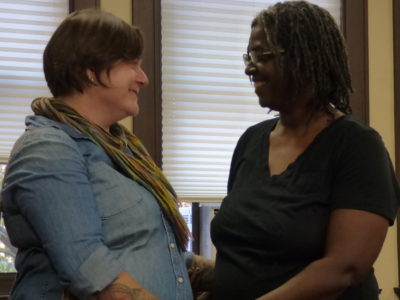
Here’s a recent example, from Circle, Song, and Ceremony, an event with 26 people that I co-convened with Barbara McAfee and Quanita Roberson (pictured on the right above, along with Katie Boone, a wonderfully skilled practitioner based in Minnesota). Our opening evening, in which I’ve come to feel that the real job is to say hello to each other, to make the transition from “out there” to “in here” and being available to each other, had several exercises. Beautiful song. Some recommended agreements and commitments. Some questions that each of us brought to the weekend gathering. An exercise to express six words to describe the state that we were arriving in. The six words were spoken out loud. It’s a good exercise. It was a good exercise that night. These words, and the spirit in which they were spoken, helped to introduce us to each other. “Tired. Curious. Happy. Nervous. Ready. Lonely.” Great teasers for depth, right.
The next day, we invited more context to be spoken in the container of the 26 of us. Not six words, but maybe six paragraphs. In circle. “Who are you? Why did you choose to come to this gathering? Give us a bit of your story.” This circle got big quickly. In time. In content. It got full. And honest. We’d planned on it going for 60-75 minutes, and it did. Deliciously. Because, we had the weekend together, this was not time getting away from us. This was essential weaving together.
There were four things that I learned (relearned) in that circle.
I love Circle. As a form of meeting. As a way of being. As a container to re-insert context and honesty into these many encounters we humans have with one another, while trying to do good with the things and people that we care about.
Context matters. Essentially. The Circle Way gives us format to welcome it.
I’m in the longest stretch I’ve had in the last two and one half years of not posting on this blog. It’s only a month, but I can feel the hunger in my fingers. I can feel the grown cue of ideas that have come, rested a while, and then left. Or of some that just cooked in me in a different way through oodles of conversations with people.
It’s been a full stretch of travel, working with groups, teaching, and learning in public. Wonderful bits with really amazing partners and participants that have occupied me from early mornings well past sun-setted evenings. I’ve been to Whidbey Island, teaching The Circle Way with Amanda Fenton. It’s one of my favorite places in the world. Then further with Amanda and Penny Hamilton to Australia to introduce more of The Circle Way to a community services organization and others so honest in their hunger for deliberate containers of connection. Then immediately upon my return to Minnesota to teach and offer Circle, Song, and Ceremony with Quanita Roberson and Barbara McAfee, bringing forward a new offering.
What great pairs and trios to be a part of! Sometimes in the profound and broad narratives of humanity — how we human beings are, after long drought, requenching our way back to story, context, voice, song, ritual, and wisdom together. Sometimes the satisfying moments with my teaching companions have been in the simple ahas that come over a bite of left over pad thai at the end of the day. “I loved the way that ____ came alive today.” Or, “Wasn’t that a great question that _____ asked!”
It is a gift to host. It is a gift to be hosted. It is a gift to reshape paradigms of teaching that encourage ourselves and others to go together.
Among the many bits that will no doubt continue to unfold within my awareness, or begged from within to be shared more broadly, here’s a gem from the gathering that concluded just yesterday. It is original song from Barbara McAfee, “I Wish That I Could Show You.” The group of 26 of us sang it a few times over the weekend. It’s quite a thing to be touched deeply, and dare to find any words to share moments of aliveness. Thanks Barbara — and all.
 asd
asd
Gifts of Circle is 30 short essays divided into 4 sections: 1) Circle's Bigger Purpose, 2) Circle's Practice, 3) Circle's First Requirements, and 4) Circle's Possibility for Men. From the Introduction: "Circle is what I turn to in the most comprehensive stories I know -- the stories of human beings trying to be kind and aware together, trying to make a difference in varied causes for which we need to go well together. Circle is also what I turn to in the most immediate needs that live right in front of me and in front of most of us -- sharing dreams and difficulties, exploring conflicts and coherences. Circle is what I turn to. Circle is what turns us to each other."
Question Cards is an accompanying tool to Gifts of Circle. Each card (34) offers a quote from the corresponding chapter in the book, followed by sample questions to grow your Circle hosting skills and to create connection, courage, and compassionate action among groups you host in Circle.
This will close in 60 seconds

asd
In My Nature is a collection of 10 poems. From A Note of Beginning: "This collection of poems arises from the many conversations I've been having about nature. Nature as guide. Nature as wild. Nature as organized. I remain a human being that so appreciates a curious nature in people. That so appreciates questions that pick fruit from inner being, that gather insights and intuitions to a basket, and then brings the to table to be enjoyed and shared over the next week."
This set of Note Cards (8 cards + envelopes) quotes a few favorite passages from poems in In My Nature. I offer them as inspiration. And leave room for you to write personal notes.
This will close in 60 seconds
 asd
asd
Most Mornings is a collection of 37 poems. I loved writing them. From the introduction: "This collection of poems comes from some of my sense-making that so often happens in the morning, nurtured by overnight sleep. The poems sample practices. They sample learnings. They sample insights and discoveries. They sample dilemmas and concerns."
This set of Note Cards (8 cards + envelopes) quotes a few favorite passages from poems in Most Mornings. I offer them as inspiration. And leave room for you to write personal notes.
This will close in 60 seconds