Wound

I am but a simple Canadian boy.

I grew up in the prairies of Alberta, nestled in what was the outskirts of urban Edmonton life in the 1960s. I loved sports. My Dad was my baseball coach for a few years. My Mom taught tap-dance after school to neighborhood kids in our basement. I had one sibling; my sister was 20 months older and two school grades ahead of me. I liked school. Math in particular. I loved times tables. I loved recess even more. I had crushes on girls. In fifth grade I asked one if I could carry her books home for her. It took me weeks to muster enough courage to ask. My first kiss came at summer camp. Different girl.

There was a time in my youth, beginning about age nine, that I started grasping for certainties that of course didn’t exist. I didn’t know I was doing that. And I didn’t want to know that certainties didn’t exist. It was my wound, a wound that I tell myself that many of us have, that had me fabricating circumstances through which I might feel a semblance of control. Through which I might feel that I was OK. Kids don’t know these things. Generally. They just adapt marvelously, and if lucky, later come to understand and empathize with some of the “why,” turning the wound into wisdom.

Control. Safety. For me, with hockey stick in hands, I’d shoot tennis balls against the basement wall to see how many times out of ten I could hit the dancer’s rail of my mom’s tap-dance studio. It was just me, the stick, and the ball. Or, racket in hand, and by myself, I’d bounce ping pong balls against Grandma and Grandpa’s basement wall, recording the number of times that I could do it without missing or breaking the rhythm, always seeking a new record high. Hmmm…, there was comfort in the basement. And then there was jogging further or faster to beat my personal bests, or sometimes, those around me. There were personal bests for doing more situps and pushups. There was seeking approval through chores accomplished — “yes, I mowed the lawn AND weeded the garden.” There was working harder and faster at my first job, the IGA grocery store.

Nobody wants to feel the wound again. Nobody wants to feel the pain of the wound again.

I was a kid. I’m coming to realize how the wound shaped me. Yes, there was pain and suffering. I coped. I tried to cope. I buried most of it, even with good people helping me. I sought validation because it was the only thing I knew to do, as a simple Canadian boy, to cope with what would take me forty years to even begin to understand more substantially and with some surprised awe.

It’s quite a thing to see the layers come off. Grown to man, I now can see more clearly, that I just didn’t want to hurt. I just wanted to feel that it was safe, again, to expect, what I would now call, unapologetic and unrestrained joy. What I would now call vibrancy and life, without subconscious fear of loss.

Maybe not so simple. But learning to see more simply. And to feel.
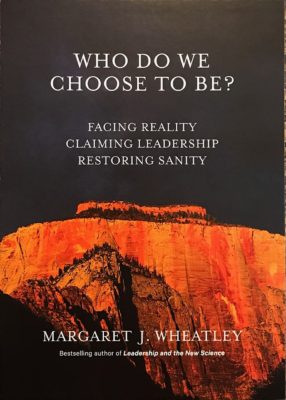
Who Do We Choose To Be?

This is a good book. It’s written by my long-time friend, Margaret Wheatley. Meg has influenced my life deeply since we first met 25 years ago.

I love the title — the emphasis on restoring the act of choice.

I love the the subtitle — “facing reality, claiming leadership, and restoring sanity” are three outstanding and needed practices.

I loves Meg’s ability to speak to the patterns in systems, and uniquely so, in these times.

The book contains these bold and important practices, for “Warriors of the Human Spirit.” Thank you Meg.

We have unshakable confidence that people can be kinder, gentler and wiser than our current society tells us we are. We rely on human goodness and offer this  faith as a gift to others.

We offer ourselves not as activists to change the world, but as compassionate presences and trustworthy companions to those suffering in this world. We embody compassion without ambition.

Our confidence, dignity and wakefulness radiate out to others as a beacon of who we humans are.

Our confidence is not conditioned by success or failure, by praise or blame. it arises naturally as we see clearly into the nature of things.

We create an atmosphere of compassion, confidence and upliftedness with our very presence.

We create a good human society wherever we are, whenever we can, with the people and resources that are available to us now.

We rely on joy arising, knowing it is never dependent on external circumstances but comes from working together as good human beings.

We encounter lifes’ challenges with a sense of humor, knowing that lightness and play increase our capacity to deal with suffering.


The Seven of Pentacles — Marge Piercy

A friend spoke this poem today. It was a perfect cap to the learning circle that we had just completed.

Marge Piercy is an American poet, novelist, and activist. I enjoy how her writings so often point to the theme of keeping it real – “build real houses, weave real connections, create real nodes.”

The Seven Of Pentacles
By Marge Piercy

Under a sky the color of pea soup
she is looking at her work growing away there
actively, thickly like grapevines or pole beans
as things grow in the real world, slowly enough.
If you tend them properly, if you mulch, if you water,
if you provide birds that eat insects a home and winter food,
if the sun shines and you pick off caterpillars,
if the praying mantis comes and the ladybugs and the bees,
then the plants flourish, but at their own internal clock.

Connections are made slowly, sometimes they grow underground.
You cannot tell always by looking what is happening.
More than half the tree is spread out in the soil under your feet.
Penetrate quietly as the earthworm that blows no trumpet.
Fight persistently as the creeper that brings down the tree.
Spread like the squash plant that overruns the garden.
Gnaw in the dark and use the sun to make sugar.

Weave real connections, create real nodes, build real houses.
Live a life you can endure: Make love that is loving.
Keep tangling and interweaving and taking more in,
a thicket and bramble wilderness to the outside but to us
interconnected with rabbit runs and burrows and lairs.

Live as if you liked yourself, and it may happen:
reach out, keep reaching out, keep bringing in.
This is how we are going to live for a long time: not always,
for every gardener knows that after the digging, after
the planting,
after the long season of tending and growth, the harvest comes.

Failure

Last week I wrote that many of us have an involved relationship with expertise. The same feels true of failure.

I was raised in an era when failure was to be avoided or hidden. Failure of not getting it right (“get it right or go home;” “get it right the first time or don’t do it at all”). When speed and efficiency were mechanically imprinted to the collective psyche, you get such belief systems. Failure often came with punishment, reprimands. Or reassignments. Or getting fired. There’s just loads of fear in all of that. And no, I was not raised in a military family. My family was fortunately, kind, patient, and able to laugh at such orientations — at least at home.

These days, there is a much different orientation to the flavors associated with failure. How wonderful that experimenting and prototyping are norms. “Failing fast and often” is a value to support continuous learning. Many people and organizations have developed cultures that support fantastic trial and error, in which there will of course be failures. Stuff that doesn’t work. Stuff that doesn’t work like we thought it would. But, failure has been reworked significantly to welcome learning — in the best of environments.

I’ve known some people (including myself) for whom the psychology of failure is still living in an old era, trying to catch up to the accepted strategies of the day — innovation and creativity as life blood of organizational and human evolution. In the depth of that lag, I’ve heard the phrase, “failure as a human being.” It’s one of those expressions that we all know is absurd, but none the less, the feeling of it can be quite prevalent.

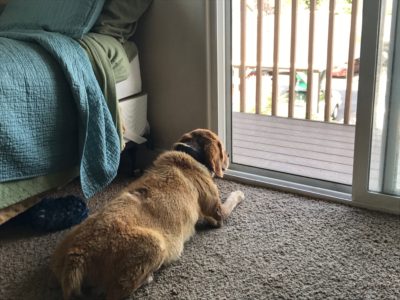
This morning while sitting briefly in my bedroom, I watched my dog, my now pushing 14 lab / retriever mix staring out the window. We humans with our ability to abstract and project, come up with statements about failure. I was imagining how it would sound if dogs were to state to each other, “you are a failure as a dog.” Outside of a Disney movie script, I doubt it. Absurd, right. A dog is a dog. With foibles. With satisfying moments of fetch. With challenging moments of barfing or pooping on the carpet. A dog is a dog. “Failure as a dog” is like telling a cucumber it has failed as a cucumber. I laughed when I thought this.

I don’t know if dogs need encouragement to not think that way. I’m going to let myself be simple and say no for the moment. But humans, we do think this way at times. We do need encouragement to free ourselves from some absurdities. Though there are many kinds of humans, the extremity of the statement, “failure as a human” is just too harsh. We have our satisfying moments of preparing a good meal. We have our challenging moments of not taking out the trash that stinks up the place. But it’s all part of the package that is being human.

Here’s to kindness with ourselves and with each other, reorienting ourselves in the small and big scales of learning, failing, experimenting, daring to try some difference, and daring to welcome all of what shows up.

Gifts of Circle - Question Cardsasd
Gifts of Circle is 30 short essays divided into 4 sections: 1) Circle's Bigger Purpose, 2) Circle's Practice, 3) Circle's First Requirements, and 4) Circle's Possibility for Men. From the Introduction: "Circle is what I turn to in the most comprehensive stories I know -- the stories of human beings trying to be kind and aware together, trying to make a difference in varied causes for which we need to go well together. Circle is also what I turn to in the most immediate needs that live right in front of me and in front of most of us -- sharing dreams and difficulties, exploring conflicts and coherences. Circle is what I turn to. Circle is what turns us to each other."

Question Cards is an accompanying tool to Gifts of Circle. Each card (34) offers a quote from the corresponding chapter in the book, followed by sample questions to grow your Circle hosting skills and to create connection, courage, and compassionate action among groups you host in Circle.

This will close in 60 seconds

asd
In My Nature
is a collection of 10 poems. From A Note of Beginning: "This collection of poems arises from the many conversations I've been having about nature. Nature as guide. Nature as wild. Nature as organized. I remain a human being that so appreciates a curious nature in people. That so appreciates questions that pick fruit from inner being, that gather insights and intuitions to a basket, and then brings the to table to be enjoyed and shared over the next week."

This set of Note Cards (8 cards + envelopes)  quotes a few favorite passages from poems in In My Nature. I offer them as inspiration. And leave room for you to write personal notes.

This will close in 60 seconds

asd
Most Mornings is a collection of 37 poems. I loved writing them. From the introduction: "This collection of poems comes from some of my sense-making that so often happens in the morning, nurtured by overnight sleep. The poems sample practices. They sample learnings. They sample insights and discoveries. They sample dilemmas and concerns."

This set of Note Cards (8 cards + envelopes)  quotes a few favorite passages from poems in Most Mornings. I offer them as inspiration. And leave room for you to write personal notes.

This will close in 60 seconds