Anticipation

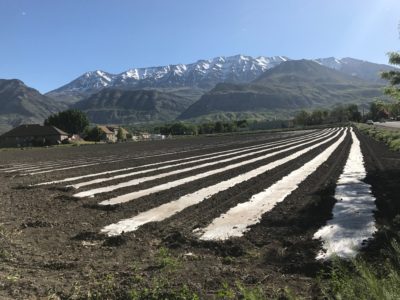
I live in Lindon, Utah. I describe Lindon as a place “where urban meets rural.” I love the mountains that border the east of Utah Valley, The Wasatch Mountains. That’s Timpanogos in this picture.

The field above is along a path on which I often walk my dog. We walk past houses and another large field. This field above used to have horses in it. When it was sold, I was afraid it would become more houses. It didn’t. Instead, it became this place for growing tomatoes and peppers.

More rural, preserved.

In two months ish, there will be rows and rows of maybe 100 yards in length, with vegetables and fruit (tomato) ready to pick. It’s run by a local greenhouse. Between now and then, I’ll watch the growth as I walk my dog.

When I see this field, with these rows tilled and ready, I get excited. I feel anticipation. And somehow, just a bit of unique health in seeing a field ready to grow.

To Gold

Dreams inform my life. As symbols. As glimpses to the subconscious. As touch-points to what is collectively invisible. There are no absolutes for me in dream interpretation. An entry point to sense-making beyond rational brain is enough. And utterly fruitful. I give myself permission to pick any detail or details from the dream, with the only reason being that it / they have my attention in recall. That’s where I start. I find that when I give my dreams my attention, I remember more of them.

This week I dreamed:

I am an old man, perhaps in my 80s. I live in a village where there is a king (or prince). There is a narrow and steep path of stone on the edge of a mountain that leads from the village up and over a mountain. Each stone is like a shingle, overlapped by the next. Each stone is rectangular, two feet in length and about nine inches wide, and 1.5 inches thick. The king has asked for someone to do an enormous task (I can remember what it was in the dream). As an old man, I tell him that I can’t do that, but I can “paint” each stone from the path that leads up and over the mountain. There is some reward that I will receive if I’m able to do this. The king accepts. I proceed. With each slab of stone, I brush its full surface with at first a cedar bough, that then turns to a paint brush, though there is no paint. I begin to get scared from the height of the path when I am about 50 feet above the village. It is very narrow and it is a steep fall. I can see villagers below and know that I’m in a dangerous place. At first, I don’t want to stop. I don’t want to feel embarrassed or ashamed for not accomplishing the task. However, my fear of the height over takes me. I call out in fear and slowly step down the stone-shingled path, one stone at a time, which continues to really scare me. But then I’m able to hold the slabs with my left hand and slide all at once to the bottom. I feel my failure of not painting the whole path. The next morning I wake to find that each stone that I brushed and painted has turned to gold. The king is wondering how I did it (and valuing it). I don’t know how I did it. I wake.

One of my details in this dream is the alchemical change, which is as good of a narrative as I find to invite depth in human beings together in work, community, family, etc.

Whether you think it, respond with a comment, or reach me privately, what do you touch that turns to gold, even without knowing exactly how it happens?

Courage to Be Communal

Courage — from the heart.

When I was younger, I often thought about courage as being brave. Brave to take on scary things or very demanding things. Against bad odds. Like going in to a dark (but harmless) room, or turning out the lights and then jumping to my bed for fear that something under the bed would get my toes (humor me — it still took some courage).

There was courage in telling the truth that was less than flattering. “I’m sorry mom; I failed test.” There was courage in playing ice hockey. It was a game that I loved and was really important in my growing up. I remember it took courage to commit to the physicality of playing hockey — you had to be in good shape, and, there was that one kid in Pee Wee C (10 year olds) that said he was going to kill me. It scared me for a long time.

Courage was a kind of armor. For protection and for battle.

Now, all grown up (humor me again — more grown up), courage has come to take on other forms. It takes a bit of living to realize some of the nuance of courage.

Recently a friend shared a sermon in which the minister named that it takes courage to be communal (and that community is the central act that we need humans need to reclaim). Ah, now that’s interesting, isn’t it.

My earlier versions of courage all felt very personal and individual. Stuff that I had to do. But this being communal, well that’s a new spin isn’t it. The courage to lean in to going together rather than alone. The bravery to be in the messiness of figuring things out together when it’s so much easier to isolate and proclaim narrowed certainties. The demanding, yet attractive requirement to see the invisible and the subtle together, not just alone. It takes courage to be together, despite, I believe, being hard-wired to be communal. How odd, right. Yet, so many of the norms of society now have us in this place.

I’m challenging myself these days to have courage to be communal. To be vulnerable enough to share what is easier to keep private, stuff that I don’t know. To listen to another’s truth and position, though different from mine, to hear the person’s passion and conviction and be ok about disagreeing. To act together, even when I feel all acted out. To encourage narrative of seeing together — it takes a village. To show up for conflict — ouch — when I would rather dismiss it or run away.

It takes courage, heart, to take off the armor. It takes courage, heart, to undo centuries old stories of individuals as just the sum of the parts. It takes courage, heart, to live as a composite being that is community. I’d like to say it is all clear. I want that to be so. I’d like to say that is is easy. Maybe it is. But courage remains central in all of that. Even for the most natural of things.

The Truest Statement — You Never Know


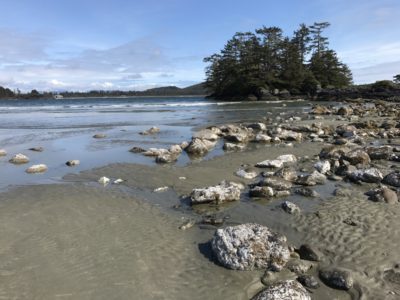
Last week at The Circle Way Tofino (Chesterman Beach, above), my teaching colleague and friend Amanda Fenton shared the passage below. It is from Richard Wagamese. Wagamese is Ojibwe, a Canadian author and journalist who died earlier this spring.

The beginning of wisdom is the same as its attainment: wonder. The truest statement in the world is “you never know.” There is always something to evoke wonder, to wonder about, because this world, this life, this universe, this reality is far more than just the sum of its parts. Even the slightest detail contains much more. The overwhelming awe and wonder we feel teach us more than we can ever glean or come to know of things. In the presence of that wonder, the head has no answers and the heart has no questions.

I was moved by the part, “the truest statement in the world is ‘you never know.'” It had particular relevance in this context of working in the Nuu Chah Nulth region on Vancouver Island in Canada. Kelly Foxcroft Poirier and her sister Dawn Foxcroft shared many insights with us that were drawn from their indigenous heritage. This included the statement that “for our people, everything is contextual.”

Ah…, there is something that I was looking for. The appreciation and commitment for the subjective, the contextual, and the relational. It’s a contrast to the so much dominant contemporary pattern of the objective, the isolated, and the individual. Any time you can find just a few words that encapsulate a couple of decades of searching — well, that’s a good day. That’s what was sparked for me in “you never know.”

Wagamese’s life is itself an important story. On its own, and for the pattern that it represents in the last century of indigenous, First Nations life and culture taken by European settlers. From Wikipedia, these paragraphs also moved me.

Wagamese described his first home in his essay “The Path to Healing” as a tent hung from a spruce bough. He and his three siblings, abandoned by adults on a binge drinking trip in Kenora, left the bush camp when they had run out of food and sheltered at a railroad depot. Found by a policeman, he would not see his family again for 21 years. He later described the adults in his family. “Each of the adults had suffered in an institution that tried to scrape the Indian out of their insides, and they came back to the bush raw, sore and aching.” His parents, Marjorie Wagamese and Stanley Raven, had been among the many native children who, under Canadian law, were removed from their families and forced to attend certain government-run residential schools, the primary purpose of which was to separate them from their native culture.

After being taken from his family by the Children’s Aid Society, he was raised in foster homes in northwestern Ontario before being adopted, at age nine, by a family that refused to allow him to maintain contact with his First Nations heritage and identity. Of this experience he wrote: “The wounds I suffered went far beyond the scars on my buttocks.” He was moved to St. Catharines, Ontario. The beatings and abuse he endured in foster care led him to leave home at 16, seeking to reconnect with indigenous culture. He lived on the street, abusing drugs and alcohol, and was imprisoned several times.

He reunited with his family at 23. After recounting his life to this point, an elder gave him the name Mushkotay Beezheekee Anakwat – Buffalo Cloud – and told him his role was to tell stories.

The truest statement — you never know. What an invitation to essential wonder that can and does do wonder in human beings being together.


Gifts of Circle - Question Cardsasd
Gifts of Circle is 30 short essays divided into 4 sections: 1) Circle's Bigger Purpose, 2) Circle's Practice, 3) Circle's First Requirements, and 4) Circle's Possibility for Men. From the Introduction: "Circle is what I turn to in the most comprehensive stories I know -- the stories of human beings trying to be kind and aware together, trying to make a difference in varied causes for which we need to go well together. Circle is also what I turn to in the most immediate needs that live right in front of me and in front of most of us -- sharing dreams and difficulties, exploring conflicts and coherences. Circle is what I turn to. Circle is what turns us to each other."

Question Cards is an accompanying tool to Gifts of Circle. Each card (34) offers a quote from the corresponding chapter in the book, followed by sample questions to grow your Circle hosting skills and to create connection, courage, and compassionate action among groups you host in Circle.

This will close in 60 seconds

asd
In My Nature
is a collection of 10 poems. From A Note of Beginning: "This collection of poems arises from the many conversations I've been having about nature. Nature as guide. Nature as wild. Nature as organized. I remain a human being that so appreciates a curious nature in people. That so appreciates questions that pick fruit from inner being, that gather insights and intuitions to a basket, and then brings the to table to be enjoyed and shared over the next week."

This set of Note Cards (8 cards + envelopes)  quotes a few favorite passages from poems in In My Nature. I offer them as inspiration. And leave room for you to write personal notes.

This will close in 60 seconds

asd
Most Mornings is a collection of 37 poems. I loved writing them. From the introduction: "This collection of poems comes from some of my sense-making that so often happens in the morning, nurtured by overnight sleep. The poems sample practices. They sample learnings. They sample insights and discoveries. They sample dilemmas and concerns."

This set of Note Cards (8 cards + envelopes)  quotes a few favorite passages from poems in Most Mornings. I offer them as inspiration. And leave room for you to write personal notes.

This will close in 60 seconds