
On The Myth of Managing Culture Change

One, I love challenging myths. It’s fascinating to me to see how an idea, once fuzzy and only one of many choices, can become calcified in certainty and encrusted as habit and insulated truth. Whether that’s simple stuff like cutting the ends off the roast, as Grandma always did (aha, to make it fit in the pan), or more involved stuff like attributing all power and intelligence to an individual leader (aha, it turns out the group can be smarter and more sustainable).

Two, I often find myself trying to “buy room” with people I’m working with by inviting the term “culture change.” It has enough legitimacy to shift attention from projects that are good, but only part of the puzzle — most people know this but just need a bit of leadership support to see the bigger picture. Culture change invokes seeing more of the horizon, more of the forest and not just the trees. It invokes a change of being, not just more fierce commitment to managed doing.

Three, I love what Chris Corrigan wrote on this topic recently. Chris is smart as hell and fiercely committed to the dynamics of the system at work. He is a myth buster among many things, who offers grounded tools and theory to change even the myths about change.

Changing the dynamics of how a system of people interact with one another is the game. It is setting the table for emergence to occur — the naturally arising dynamic of life. It is helping people, all of us, experience being in relation with emergence and growing in our comfort to be in the clarity and messiness of that. Pause with that thought — it is key — being in relation with emergence.

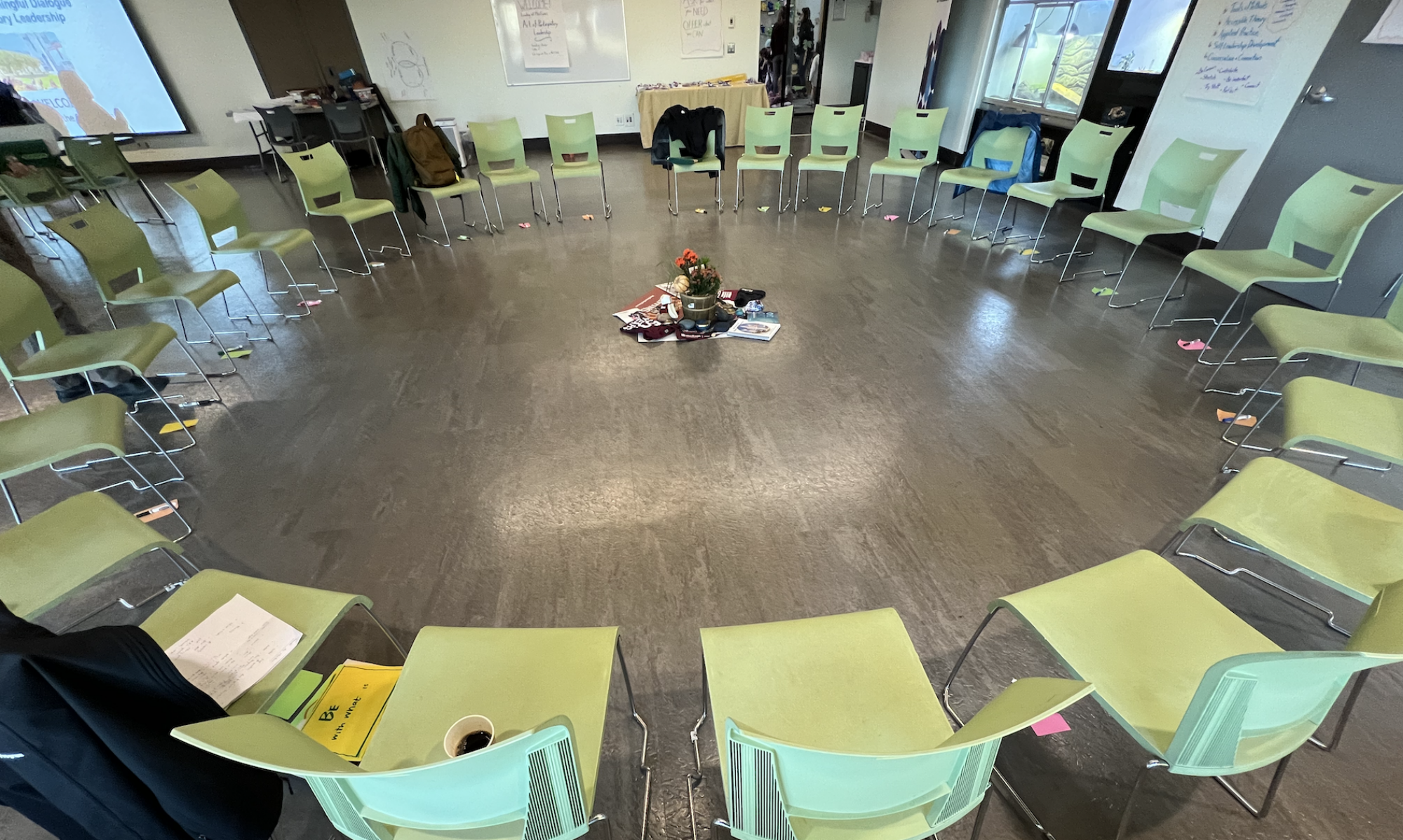
Culture change is not selling a grand idea and manipulating others to get on board with power, coercion, or even charisma. The game in culture change, the real importance, is a process change in how people engage with one another. Culture change is less planned and managed. It is more encountered and adjusted. What would it take for any of us to be more comfortable with encountering and adjusting with each other?

Check this from Chris’ site. I love his articulation and think out loud ability, to take on a myth.

Principles

  • Culture is an emergent set of patterns that are formed from the interactions between people. These patterns cannot be reverse engineered. Once they exist you need to change the interactions between people if you want to change the patterns.
  • Culture includes stories but it is not a story. This is important because simply changing the story of the organization will not change the culture. Instead you need to create ways for people to interact differently and see what comes of it.
  • Cultural evolution is not predictable and cannot be led to a pre-determined character. You can aspire all you want to a particular future culture but it is impossible to script or predict that evolution.

Practices

  • Start by getting clear about the actual work. In my experience people use the term “culture change” as a proxy for the real work that needs to be done: improving employee relations, becoming more risk tolerant, shifting leadership styles…whatever it is, it’s best to start with getting clear what is ACTUALLY going on before assuming that the problem is the “culture.”

  • Look at what actually is. Studying the way things are is important, because that helps you to identify what you are actually doing. It seems simple, but it’s important to do it in a way that doesn’t bring a pre-existing framework to the work.  You have to look at the patterns from the work that you already do, not from how it illuminates a pre-existing model.

  • Work with emergence to understand patterns together. Using tools such as anecdote circles, organizations can discover the patterns that are present in the current environment. Anecdote circles generate small data fragements that describe actual actions and activities. Taken together and worked through, patterns become clear, like the process of generating a Sierpinsky triangle.  Out of large data sets, hidden patterns appear.

  • Identify those patterns and discuss ways to address them with safe to fail experiments. Run a session to create several ideas that are coherent with the patterns, design multiple small experiments to try to shift the patterns.  Institute rigorous monitoring and learning and allow for experiments to fail.

  • Support new ideas with appropriate resources. If you really want to change the interactions between people you need to resource these changes with time, money and attention. The enemy of focused innovation is time. Even allowing employees to work on something a half day a week could be enough to create and implement new things. Butif they have to do it on top of the full workload they have, nothing will get done.

  • Learn as you go. Developmental evaluation is they way to go with new forms of emergent practice. To be strategic about how change is happening, it’s important to design and build in evaluation at the outset.

Presence First

It was many years ago now that I asked my good friend and colleague Toke Moeller, “If you had one tool, what would that be?” We had just completed an Art of Hosting, the first in North America, helping to further encourage the body of work that is participative leadership. We were at the Marsh House at the Aldermarsh property on Whidbey Island in Washington State. The building and retreat center were empty, 30 bodies had scattered out into there varied destinations, after having been together for three wonderful days together. This was 2002. Toke’s response, in the quiet of this now empty building, was “presence.” His words echoed just a tiny bit in the empty meeting space. Those words have not stopped echoing in me.

It was only a day ago that in conversation and planning with another friend and colleague, Christina Baldwin, I heard similar words. She was sharing what was the essence for her, a version of response to “Why circle?” “Presence,” she began, “is what changes how we are together. Presence is what people are longing for. Presence is what people are struggling to have in a world that requires tending through multiple distractions. Circle helps to create this.”

There it was again. Simplicity. If in doubt, give energy and attention to presence. Showing up to listen to silence together. To listen to each others words. To listen to what is in the middle of those words and that silence that glues them together.

Both of these people, Toke and Christina, are woven into my soul. They are both kind and gracious. They are both welcoming. They are both fiercely committed to good. My friendship and growing up with them is one of the things I’m most grateful for in my life.

And there are days, for all of us, when returning to the simple advice from friends that travel life together, is the only thing that seems to matter.

Presence first.

On Identity in Self Organization

I’ve just returned from a few days with family. My adult son. My 11 year-old son. His sixth grade friend. My parents. My aunt and uncle that were so key in my pre-teens, teens, and early adult life. These few days were a lot of fun. Playing cards and games. Enjoying food together. Lots of laughter. Lots of sunshine through the palms of Palm Springs, California.

Family is a key point of identity for me. For many of us. It has defined who I am. Where I belong. There is something in me that relaxes when I enter the space of family. That feels at ease. That feels a joy of what I’ve come to know as inherent belonging. Yes to all of the values and stories and shared experience. There is deep psychology and spirituality at play here. But, mostly, it’s good to feel part of a pack.

Family, as such key identity, also creates a baseline for differentiation and departure. I’m not a carbon copy of my parents, nor should I be. They wouldn’t advise this. A little “chip off the old block” maybe — a grounding in identity — but difference is healthy. Curiosity in that difference and being able to engage it is really healthy — health spa and organic food healthy.

In my early learnings with self-organization in the 1990s, Margaret Wheatley and Myron Rogers taught about three domains of self-organization. Identity was one of them. There must be a “self” around which attraction occurs and boundaries are created. Self-organization is an alternative story to how life organizes and how people in them organize. It’s an essential contrast to a still hanging on mechanistic paradigm that often portrays merely linear connection and cogs in wheels.

In humans and human systems, identity can get really interesting. The self, the identity, can have many appearances. A quality (tenacious, kind, funny). A role (a dad, an accountant, a baker). A commitment (curiosity, edge-pushing, enduring). A collective (team, community, ecosystem). All of these are good. My point today isn’t to challenge the merits of a particular role or identity. But rather, to call attention to some of these key aspects of identity. I suppose some parts of our identity stay the same — I will always be that boy that grew up in Edmonton. But some parts of our identity change, and should — I’m a dad with kids on the move whose “home” most likely won’t be a fixed place in the way it was for my parents, aunts and uncles.

Life can’t help but organize itself. Similarities. Essential differences and diversity. In the book I’m reading, Spontaneous Evolution, there is great description about the evolution from “no life” to “single cells” to “multi-cellular life” to “communities.” Self-organization, irrepressible self-organization, is biology.

When I apply this irrepressible organizing to the self that is the “cell of an ideology” or the “multiple cells that are a quality like curiosity,” I’m filled with wow. It’s a bit hard to articulate, but, with some level of consciousness, we humans can choose identity — and set in motion irrepressible organizing around that choice of identity.

For me, this doesn’t point to a grand, scaled plan for old stories of command and control. It is an awe, and wonder about the paramount attention and importance of being aware of identity, the self. It is an awe and appreciation of being with my boys and feeling myself sandwiched in three generations of family that bring out both a comfort and difference, and awareness of how identity shapes me — shapes what I long for and what I long to change as part of being alive.

Road Trip

That’s Shadow. He’s 13 and a half. He is a Lab / Retriever mix. He’s the kind of dog that follows you around from room to room. Dutifully. Lovingly. Great to project, isn’t it.

These days, that following isn’t so quickly. He isn’t so spry as, say, five years ago. Shadow lumbers up and down the stairs. He remains the kind of dog that sits next to someone if they are sad — I’ve seen it many times. Dog’s seem to know, don’t they.

Shadow hasn’t had many road trips in his days. In fact, yesterday was his first that exceeded 20 miles. Yesterday I drove from Lindon, Utah to Cedar City, Utah (225 miles). My 11 year-old and his friend were in the back seat. Shadow in the front on the floor, but here, enjoying a stop for gas.

Yes, he did enjoy a bit of head out the window with ears flapping in the wind. I wonder what he was thinking.

No big story to tell here today. Just the happiness I felt in the uniqueness of this road trip moment. And gratitude for this canine companion who has been with me through a lot of big stories over the last 13 years.

Gifts of Circle - Question Cardsasd
Gifts of Circle is 30 short essays divided into 4 sections: 1) Circle's Bigger Purpose, 2) Circle's Practice, 3) Circle's First Requirements, and 4) Circle's Possibility for Men. From the Introduction: "Circle is what I turn to in the most comprehensive stories I know -- the stories of human beings trying to be kind and aware together, trying to make a difference in varied causes for which we need to go well together. Circle is also what I turn to in the most immediate needs that live right in front of me and in front of most of us -- sharing dreams and difficulties, exploring conflicts and coherences. Circle is what I turn to. Circle is what turns us to each other."

Question Cards is an accompanying tool to Gifts of Circle. Each card (34) offers a quote from the corresponding chapter in the book, followed by sample questions to grow your Circle hosting skills and to create connection, courage, and compassionate action among groups you host in Circle.

This will close in 60 seconds

asd
In My Nature
is a collection of 10 poems. From A Note of Beginning: "This collection of poems arises from the many conversations I've been having about nature. Nature as guide. Nature as wild. Nature as organized. I remain a human being that so appreciates a curious nature in people. That so appreciates questions that pick fruit from inner being, that gather insights and intuitions to a basket, and then brings the to table to be enjoyed and shared over the next week."

This set of Note Cards (8 cards + envelopes)  quotes a few favorite passages from poems in In My Nature. I offer them as inspiration. And leave room for you to write personal notes.

This will close in 60 seconds

asd
Most Mornings is a collection of 37 poems. I loved writing them. From the introduction: "This collection of poems comes from some of my sense-making that so often happens in the morning, nurtured by overnight sleep. The poems sample practices. They sample learnings. They sample insights and discoveries. They sample dilemmas and concerns."

This set of Note Cards (8 cards + envelopes)  quotes a few favorite passages from poems in Most Mornings. I offer them as inspiration. And leave room for you to write personal notes.

This will close in 60 seconds