
Everything is Not What it Seems

I’ve started reading a book recommended by my partner, Teresa Posakony. It is by Bruce Lipton and Steve Bhaerman called Spontaneous Evolution. The main theme is about society participating in evolution (evolving the way we evolve) by making a significant change in beliefs and behaviors. I met Bruce Lipton once — his presentation was full and intense. He knows a lot of stuff and weaves it quite fiercely to create bridges between science and matters of spirit.

Generally speaking, I find it delicious to crack open a new book. I love the introduction and I love the table of contents, and preamble, and preface — as ways to understand the narrative arc that the author is about to invite us to ride upon. A ride is coming — that is what I love. One that might tease and tumble my imagination.

In this book, Spontaneous Evolution, Chapter 1 is titled, “What if Everything We Know is Wrong!” Funny that I just noticed it is punctuated with an exclamation point, not a question mark. The authors aren’t asking if this is true. They are asserting it.

I find it exquisite when people take on this theme of “everything we know is wrong.” It’s the river under the river. For me, more often I speak it as “all is not what it seems.” Or even more accurately, that everything is incomplete because this fantastic set of symbols that we call words, could never express the fullness of what is — it’s a good system, but remains a reductive system.

It’s the description of the nature of reality that has so often felt off to me, rendering much of the discussion and action plans that we humans create, off as well. A key first step for working and living together as teams, or families, or communities, is to be willing and able to explore the underlaying story that supports our knowing and insights. One of my colleagues has been reminding me of the need for “round world” rather than “flat world” strategies.

There’s a story in this chapter by Lipton and Bhaerman that illustrates how our perception (and certainty) can trick us. And by us, I do mean all of us. It’s not whether we will be wrong that is the issue to me. Rather, it is whether we are willing to engage with self and others about the incompleteness of it.

“Gaze into the sky on a clear, dark, moonless night, and you will see thousands of pinholes of light — each one a massive, magnificent star in a Universe too large to imagine. Focus on one star and realize that it might no longer exist but may have burned out and collapsed into space rubble eons ago. But because the star was light-years away, illumination from its former existence is still visible, serving as a navigational guide for mariners.

Now, turn your gaze from the heavens to our less-than-heavenly Earth and ask: ‘Is it possible that we have been charting our course by a burned-out philosophical star? What if our belief system about life is wrong?'”

Good, right? Following a star that has already died. I love the reference.

I think that the most important disposition that I’ve been able to offer in working with groups is to, just for a moment, help them (and me) entertain the notion that we might not have it all figured out. Curiosity is the need — that’s what I tell them. Dislocation of certainty, even for a moment — this reawakens a fundamental human quality of evolving not just what we do, but how we are together.

The willingness to engage around such vulnerability of not knowing, and just maybe, not having it all figured out — that’s a game changer.
Four Pillars — Why Talk?

Over the years, I’ve come to claim four pillars — four weight-bearing columns — that help me respond to people asking the question, “Why talk?” Sometimes the question is nuanced — “Why engage with a group?” Sometimes, the question is buried beneath piles of assumptions and efficiency habits — “Talking is nice but isn’t it really a waste of time? We don’t have time to be nice here.”

These pillars are simple. Yet have significant impact to dialogic design and encountering the subtle energy and less visible belief systems that accompany people into a room. Pillars. Not two by fours. Not willow sticks. Pillars hold up very large structures. In this case, the very large platform of trusting the imperative of working together, not just separately (though this too is essential within working together).

  • Who we are together is different and more than who we are alone. This is one that I learned over and over with Margaret Wheatley. Since the early 90s she has been encouraging people to see systemically, knowing that engagement with one another gives us access to a magic, or difference, of who we are together. It is a principle of “the whole is greater than the sum of the parts.”
  • If you want a system to be healthy, connect it to more of itself. This is a biological principle that I connect back to Humberto Maturana, the Chilean biologist and philosopher. In human systems, talking and listening are part of that, right. Telling stories. Sharing observations. Asking questions of each other. Creating a healthy system is the work of leadership. For the long term.
  • People support what they create. This is a principle that starts to lead to action. It’s easy to get that people want to act together. People want to do good. Talking together creates essential condition for that action to occur in a more sustainable way. So does listening. So does harvesting. Dialogue is a way to create together. To create thought. To create perspective. To create purpose. To create a narrative arc to hold many, many snippets of experience.
  • If you want to go faster, go alone. If you want to go further, go together. This is an African proverb that I learned in my early days with The Berkana Institute, where we were encouraging process to help us go together. To help us remember a kind of belonging together. Talking, listening, harvesting creates belonging. It takes courage to go together. Patience too. But it’s not grand news to most of us. It just takes perseverance to undo a paradigm of entrenched thought and hallowed habit of individualism.

I love asking people to reflect on these pillars. And to ask them to notice their own pillars that guide their work. Consciousness of story, found in pillars, will never sell you short.

Unity, Diversity, and Choice

My friend and colleague Amanda Fenton has been writing about love, power, and choice. One of the things I appreciate in Amanda is her thoughtfulness, and her keen perception that welcomes multiple perspectives and insights. She shares some background, some story, and her evolution of thinking in this excerpt from her blog:

I’ve been reflecting on my experience in a session I co-hosted and the connection with philosopher Paul Tillich’s concept of power and love:

  • Power: The drive of everything living to realize itself, with increasing intensity, to achieve one’s purpose and grow. It isn’t “power over” but about achieving “the whole in itself”.
  • Love: The drive to unite the separated, to recognize and make whole, with a focus on relationship and connection. It is unity of the larger whole.

Adam Kahane describes power and love not as an either/or, but a polarity or dilemma, and the way through is by cycling between them. Like walking – moving one foot then the other – they are never in static balance. And it is also fractal – there is the “whole in itself” and at the same time, the whole is “part of a larger whole” that reveals and enacts a similar pattern.

Go here for the full post.

On Beauty and Distance Between

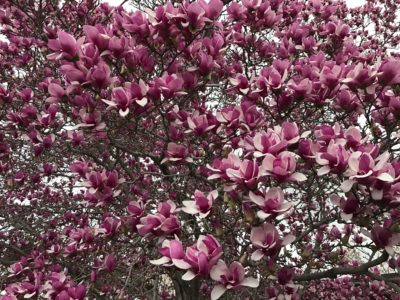
One of my friends calls it a “Tulip Tree” because the blossoms resemble tulips. I think it is more properly a “Magnolia Tree.” This one above is on the walk that I most often take with my dog, along Heritage Trail in Lindon, UT. The blossoms are gorgeous, and as you can see plentiful. They are delicate too. A good spring windy day can quite immediately move the bulk of those petals to the ground.

In response to my post yesterday on choice, friendship, and welcome, another friend sent me this from Rainer Maria Rilke, the Austrian poet and mystic of the early 1900s.

“Once the realization is accepted
that even between the closet human beings
infinite distances continue to exists,
a wonderful living side by side can grow up.
If they succeed in loving the distance between them
which makes it possible
for each to see the other
whole and against the wide sky”!

Here’s to the beauty of space between that comes with choice, friendship, and welcome. And to good friends — like the one currently in Maui, Hawaii, who sent me this Rilke passage.

Gifts of Circle - Question Cardsasd
Gifts of Circle is 30 short essays divided into 4 sections: 1) Circle's Bigger Purpose, 2) Circle's Practice, 3) Circle's First Requirements, and 4) Circle's Possibility for Men. From the Introduction: "Circle is what I turn to in the most comprehensive stories I know -- the stories of human beings trying to be kind and aware together, trying to make a difference in varied causes for which we need to go well together. Circle is also what I turn to in the most immediate needs that live right in front of me and in front of most of us -- sharing dreams and difficulties, exploring conflicts and coherences. Circle is what I turn to. Circle is what turns us to each other."

Question Cards is an accompanying tool to Gifts of Circle. Each card (34) offers a quote from the corresponding chapter in the book, followed by sample questions to grow your Circle hosting skills and to create connection, courage, and compassionate action among groups you host in Circle.

This will close in 60 seconds

asd
In My Nature
is a collection of 10 poems. From A Note of Beginning: "This collection of poems arises from the many conversations I've been having about nature. Nature as guide. Nature as wild. Nature as organized. I remain a human being that so appreciates a curious nature in people. That so appreciates questions that pick fruit from inner being, that gather insights and intuitions to a basket, and then brings the to table to be enjoyed and shared over the next week."

This set of Note Cards (8 cards + envelopes)  quotes a few favorite passages from poems in In My Nature. I offer them as inspiration. And leave room for you to write personal notes.

This will close in 60 seconds

asd
Most Mornings is a collection of 37 poems. I loved writing them. From the introduction: "This collection of poems comes from some of my sense-making that so often happens in the morning, nurtured by overnight sleep. The poems sample practices. They sample learnings. They sample insights and discoveries. They sample dilemmas and concerns."

This set of Note Cards (8 cards + envelopes)  quotes a few favorite passages from poems in Most Mornings. I offer them as inspiration. And leave room for you to write personal notes.

This will close in 60 seconds