
A Lot of Life

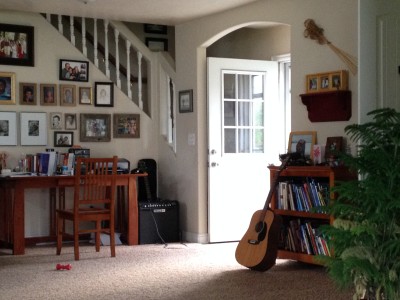
VillaThough this photo may be quite plain and nondescript for many, there is something that I really like about it.

I took it last week in my home using my iPhone. What I was first drawn to was the early morning light shining through the door. A new day. A new beginning.

What I realized after is that there are easily a couple dozen artifacts in this picture that represent significant parts of my life.

The Norfolk Pine in the front right, that was my family Christmas tree in 2014. Then, it was decorated with dried lemons and limes, a tradition of simplicity that my kids and I have come to really enjoy.

The Seagull Acoustic Guitar in front of the bookshelf, made in Canada. I got it in 1986 when I’d returned from living two years in Korea. I wanted to learn to play. I think I knew then, just as I do now, that I needed another medium to deal with some feelings.

A valentine card on the bookshelf from my partner. I just want it there.

The many pictures on the wall. They include my kids when they were three and five years old. They include a picture of my Dad as a young boy, me as a young boy. One of my partner and her kids from our 2012 marriage. I love that it is a kind of collage of different images and frames.

There’s a picture of a boy playing ice hockey on a frozen pond in the wheat fields of Alberta. I come from Canada. It was not uncommon for me to skate with friends or anyone at the rink, using boots as goal posts. I come from people and traditions.

The amp that my son uses to play his electric guitar. I gave it to him in 2010 when first moved into this townhouse that I call The Villa, so that we would have music in our home.

The red chew toy in the front left for my dog Shadow, who is now coming up on 12 years old. His face is grayed. His hearing is quite limited. His tail still wags perpetually. He is the kind of dog that prompts the description of “man’s best friend.”

The Cherry desk that comes from my time working with The Berkana Institute and Meg Wheatley. There I met friends and colleagues that remain my most trusted confidants.

And more. Yes, perhaps nondescript, but worth a thousand or more words and a couple dozen powerful associations and memories. Something is important to me in finding the extraordinary in the ordinary.


Richard Rohr on Human Maturity

Sunday I got to offer the sermon at United Church of Christ in Holladay, Utah. It is a kind of home to me. Because of a few key friends who I trust for their honesty. Their particular kind of spirituality is so well accompanied by a spirit of social justice. And home further, because I’ve been able to sit by myself quietly in their chapel, reflecting, in times when I really needed it.

My focus for the sermon on Sunday was “rehumaning,” a phrase that I’m using quite a bit lately. As I said with the UCC people, I’m not even sure what that means, but it has something to do with reclaiming who we are and how we are together in a way that is more authentic and more honest. It infers a kind of showing up together in the real time quality of our stories and wonder together. In the name of healthy and well community. Something like that.

In that spirit, I told stories. One of my daughter. One of my oldest son. One of a good colleague. All pointed to a level of deep presenting together.

I also offered two passages from Franciscan Friar Richard Rohr for the sermon, both from the book, Hope Against Darkness. One as Silent Meditation. The other as Centering Reading. Both point to a quality of human maturing, particularly in our ability to sit in tension and unknowables.

  • “You could say that the greater opposites you can hold together, the greater soul you usually have. By temperament, most of us prefer one side to the other. Holding to one side or another frees us from the tension and anxiety. Only a few dare to hod the irresolvable tension in the middle.”
  • “I’m seeing people of great faith today, people of the Big Truth, who love the church, but are no longer on bended knee before an idol. They don’t need to worship the institution; neither do they need to throw it out and react against it. This is a great advance in human maturity. Only a few years ago it was always either/or thinking: ‘If it isn’t perfect I’m leaving it.’ We are slowly discovering what many of us are calling ‘the Third Way,’ neither flight nor fight, but the way of compassionate knowing.”

Grateful to the UCC community and to the needed journey of evolved being together in the unknowables. Grateful to Richard Rohr for a lifetime of presenced living.


All We Need To Do Is Wander

When I was in graduate school in the early 90s, I remember a reference point to a management strategy — Management by Wandering Around. It immediately caught my attention. Wander. Follow curiosity. Get to know people. Explore the system. Cool, right. I don’t remember if all of that was in the official description that I read, but that’s where my brain went with it!

The last two days for me have included a lot of wandering. A friend and colleague that I trust and love, Glen Lauder, is staying with me for a few days. Glen lives in New Zealand, and has been the central point of the two trips I’ve been able to take to New Zealand in 2009 and 2010. He’s on a return from some engagements in Boston, headed back to New Zealand.

Glen gets the value of wandering. When he arrived two days ago, we were both quite clear as we said our first hellos to each other and drove 40 minutes from the Salt Lake City airport to my home. We could do some work. We are in fact planning workshops together. We’ll get to that. But for these days, our only job is to wander together. It means take walks with my dog Shadow. It means prepare and eat simple foods together. It means meet my kids and get to know each other. It means play some games. It means take some naps.

It sounds like holidays, doesn’t it. It is. But here’s the kicker. In the wandering, particularly conversationally, and in the ample spaciousness, we get to share what is holding our respective attention. We get to wonder. We get to ask questions. We get to just be authentic together. And in that authenticity, is a geiser of movement, projections from inner perception brought forth to outer worlds of potential tangibility.

There is something freeing in me to say, “it’s our job.” There is a work ethic in me and the people I come from that values having a job. Sometimes to a fault of constant doing and planning. Reframing “wandering” to our job, is both productive and delightful.

I realize as I write this today that a part of me doesn’t want to make wandering utilitarian. Wandering just to wander, without languaging it to a greater use is important too. It’s worth noting for now — oh yah, doing it again.

Now it’s time to move to the wandering of making a smoothie and enjoying more friendship.


More Stories Like This

More stories like this. And less stories like that.

When I was a kid, my Grandpa on my father’s side always began his stories with, “On a dark and stormy night, once upon a time there were three robbers….” It was cue for my sister, me, and my aunt who was almost our same age to huddle in, giggle with excitement, and get ready to be a bit scared. Grandpa would then proceed to make stuff up that would, in fact scare us, mostly for fun, and I suppose to do a bit of covert parenting through the morals of the stories.

Stories are fun, aren’t they.

Creating story, or narrative, is also some of the most fundamental leadership work that I get to do. With teams and organizations. Sometimes it is visioning — what is the story of who we want to be around here? Sometimes it is problem solving — what is some of the story of what is happening here? Sometimes it is discovery — what is the story we are telling ourselves that is shaping this work? Sometimes it is consciousness building — what other stories might we choose to move our work forward, and do you get that it is a story?

Story often connotes something we make up. It isn’t really real, right. It’s a departure from what is really happening, the stuff that we must certainly return our full and undivided attention too. It’s true, yes. Sometimes. Except when it is not.

The good news of the tenuous nature of story is that we do get to make it up. We have choice. One of the most powerful questions I’ve ever encountered was when I was doing research on metaphors. “What is the most fruitful make-believe?” It wasn’t asked as a marketing question. It was asked as a fundamental believe and invocation about who we are together and what we are up to.

The relevance of this for me lays in a self-organizing systems framework that I learned with Meg Wheatley in the early 90s, and have since practiced. The gist of it is this.

  • Organizations are living systems.
  • Living systems have the capacity to self-organize.
  • Self-organization occurs around an identity (a narrative).
  • Identity is a choice (and arrived at through engagement and participatory practices).
  • Choice of identity, when supported by well-tended relationships and an attitude of openly exchanging information, avails us to self-organization. We get order for free, so to speak.

So, there is a good body of work, and a good body of theory in this kind of work.

One of the ways this is brought down to some simple application is by asking questions and inviting dialogue around stories. I heard it most recently from Bhav Patel, a friend on the Art of Hosting list serve. What kind of stories do we want more of? What kind do we want less of? It’s a great way to wade through the complexity that exists in most organizations and to reset the compass to find our way together.

More stories like this. Less stories like that.


Gifts of Circle - Question Cardsasd
Gifts of Circle is 30 short essays divided into 4 sections: 1) Circle's Bigger Purpose, 2) Circle's Practice, 3) Circle's First Requirements, and 4) Circle's Possibility for Men. From the Introduction: "Circle is what I turn to in the most comprehensive stories I know -- the stories of human beings trying to be kind and aware together, trying to make a difference in varied causes for which we need to go well together. Circle is also what I turn to in the most immediate needs that live right in front of me and in front of most of us -- sharing dreams and difficulties, exploring conflicts and coherences. Circle is what I turn to. Circle is what turns us to each other."

Question Cards is an accompanying tool to Gifts of Circle. Each card (34) offers a quote from the corresponding chapter in the book, followed by sample questions to grow your Circle hosting skills and to create connection, courage, and compassionate action among groups you host in Circle.

This will close in 60 seconds

asd
In My Nature
is a collection of 10 poems. From A Note of Beginning: "This collection of poems arises from the many conversations I've been having about nature. Nature as guide. Nature as wild. Nature as organized. I remain a human being that so appreciates a curious nature in people. That so appreciates questions that pick fruit from inner being, that gather insights and intuitions to a basket, and then brings the to table to be enjoyed and shared over the next week."

This set of Note Cards (8 cards + envelopes)  quotes a few favorite passages from poems in In My Nature. I offer them as inspiration. And leave room for you to write personal notes.

This will close in 60 seconds

asd
Most Mornings is a collection of 37 poems. I loved writing them. From the introduction: "This collection of poems comes from some of my sense-making that so often happens in the morning, nurtured by overnight sleep. The poems sample practices. They sample learnings. They sample insights and discoveries. They sample dilemmas and concerns."

This set of Note Cards (8 cards + envelopes)  quotes a few favorite passages from poems in Most Mornings. I offer them as inspiration. And leave room for you to write personal notes.

This will close in 60 seconds