
Impact Ecology at Impact Hub SLC

In the last few months I’ve been able to do some work with friends at the local Impact Hub in Salt Lake City. They are good people, who I really enjoy, including Dustin Haggett, Soren Simonsen, Ane Axford, and Ryan Chatterton.

One of the things I love about these people is their commitment to an “impact ecology.” Bringing good ideas to life and scale. Good ideas that make sense now. Green Bike was the one that caught more of my attention yesterday. It is a bike share system in the core of SLC that helps people get around, reduces carbon footprint, builds community consciousness, and I would say influences city planning.

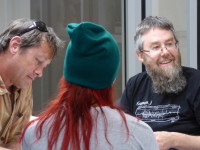
People at the Hub SLC, now numbering 200, are generally people that:P1000107

  • get it that being together is different and more than being alone.
  • have a natural spirit of entrepreneurship, co-working, and collaboration.
  • are committed to social good and an impact ecosystem.

This means that people in the Hub are there, not only for the co-working space, but for the “idea” that is the Hub. For the idea and dream of culture making in Salt Lake City — creative, smart, adaptive, doers.

This was evident last night in the “members dialogue” that I hosted for them. Twenty-five people joined to explore questions about what they value most significantly at this hub, and what they need to make their big dreams happen.

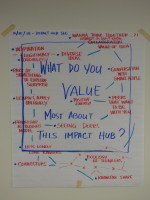
Our format was simple:P1000109

  • 30 minutes mingle, munch, wine, cheese
  • 10 minutes introduction and context setting
  • 5 minutes partner conversation — Why did you choose to come to this dialogue tonight?
  • 30 minutes Round 1 World Cafe conversation table and mapped group harvest — What do you value most about this Impact Hub?
  • 60 minutes Rounds 2 and 3 World Cafe and harvest with sticky notes — What do you need to make big dreams happen here?

“Less lonely lone rangers” was one of my favorite comments from the question on values. And plenty more that you can see on the harvest paper.

It’s impressive. A group that has a strong but informal commitment with one another to be curious, offer ideas, ask for help, connect with other smart people, often under the same roof that is the buzz of this Impact Hub.


What To Do?

What to do when things are simple is one thing. It’s usually clear. Not something to wrestle with. Might be a to-do. Might be a to-be.

What to do when things are complicated or complex can be a bit more muddy and challenging. More grey areas. More uncertainty. More unknowing. More unpredictability. Sometimes fear. Sometimes insecurity. Sometimes vulnerability. Sometimes stuck.

It was in recent conversation with my friend Charles LaFond that I picked up some sound advice for those complicated and complex times. His voice was clear, rolling off the tongue.

  • Be as good of a person as I can be.
  • Be as kind of a person as I can be.
  • Make good choices for the next 15 minutes.

Be good and kind. I can relate to that. I can remember the parts of me that are good and kind, or that other people see in me as good and kind. Ahh, that’s clear. That’s a good starting point.

Make good choices for the next 15 minutes. It’s nice to feel that all of the future is NOT riding on my shoulders. All time. All people. I know it sounds enormously exaggerated, but it feels like that sometimes, doesn’t it. The mind does that. Fifteen minutes I can handle. It’s relieving and freeing.

I like the feeling of temporary, yet essential reset in Charles’ words. “What to do?” is often the question running in the background for many of us. There are times when that question is noisy beyond comprehension. Even debilitating.

I’m grateful for people like Charles who remind me that I have a possible reset, right in front of me.

Enlightenment is Something We Do Together

A Seattle friend who inspires me often, Christy Lee-Engel, recently sent me an article written by John Tarrant. John is Director of the Pacific Zen Institute, which looks very enticing to me. His article, with the above title about enlightenment is a short read that invokes long contemplation.

I particularly loved his framing in the opening: “There’s a romantic idea of enlightenment as a solitary and heroic act, but even if you’re off by yourself in a cave, you are still part of a culture, and it’s observable that some cultures are more friendly to discovery than others.”

John goes on to list several conditions for creating a conversational culture and culture of transformation, a together culture. There is a simplicity in them, which I continue to feel at home in.

1. Kill your sacred cows. We inherited a tradition of never talking about koans because it would ruin the experience for others. But we learn more quickly by talking and meditating together. People wake up more easily when they can talk about what’s real for them.

2. Look behind the “no trespassing” sign. Everyone has something they have decided not to look at, and we might not know where we are not looking. What’s behind your no trespassing sign?

3. Speak from the heart. Don’t talk bullshit. Say something real, not something impressive. When I speak from the heart, I allow myself to know what is important to me. When we are afraid to say something, it’s not so much other people we are afraid of, it’s that we’re afraid of what we ourselves might think.

4. Listen with your whole body. Listening means doing less. When we’re not trying to influence the other
person in any way, we are simply present. Then a vast peace appears. Gratitude, the moon, and the stars enter the room. Listening is a form of love. It’s a way to keep company with each other in the night.

5. When all the voices are in the room, it’s a good day. We invite people to speak who normally stay silent. People can trust their own moves and be interested in their own lives. If we want to wake up, we probably will.

6. New people count. Even before we begin, we might not be doing it wrong. The person who just walked
in has something amazing to say, and it’s good if there’s no waiting period before they can jump in.

7. Fewer rules equals more innovation. If I’m afraid to say the wrong thing, or bow the wrong way in the meditation hall, I’m worried about approval and I don’t take risks.


Sweet Partings — A Family Reflection

I’ve just spent the last three days with my parents, them visiting Lindon, UT where I live, on their way back from three months in California. My Mom is 20 years older than me. We laugh together a lot. We tease each other. And we get to the serious stuff when needed. My Stepfather is also playful. Kind. Loves being a Grandpa, and I love him for that. These three days were simply to be together. It happens two or three times during a calendar year. I think we make up for lost time together in a compact way. Some play. Some important conversations. Some cooking food together. Linking together family.

I am rather lucky, I’d say. I’ve known my grandparents well. I’ve been close to my parents. I adore my kids. I particularly adore the times that link all of these together. Family line has always been very strong for me.

Today was a sweet parting, sending my parents along the way, the next leg of highway driving back to Canada. After nearly four months away, they will be returning to a system of my aunts, uncles, cousins, grandmother and other family.

The sweet aspect of parting is the tenderness that arrives. For all of us, welling tears. Sometimes a flood running down our cheeks. It was that way for me today, as they pulled away from the parking lot. I experience this tenderness as pure gratitude. These are moments to remember.

The sad part is the heart tugging. Perhaps it is fear and uncertainty for the future. Will we have this again? Will my kids have this? The family is growing and will be launching in several directions likely within the next five years. Young adults getting married. Following jobs, I hope. Creating their life paths. Living in to who they are. I hope, very soulfully.

Life is holding. Life is letting go. Life is moving on.

And perhaps, the sad part is just love. Perhaps that is just what love does. Regardless, partings like this leave me involuntarily touching my heart with my hand, so that I can remember that moment, and that feeling, forever.

Gifts of Circle - Question Cardsasd
Gifts of Circle is 30 short essays divided into 4 sections: 1) Circle's Bigger Purpose, 2) Circle's Practice, 3) Circle's First Requirements, and 4) Circle's Possibility for Men. From the Introduction: "Circle is what I turn to in the most comprehensive stories I know -- the stories of human beings trying to be kind and aware together, trying to make a difference in varied causes for which we need to go well together. Circle is also what I turn to in the most immediate needs that live right in front of me and in front of most of us -- sharing dreams and difficulties, exploring conflicts and coherences. Circle is what I turn to. Circle is what turns us to each other."

Question Cards is an accompanying tool to Gifts of Circle. Each card (34) offers a quote from the corresponding chapter in the book, followed by sample questions to grow your Circle hosting skills and to create connection, courage, and compassionate action among groups you host in Circle.

This will close in 60 seconds

asd
In My Nature
is a collection of 10 poems. From A Note of Beginning: "This collection of poems arises from the many conversations I've been having about nature. Nature as guide. Nature as wild. Nature as organized. I remain a human being that so appreciates a curious nature in people. That so appreciates questions that pick fruit from inner being, that gather insights and intuitions to a basket, and then brings the to table to be enjoyed and shared over the next week."

This set of Note Cards (8 cards + envelopes)  quotes a few favorite passages from poems in In My Nature. I offer them as inspiration. And leave room for you to write personal notes.

This will close in 60 seconds

asd
Most Mornings is a collection of 37 poems. I loved writing them. From the introduction: "This collection of poems comes from some of my sense-making that so often happens in the morning, nurtured by overnight sleep. The poems sample practices. They sample learnings. They sample insights and discoveries. They sample dilemmas and concerns."

This set of Note Cards (8 cards + envelopes)  quotes a few favorite passages from poems in Most Mornings. I offer them as inspiration. And leave room for you to write personal notes.

This will close in 60 seconds