
I’m not an economist. My understanding of capitalism as an economic system is simple and basic. I think of it as a system for producing goods and services that relies on market freedom such that a society’s needs and desires are fulfilled and such that overall health and well-being is created for individuals and for the whole. It’s impressive, this story. I benefit from so many aspects of living in a centuries old capitalist system.
While I’m not an economist, I am a systems oriented thinker. I come from the educational field of organizational behavior. Which means, I tend to give my attention to nuanced details of what it means to be connected, what it means for people to be in learning together, and what it means to experiment together. My particular orientation to leadership and organizational development is summarized well by the Zen saying — “Everything is connected. Everything changes. Pay attention.”
My learning in my field has taught me that with anything projected as good, there is some downside. The corollary is also true. With anything projected as bad, there is also an upside. Basic truisms are accurate except when they are not.
This multiplicity is true for such an overarching and simplified story as capitalism. Good for many that amplifies “haves” while at the same time punishing for many that amplifies “have nots.” It inspires with incentive well at the same time distorts and punishes aspects of self worth. It is impressive to have shared wealth. It’s not impressive to make wealth the defining quality of health.
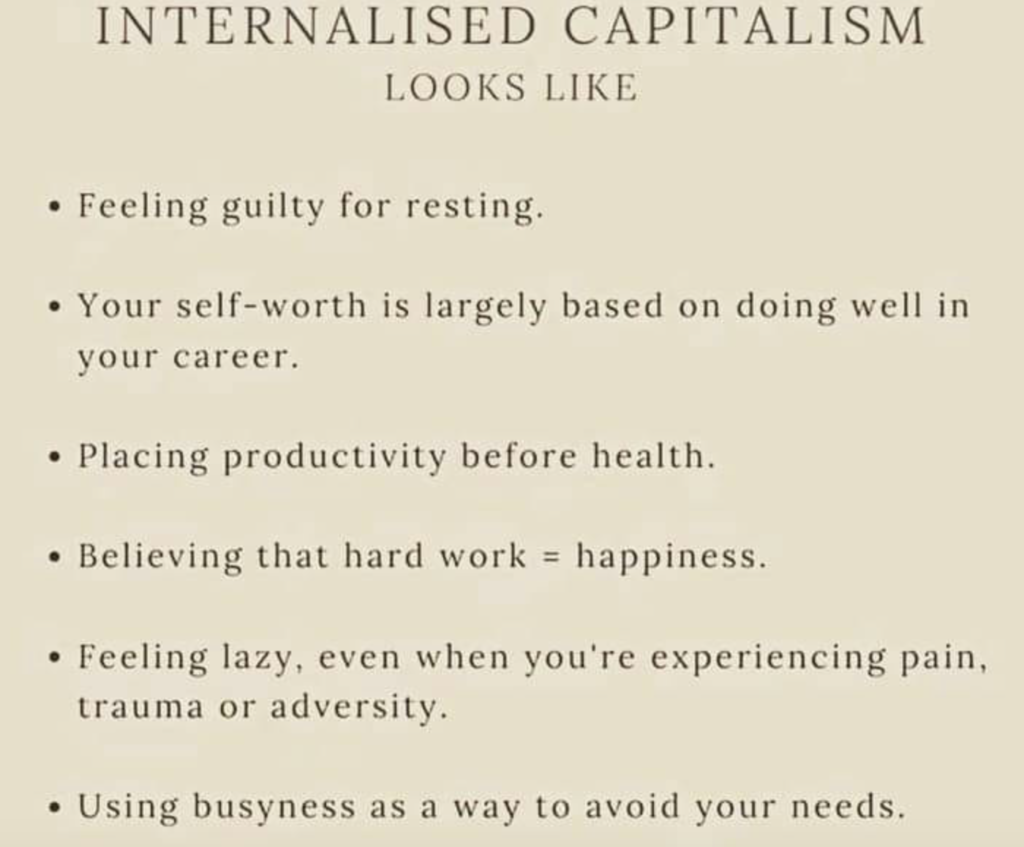
I got the diagram above from friend and colleague Quanita Roberson, who I appreciate for her truth-telling. She’s not an economist either, but like me, comes from a field of organizational development. Together we tend to find it wise and needed to challenge the narratives embedded, and for too long unchallenged, in the way that capitalism as an economic system has hijacked inner relevance compasses.
These are deep patterns to change. Not from one narrowed declaration only to be replaced by another. But to massage the edges of absolutism. I’m glad to know so many people that want to shed the absolutist duality of good or bad, and that are reclaiming clarity and courage to live more honestly with complex multiplicity. I’m glad to know so many people that are daring to stop the hijackings of internalized capitalism to stand for a different kind of health, needs, and desires for the individual and for the whole.


