
Margaret Wheatley on The Circle Way

In further reflection of last week’s practicum for The Circle Way, I’m appreciating Meg’s framing words in The Circle Way.

  • We don’t “discover” circle practice so much as we remember it.
  • The extraordinary Chilean biologist Humberto Maturan writes in “The Biology of Love” that humans first developed language when we moved into familial groups.
  • After all these centuries of separation and isolation, circle welcomes us back into a shape where we can listen, be heard, and be respected, where we can think and create together.

Such clear narrative is something I always appreciate. Thanks Meg. Thanks Christina and Ann.
On Minimalism

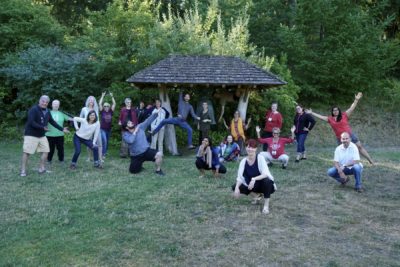
At The Circle Way Practicum, Whidbey Island, I appreciated several conversations about “minimalism.” In this context, it was about the minimal intentions and actions needed to be meeting in circle. A center. A rim. A spirit of circling up to share information and perspective.

Of course, it is true that everything minimalized can also be done at greater scale. A simple stone as center can grow to a full-blown altar. An invitation to respond to a simple question can grow to an invitation to share significant life story. And sometimes these circles must be held at such scale, depending on the circumstance.

Minimialism is something we all learn, I suppose.

I particularly appreciated one of our participants comments — Guillermo from Monterey, Mexico. “The more experience you have, the more ability you have to be a minimalist.”

Well spoken, with simplicity and minimalism, I’d say.

Teaching The Circle Way

I am in quite a stretch of teaching The Circle Way. Last week, with Amanda Fenton, it was a practicum on Whidbey Island. Really a delicious experience. The food. The location. The group of participants. The stories shared. The laughs from the belly. The tears from heart. The evolution of learning. In me, and among all of us.

Today I leave for Australia for another stretch. It will include some work within an organization. It will include another practicum. This too, I anticipate to be delicious, and quite likely for very similar reasons.

It is learning that will continue to unfold in me, but from this last week on Whidbey, I am renewed with clarity, particularly from the depth of a story council:

  • it is a privilege to hear story
  • it is a privilege to share story
  • there is healing in the hearing
  • there is healing in the sharing
  • depth of sharing needs a container
  • The Circle Way really helps to create that container

Feeling appreciative.

Gifts of Circle - Question Cardsasd
Gifts of Circle is 30 short essays divided into 4 sections: 1) Circle's Bigger Purpose, 2) Circle's Practice, 3) Circle's First Requirements, and 4) Circle's Possibility for Men. From the Introduction: "Circle is what I turn to in the most comprehensive stories I know -- the stories of human beings trying to be kind and aware together, trying to make a difference in varied causes for which we need to go well together. Circle is also what I turn to in the most immediate needs that live right in front of me and in front of most of us -- sharing dreams and difficulties, exploring conflicts and coherences. Circle is what I turn to. Circle is what turns us to each other."

Question Cards is an accompanying tool to Gifts of Circle. Each card (34) offers a quote from the corresponding chapter in the book, followed by sample questions to grow your Circle hosting skills and to create connection, courage, and compassionate action among groups you host in Circle.

This will close in 60 seconds

asd
In My Nature
is a collection of 10 poems. From A Note of Beginning: "This collection of poems arises from the many conversations I've been having about nature. Nature as guide. Nature as wild. Nature as organized. I remain a human being that so appreciates a curious nature in people. That so appreciates questions that pick fruit from inner being, that gather insights and intuitions to a basket, and then brings the to table to be enjoyed and shared over the next week."

This set of Note Cards (8 cards + envelopes)  quotes a few favorite passages from poems in In My Nature. I offer them as inspiration. And leave room for you to write personal notes.

This will close in 60 seconds

asd
Most Mornings is a collection of 37 poems. I loved writing them. From the introduction: "This collection of poems comes from some of my sense-making that so often happens in the morning, nurtured by overnight sleep. The poems sample practices. They sample learnings. They sample insights and discoveries. They sample dilemmas and concerns."

This set of Note Cards (8 cards + envelopes)  quotes a few favorite passages from poems in Most Mornings. I offer them as inspiration. And leave room for you to write personal notes.

This will close in 60 seconds