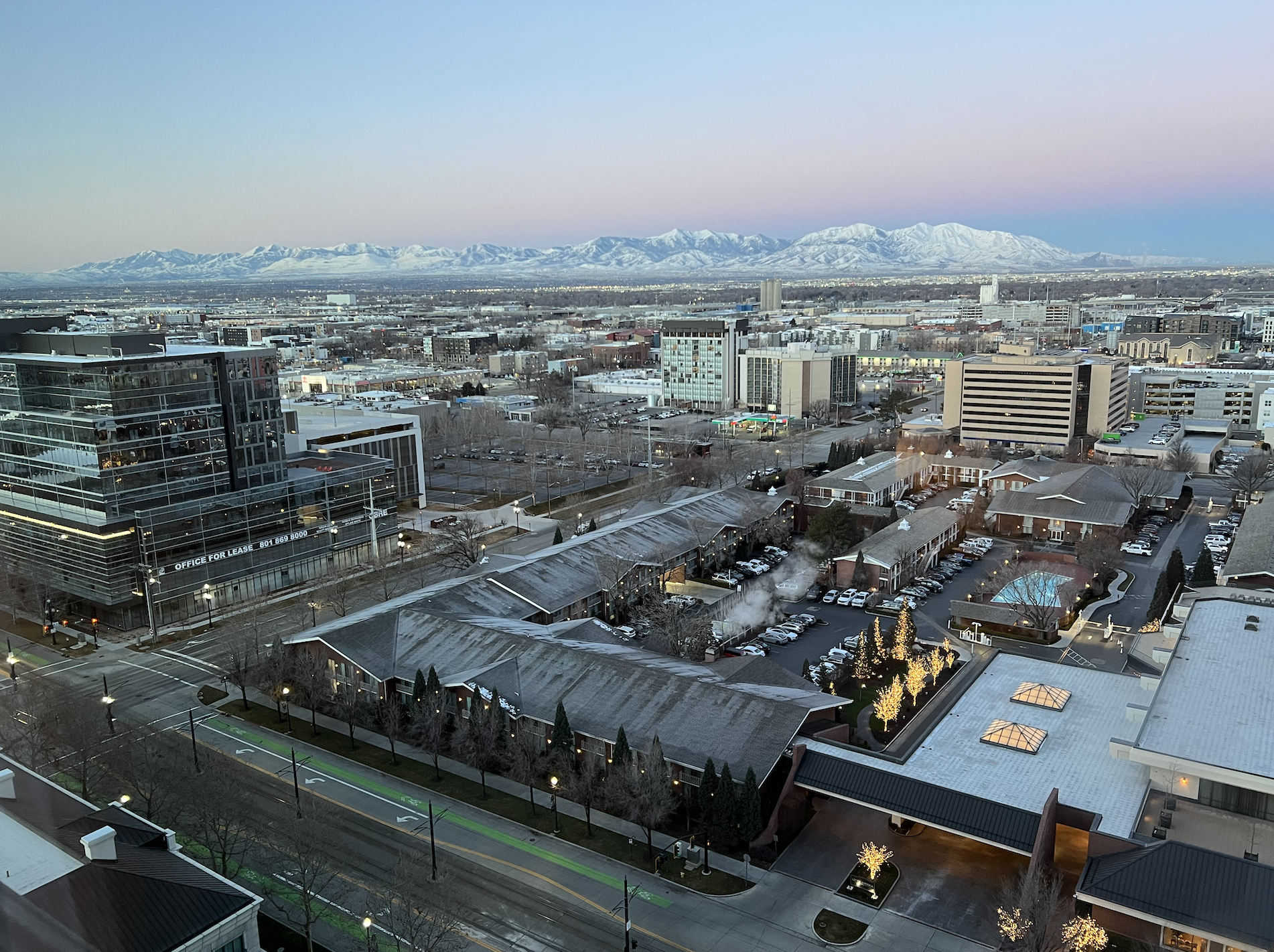

For The Interim Time

“On The Way” is a newsletter publication of The Central Pacific Conference of the United Church of Christ. I love the title. It shows commitment to movement and process. I’m working (and friending) with some really good people in that conference to support a cultural evolution and leadership centered in participation. I get to cohost their annual meeting again this fall.
This month’s “On The Way” included the poem by John O’Donohue, the Irish poet and priest who died in 2008. I love this encouragement to “dwell in the between spaces, refining the heart for the dawn of the new.” There’s a kind of spiritual maturity in that that continues to beckon for patience in the deep.
Enjoy.
For the Interim Time
John O’Donohue

 
When near the end of day, life has drained
Out of light, and it is too soon
For the mind of night to have darkened things,
 
No place looks like itself, loss of outline
Makes everything look strangely in-between,
Unsure of what has been, or what might come.
 
In this wan light, even trees seem groundless.
In a while it will be night, but nothing
Here seems TO believe the relief of dark.
 
You are in this time of the interim
Where everything seems withheld.
 
The path you took to get here has washed out;
The way forward is still concealed from you.
 
“The old is not old enough to have died away;
The new is too young to be born.”
 
You cannot lay claim to anything;
In this place of dusk,
Your eyes are blurred;
And there is no mirror.
 
Everyone else has lost sight of your heart
And you can see nowhere to put your trust;
You know you have to make your own way through.
 
As far as you can, hold your confidence.
Do not allow your confusion to squander
This call which is loosening
Your roots in false ground,
That you might come free
From all you have outgrown.
 
What is being transfigured here is your mind,
And it is difficult and slow to become new.
The more faithfully you can endure here
The more refined your heart will become
For your arrival in the new dawn.
Life Wants To Be In Partnership — II

From book-writing this week, a second teaser from the Epilogue.

d

In many indigenous traditions it is recognized that the dream an individual has may actually be a dream for the larger community and tribe. Sharing that dream might help others wake to what they need to learn or what we need to learn together.

Likewise, I’ve come to believe that when something holds our individual attention, it may not just be for us, but might be for the group. Or it might stir something beneath the surface of another individual in the group.

I have come to realize that often, when one person grows and expands their level of awareness from one state to another, it makes it possible for others to grow and expand also.

Remember the first person to run a sub 4-minute mile, the Englishman, Roger Bannister, in 1954. I’m told that after he broke this barrier for the first time, it was broken many times by others in a relatively short period of time. One person paves the way.

The way-paving for many of us is our awareness. It always has been, even for the greatest of doers among us. Way-paving comes from first, being in relationship, even partnership, with Life, this wholeness of the world. Second, from recognizing that what has our attention is a doorway in to more clear and essential understanding and purpose. Third, from recognizing and acknowledging how our inner worlds create outer realities. This step alone resets so many of the patterns of blame that show up in contemporary and complex tensions. And fourth, claiming our projections resets a vitality and honesty with Life. We are both in the world and of the world. 

Life wants to be in partnership with us. 

It does so by offering us experiences, people, and symbols 

that catch and hold our attention. 

In these offerings, Life gives us invitation 

to notice more of how our inner condition is projecting our outer reality, 

which in fact, renders us, 

co-creators with Life.

Life Wants To Be In Partnership

I’ve been writing this week. For a short book on partnering with Life. It’s got some work remaining, but I’ve started to send to a few readers. I’m excited and nervous! Here’s a teaser from the Preface.

c

I am the kind of human being that typically enjoys anything that questions the nature of reality. I good conversation. A movie. A book. I can’t really help it. Something deep in me believes that the world is not what it seems. Despite the granularity of details that science has taught us to seek, and that we’ve become pretty good at — much remains mystery, masked as an illusion of certainty. Like believing that our bodies are mostly substance, when in fact, we are mostly water. Like believing that even that water is mostly substance, when in fact, it is mostly space. 

The primary premise for this book also questions the nature of reality. The contents come from breaking down a statement that arrived to me in 2010, during another time of reflection. I can say that it arrived, but it really slow-cooked in me for much longer than a single moment.

Life wants to be in partnership with us. 

It does so by offering us experiences, people, and symbols 

that catch and hold our attention. 

In these offerings, Life gives us invitation 

to notice more of how our inner condition 

is projecting our outer reality, 

which in fact, renders us, 

co-creators with Life.

This book is about that. It is about fleshing out these phrases that I hold as a kind of user’s guide for being in this world in these days so that in particular, we do not lose the mystery and the always changing richness of human lives lived.

Pastor as Convener

“A pastor re-envisions his primary vocation not as a preacher, teacher, healer or administrator but as a host, a “convener.” It wasn’t what seminary prepared him for, but it’s a high and holy calling.”

The above is a headline for an article written by a colleague and friend, Cameron Barr, in the publication, “Faith & Leadership.” Cameron is pastor at a UCC church in Grinnell, Iowa. He’s as sharp and clear as they come. Oozes with the ability to shape story and invite people into it.

Cameron and I got to work together several times in the ways that he describes in this article. I was primary consultant in what started for them as a strategic planning process. What I was able to offer was an invitation to shift how that work is done, and a set of practices that helped give it a chance — all based on a premise of turning to one another, and going further together.

I love these words from Cameron:

The turning point came late in my first year, when I discovered the Art of Hosting(link is external), a leadership approach that views leadership primarily as a practice of hospitality. With the help of a consultant and ardent proponent of the Art of Hosting philosophy, our church focused on re-connecting with each other and “re-humanizing” our relationships. We spent time together, sharing meals, telling stories and reviewing our community’s history.

Soon, we held a series of retreats to engage church members outside our ordinary structure of boards and committees. Instead of recruiting people to existing bodies, we invited people to follow their energy and work on needs they had identified.

Gradually, I accepted that I was powerless to direct our ministry toward my own ideas of what a church should be. I began to think of myself primarily not as a preacher, teacher, healer or administrator but as a host — a convener. My greatest asset was not my knowledge but my position in our community. So I started creating a space for church members to have more genuine encounters with one another. I learned not to look within myself for answers but to summon the gifts of others.

Rehumaning is at the core of it. Funny to say this. Yet, I say it often. We are just trying to create processes (or interrupt some stuck ones) that help us to be better, smarter, kinder, more imaginative humans together in these varied arenas of life. It helps to be deliberate in noticing where there is energy. It helps to create multiple encounters that welcome genuineness of what people really care about.


Gifts of Circle - Question Cardsasd
Gifts of Circle is 30 short essays divided into 4 sections: 1) Circle's Bigger Purpose, 2) Circle's Practice, 3) Circle's First Requirements, and 4) Circle's Possibility for Men. From the Introduction: "Circle is what I turn to in the most comprehensive stories I know -- the stories of human beings trying to be kind and aware together, trying to make a difference in varied causes for which we need to go well together. Circle is also what I turn to in the most immediate needs that live right in front of me and in front of most of us -- sharing dreams and difficulties, exploring conflicts and coherences. Circle is what I turn to. Circle is what turns us to each other."

Question Cards is an accompanying tool to Gifts of Circle. Each card (34) offers a quote from the corresponding chapter in the book, followed by sample questions to grow your Circle hosting skills and to create connection, courage, and compassionate action among groups you host in Circle.

This will close in 60 seconds

asd
In My Nature
is a collection of 10 poems. From A Note of Beginning: "This collection of poems arises from the many conversations I've been having about nature. Nature as guide. Nature as wild. Nature as organized. I remain a human being that so appreciates a curious nature in people. That so appreciates questions that pick fruit from inner being, that gather insights and intuitions to a basket, and then brings the to table to be enjoyed and shared over the next week."

This set of Note Cards (8 cards + envelopes)  quotes a few favorite passages from poems in In My Nature. I offer them as inspiration. And leave room for you to write personal notes.

This will close in 60 seconds

asd
Most Mornings is a collection of 37 poems. I loved writing them. From the introduction: "This collection of poems comes from some of my sense-making that so often happens in the morning, nurtured by overnight sleep. The poems sample practices. They sample learnings. They sample insights and discoveries. They sample dilemmas and concerns."

This set of Note Cards (8 cards + envelopes)  quotes a few favorite passages from poems in Most Mornings. I offer them as inspiration. And leave room for you to write personal notes.

This will close in 60 seconds