Graphic Recording

I’ve been lucky to work with a few people who do great graphic recordings. I think of them as visual maps that capture some of the content, direction, and spirit of a meeting.

I’ve also been lucky to work with a few people that are just starting to learn this craft. I look for examples to share with them.

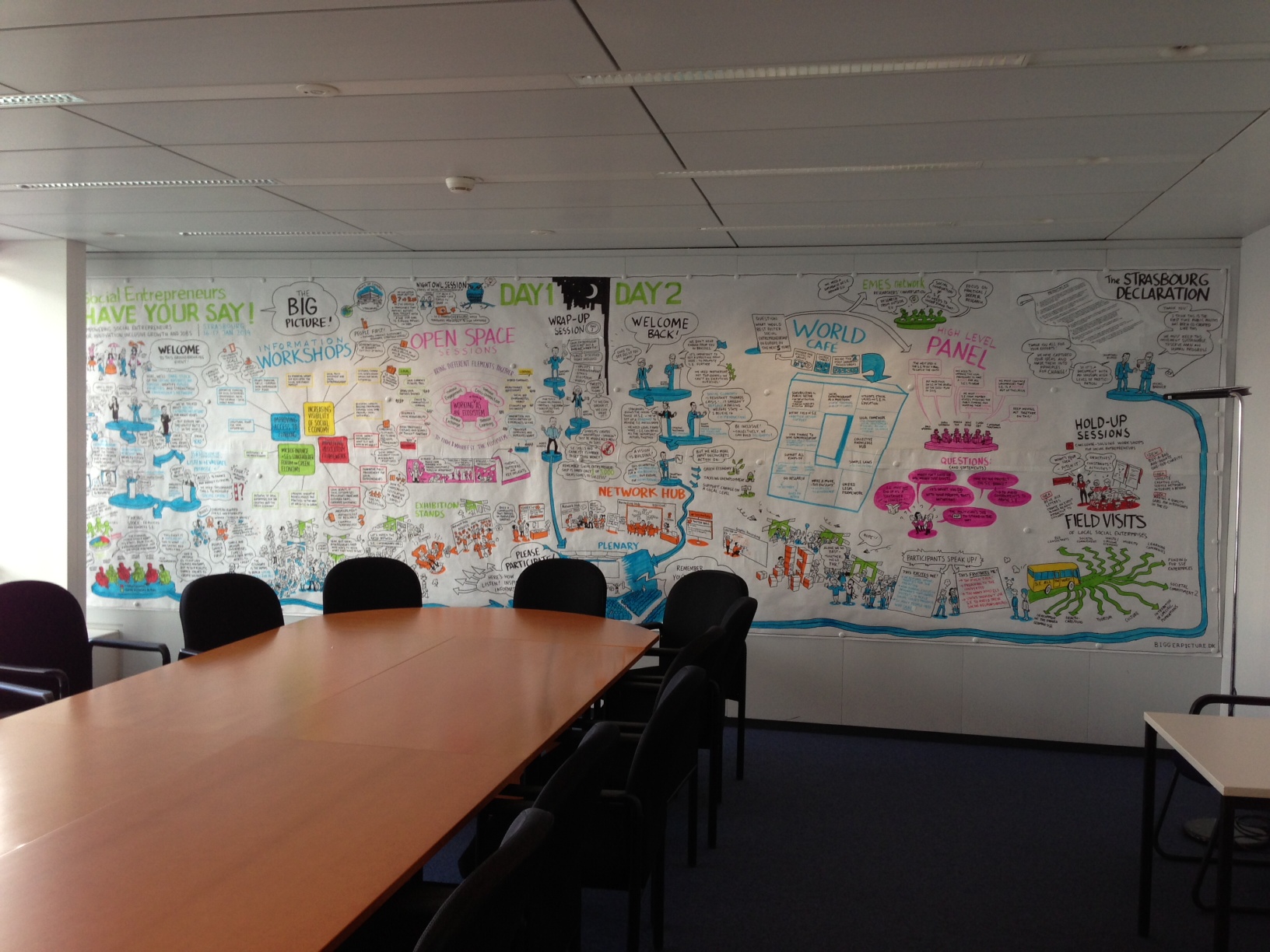
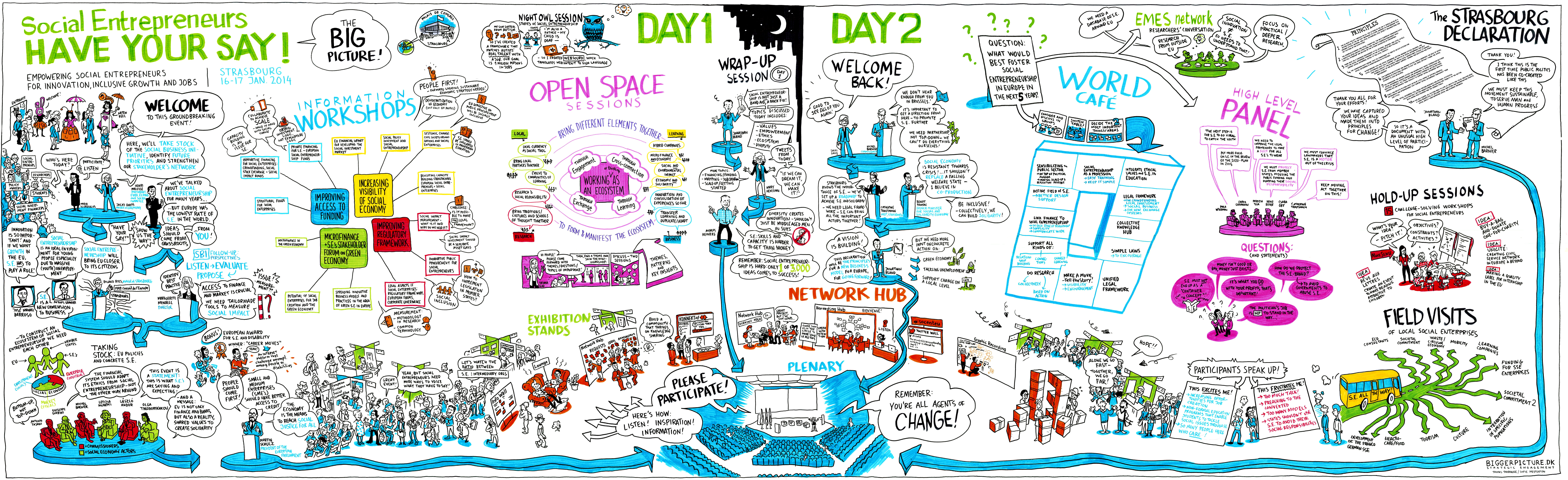
Ria -- Strasbourg Graphic harvest in the meeting room of Michel Barnier at Berlaymont BuildingRia Baeck, a friend and colleague from Belgium, recently shared the photo below on the Art of Hosting list serve. It was made by the people of Danish Bigger Picture, from a Social Business Innovation event in Strasbourg. It now hangs on the walls of the meeting room of European Commissioner Barnier, in the main EC building in Brussels.

I love the contrast in this image of the formal boardroom setting with the free flow of the graphic illustration.

My favorite line about why these help is from friend and graphic recorder, Steven Wright. He shared, “We have 3 million years of recognizing patterns and only 10,000 years with words.”

Below is the same illustration without the boardroom table. Click on it to see more of the detail.

Thanks Ria.

Ria -- Graphic harvest

May 19, 2014

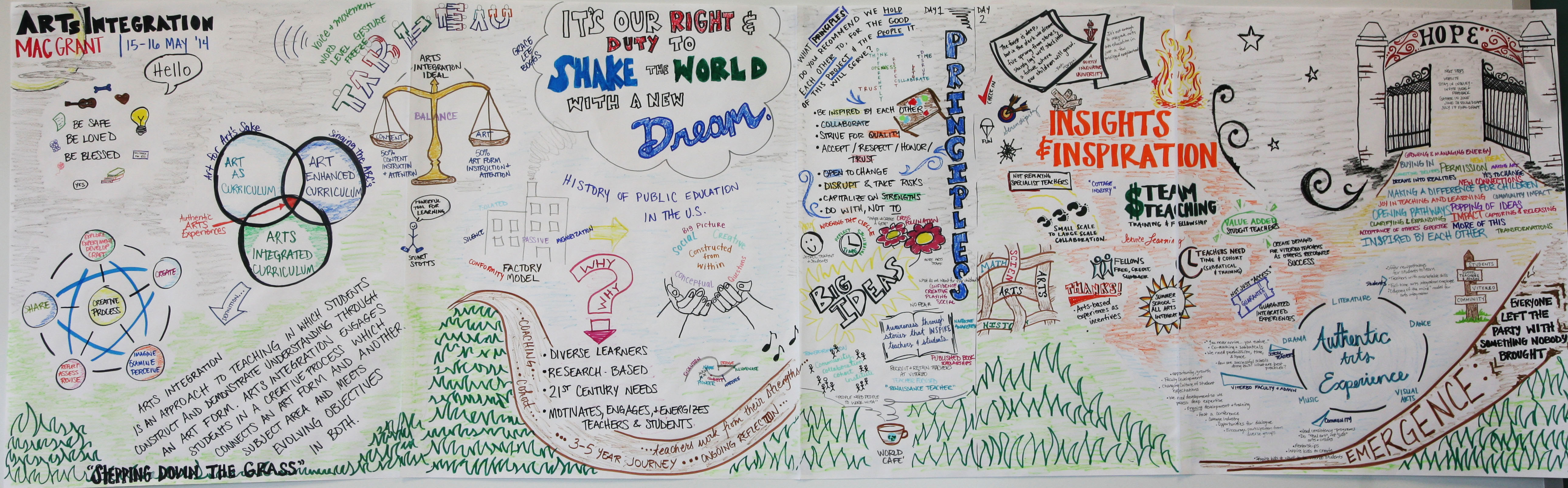
Here is another example created by Sara Cook of Viterbo University in Wisconsin, and one of her friends, Sammie. Neither of these two hand created these before. Sarah was great at catching ideas and patterns. Sammie put them to more artistic form. Fantastic work!

Gathering1_map


Conduit of the Vitality that Keeps Everything Alive

The passage below, spoken by Archbishop Desmond Tutu, was shared with me by a good friend and colleague, Glen Lauder.

I love the reference to the unspectacular.

“Archbishop Desmond Tutu speaks of how the omnipotent God we worship chooses to be impotent in the world, unless God’s work is manifest through the collaboration of human beings. In this, God entrusts the world to us. And so the miracle rests with us and is seldom spectacular, but more the work of humble people choosing to give what they have. By doing so, we become vehicles of the Devine, not in being a spokesperson for the mind of God — no one can claim that — but more, in being a conduit of the vitality that keeps everything alive.”

Tweets of the Weeks

  • “I need to take a sacred pause, as if I were a sun-warmed rock in the center of a rushing river.” Dawna Markova. Thanks Glen Lauder.
  • What today might be called “field,” or “the power of the whole,” 19th century sociologist Emile Durkheim called, “collective effervescence.”
  • I’ve redone my website and blog. Thanks to Robi Gareau at CentreSpoke. Several resources there if you want to look. https://www.tennesonwoolf.com 
  • A great 4 min video on systems. From when wolves were introduced to Yellowstone. Thanks Jerry Nagel. http://www.filmsforaction.org/watch/how-wolves-change-rivers/#.UwVvmvkr-_o.facebook …
  • BALLE offers some really good annual conferences on localism. This year it is June 11-13 in CA. https://bealocalist.org/2014-conference 
  • BALLE has some really impressive resources on localism. Check them. https://bealocalist.org/resources-spreading-solutions …
  • I’m really enjoying Steven Johnson’s book, Where Good Ideas Come From. Connects innovation in nature to innovation in human systems.
  • From Steven Johnson’s Good Ideas… When nature finds itself in need of new ideas, it strives to connect, not protect.
  • Love this from Steven Johnson: The history of life can be told as the story of a gradual but relentless probing of the adjacent possible.

Collective Effervescence

French 19th century sociologist Emile Durkheim coined this phrase, “collective effervescence,” to describe the positive impact a group or group identity could have on a person’s overall individual health. Today, many might reference this as “field,” or “the power of the whole,” whether it comes from a good meeting together or a shared rock concert. A colleague and friend, Christy Lee Engel, has explored something similar in our conversations, recalling her learnings with Dr. Bill Mitchell and their work as naturopathic physicians, “humanity itself is a modality of natural medicine.” Whether an energetic quality shared by people in the same geography or event, or a result from years of tradition, I quite like this phrase, collective effervescence.

The February 2014 edition of National Geographic includes an article, Karma of the Crowd, describing the Indian Hindu festival at Kumbh Mela that attracts millions of people. This article reminds me of conversations with Christy.

Their findings would have made Durkheim effervesce. Those who stayed in their villages self-reported no real change over the period of the study. The kalpwasis, on the other hand, reported a 10 percent improvement in their health, including less pain and breathlessness, less anxiety, and higher energy levels—an effect comparable to that of some powerful drugs. Antidepressants, for instance, have been estimated to reduce the public health burden of depression in some populations by about 10 percent. But as Reicher points out, antidepressants treat only depression, whereas the crowd “drug” seemed to have a positive influence on all aspects of the kalpwasis’ health. What’s more, the good effects last long afterward—certainly for weeks, possibly for months.

Why should belonging to a crowd improve your health? The psychologists think the cornerstone of the effect is shared identity. “You think in terms of ‘we’ rather than ‘I,’” explains Nick Hopkins, a colleague of Reicher’s from the University of Dundee in the U.K., and that in turn alters your relationship to other people:

“What happens is a fundamental shift

from seeing people as other

to seeing them as intimate.”

Support is given and received, competition turns to cooperation, and people are able to realize their goals in a way they wouldn’t be able to alone. That elicits positive emotions that make them not only more resilient to hardship but also healthier.

Belonging to a crowd—at least the right sort of crowd—might thus benefit the individual in the same ways more personal social connections do. We know that stress-resilience mechanisms can be activated by social interaction, with positive effects on the immune and cardiovascular systems. Very socially connected people tend to have lower levels of molecules associated with inflammation circulating in their blood, for example. They are less likely to die of heart disease and some cancers, and there’s some evidence that they are less vulnerable to age-related cognitive decline. They respond better to vaccinations. Their wounds may even heal faster.

Reicher makes a critical distinction between a physical and a psychological crowd. A physical crowd—commuters jostling on a subway, for instance—lacks a shared identity. Although being very socially connected isn’t the same as being physically surrounded by other people, it has a lot in common with belonging to a psychological crowd—sharing a group identity. And it isn’t just bodily systems that are altered by the shift from “I” to “we.”

Gifts of Circle - Question Cardsasd
Gifts of Circle is 30 short essays divided into 4 sections: 1) Circle's Bigger Purpose, 2) Circle's Practice, 3) Circle's First Requirements, and 4) Circle's Possibility for Men. From the Introduction: "Circle is what I turn to in the most comprehensive stories I know -- the stories of human beings trying to be kind and aware together, trying to make a difference in varied causes for which we need to go well together. Circle is also what I turn to in the most immediate needs that live right in front of me and in front of most of us -- sharing dreams and difficulties, exploring conflicts and coherences. Circle is what I turn to. Circle is what turns us to each other."

Question Cards is an accompanying tool to Gifts of Circle. Each card (34) offers a quote from the corresponding chapter in the book, followed by sample questions to grow your Circle hosting skills and to create connection, courage, and compassionate action among groups you host in Circle.

This will close in 60 seconds

asd
In My Nature
is a collection of 10 poems. From A Note of Beginning: "This collection of poems arises from the many conversations I've been having about nature. Nature as guide. Nature as wild. Nature as organized. I remain a human being that so appreciates a curious nature in people. That so appreciates questions that pick fruit from inner being, that gather insights and intuitions to a basket, and then brings the to table to be enjoyed and shared over the next week."

This set of Note Cards (8 cards + envelopes)  quotes a few favorite passages from poems in In My Nature. I offer them as inspiration. And leave room for you to write personal notes.

This will close in 60 seconds

asd
Most Mornings is a collection of 37 poems. I loved writing them. From the introduction: "This collection of poems comes from some of my sense-making that so often happens in the morning, nurtured by overnight sleep. The poems sample practices. They sample learnings. They sample insights and discoveries. They sample dilemmas and concerns."

This set of Note Cards (8 cards + envelopes)  quotes a few favorite passages from poems in Most Mornings. I offer them as inspiration. And leave room for you to write personal notes.

This will close in 60 seconds