

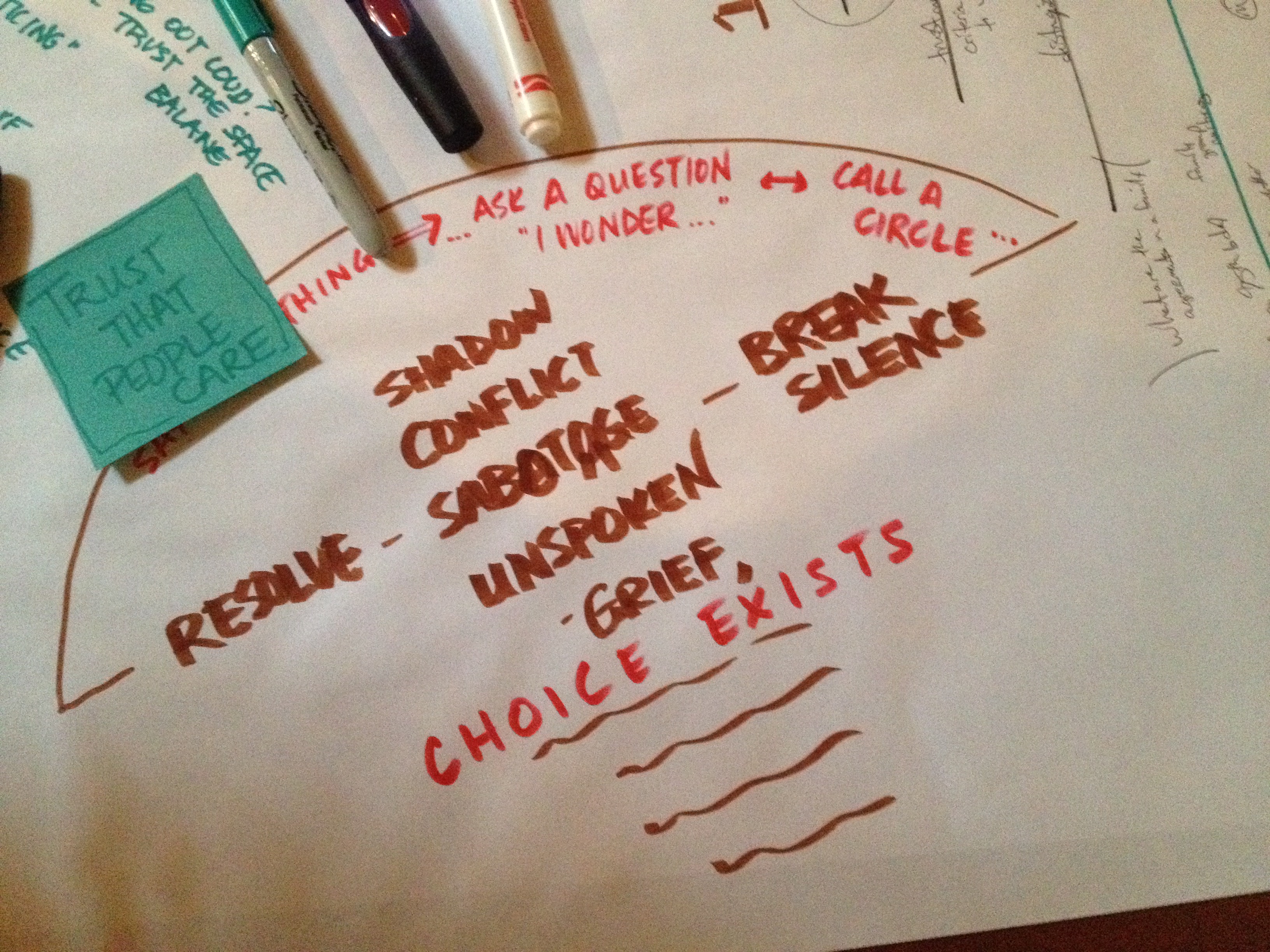
On Shadow

Shadow

.

I am in some good learning this week at the PeerSpirit Circle Practicum on Whidbey Island. This particular piece is on shadow as it applies to hosting circles. What is shadow (a broadly used term now, a bit like collaboration or cooperation, it requires some definition)? What is conflict? What is sabotage? What is unspoken? How grief relates to this? How all of these relate to each other?

It is one of those learnings for which I have more questions than answers.

Is addressing shadow to resolve? To let breath? What discernment is needed to decide what to follow, what not to follow, and how not following is not the same as denying or ignoring.

I’m not surprised it is a rich question field here at the practicum. Grateful for good container holding by Christina Baldwin, Ann Linnea, and Alex Cukier so that these questions can surface.


Wake Up Call or Don’t Bother At All

Robert Jacobs is a fellow I met in the mid 90s. He and I have both been involved in systemic change over these many years.

Jake published an article about implementation recently. It is a wake up call. Or a myth debunking.

He shares a few good stories that invite

  • challenging our assumptions about definition of implementation (not a check list item because you sent an email),
  • approach to implementing (involving a system in the process),
  • and mindset for implementing (appreciative approach, as in what you give your energy to grows).

One of Jake’s premises is that despite many of us giving much attention to successful change efforts, the success rate for implementation remains disappointingly low. I remember this very assessment 20 years ago in my grad school days too. Argh.

The encouraging part is that I feel people like Jake continue to encourage a systemic view and practice. That doesn’t necessarily sell well in a world that is so patterned to speed and efficiency. It takes longer. It takes an shared ability to be in uncertainty. It takes attention to relationships (beyond a few cute team-building exercises). It takes a pattern real inquiry together and a commitment to a bigger picture. Living the change (patterning it) in the interior and in the exterior.

There’s a boldness in Jake’s words. Wake up or don’t bother. I appreciate the realness of this.


The Power of Downward Mobility

Wayne Muller is founder of Bread for the Journey. He is author, speaker, spiritual director, and community builder.

I read one of his blogs this morning on “The Power of Downward Mobility.” A piece of it is excerpted below. The article is worth a read.

What I find with the precepts is that they are particularly good when people, groups of people, are considering what to do next. Realistically, most of us have many choices most of the time. The choices and the prioritizing can be paralyzing, enough to render action impossible. A bit like spending the night considering options for a movie, but running out of time to actually watch it.

To me, his words point to the maturing that is committed to the simple, and, a framework for why that makes perfect sense.

.

The threads of continuity that bind us together are woven out of a few simple precepts, ways of working which have stood the test of time. When we began, our precepts were clear, and few:

  • Keep it simple.
  • Fund people, not projects.
  • Trust in authentic relationships, rather than proposals.
  • Small is beautiful.
  • Start with a strength assessment, not a needs assessment.

Tweets of the Weeks

    • “Behind every face is a secret, hidden, inner life.” Thanks John O’Donahue, calling for our human perception and presence.
    • The world changes when large numbers of people change the way they think little bit. Thanks Willis Harman, from many years ago.
    • Thx @chriscorrigan: When asked to evaluate Open Space I have each participant complete this sentence: “As a result of this meeting…”
    • Richard Feynman, theoretical physicist: “Physics is like sex. There are practical outcomes, but that isn’t why we do it.”
    • “In the 1980s capitalism triumphed over communism. In the 1990s it triumphed over democracy.” Thanks @dkorten.
    • “Failure is always an option when exploring; but fear is not.” Thanks Charles LaFond: http://www.sjcathedral.org/DailySip/PostID/433 …
    • We’re all ducks on this lake. We can’t have labels or divisions. We’re all connected in the problems and in the solutions. @WaNonprofits
    • Heard through @quanitam this weekend: “Life is out to gift us, not to get us.”
    • “The central silence is the purest element of the soul, the soul’s most exalted place, the core, the essence of the soul.” Meister Eckhart

Gifts of Circle - Question Cardsasd
Gifts of Circle is 30 short essays divided into 4 sections: 1) Circle's Bigger Purpose, 2) Circle's Practice, 3) Circle's First Requirements, and 4) Circle's Possibility for Men. From the Introduction: "Circle is what I turn to in the most comprehensive stories I know -- the stories of human beings trying to be kind and aware together, trying to make a difference in varied causes for which we need to go well together. Circle is also what I turn to in the most immediate needs that live right in front of me and in front of most of us -- sharing dreams and difficulties, exploring conflicts and coherences. Circle is what I turn to. Circle is what turns us to each other."

Question Cards is an accompanying tool to Gifts of Circle. Each card (34) offers a quote from the corresponding chapter in the book, followed by sample questions to grow your Circle hosting skills and to create connection, courage, and compassionate action among groups you host in Circle.

This will close in 60 seconds

asd
In My Nature
is a collection of 10 poems. From A Note of Beginning: "This collection of poems arises from the many conversations I've been having about nature. Nature as guide. Nature as wild. Nature as organized. I remain a human being that so appreciates a curious nature in people. That so appreciates questions that pick fruit from inner being, that gather insights and intuitions to a basket, and then brings the to table to be enjoyed and shared over the next week."

This set of Note Cards (8 cards + envelopes)  quotes a few favorite passages from poems in In My Nature. I offer them as inspiration. And leave room for you to write personal notes.

This will close in 60 seconds

asd
Most Mornings is a collection of 37 poems. I loved writing them. From the introduction: "This collection of poems comes from some of my sense-making that so often happens in the morning, nurtured by overnight sleep. The poems sample practices. They sample learnings. They sample insights and discoveries. They sample dilemmas and concerns."

This set of Note Cards (8 cards + envelopes)  quotes a few favorite passages from poems in Most Mornings. I offer them as inspiration. And leave room for you to write personal notes.

This will close in 60 seconds